This profile is part of a series on students who have received research awards from Bowdoin to pursue faculty-mentored, independent projects.
Trafton, who grew up in New Hampshire, is majoring in German and minoring in physics, and is considering a nursing career after she graduates from Bowdoin (following a postgraduate year in Germany).
She is also fascinated by art, history, religion, and media studies. Despite the breadth of her interests, she has found an honors project in her major that covers them all.
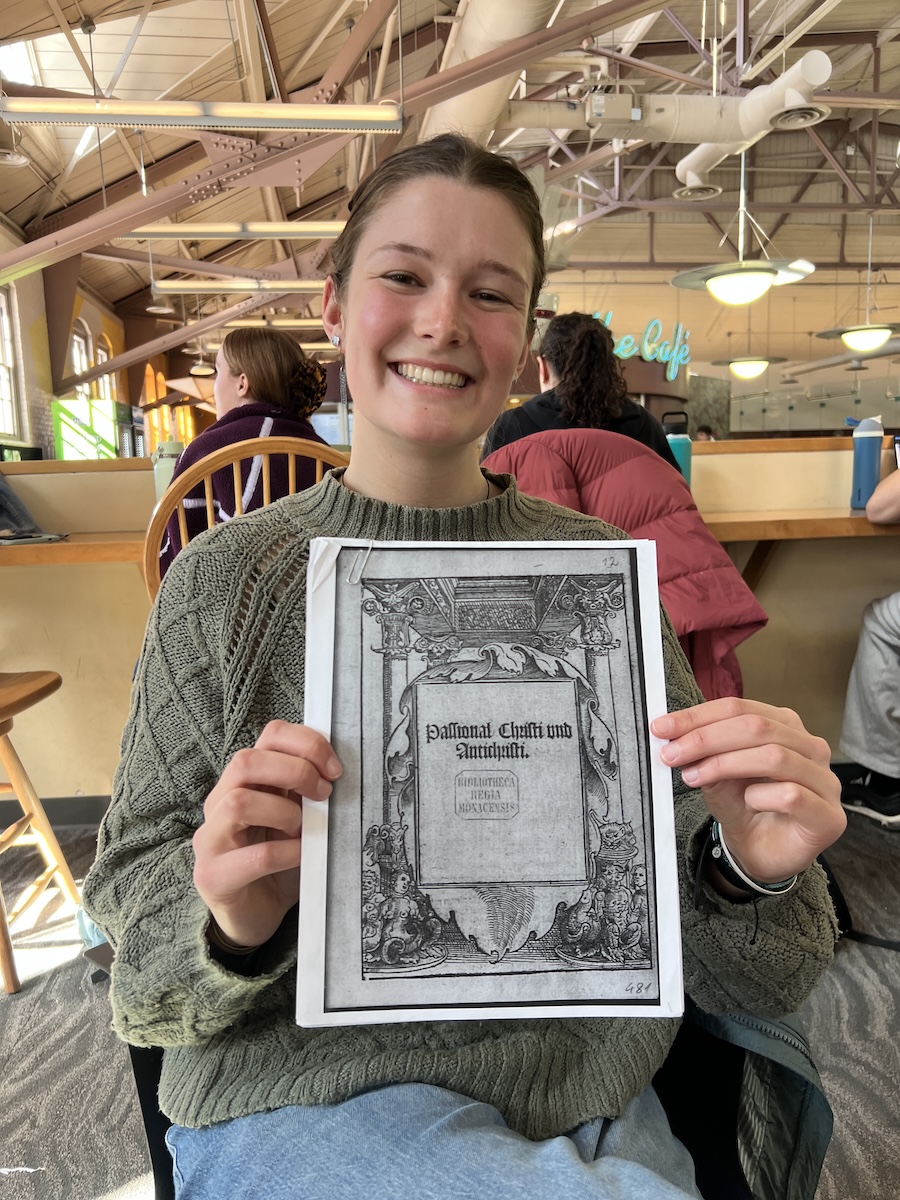
For her thesis, she’s researching a relatively understudied but influential twenty-six-page Reformation pamphlet called Passional Christi und Antichristi. (The Passional of Christ and the Antichrist.)
The booklet includes woodblock prints by the artist Lucas Cranach the Elder. Each illustration is accompanied by a short passage from the Bible, primarily the Gospels, or from the Catholic Church's official decrees, selected by Philip Melanchthon, a theologian associated with Martin Luther.
“The pamphlet argues that the Pope is the Antichrist and shows why you shouldn’t follow him, because he's leading you away from God,” Trafton said. (While the pope is not named, the figure resembles Pope Leo X, who led the church from 1513 to 1522.) “It was one of the first times Reformation leaders were very clearly saying that the Pope was the Antichrist.” Even Luther had rarely been so bold.
Trafton describes the pamphlet as “propaganda and pop art” for the Protestants, as it powerfully spread a message of anti-Catholicism to a largely illiterate population who could easily interpret the images. The biblical passages would have been familiar to many if they were read aloud.
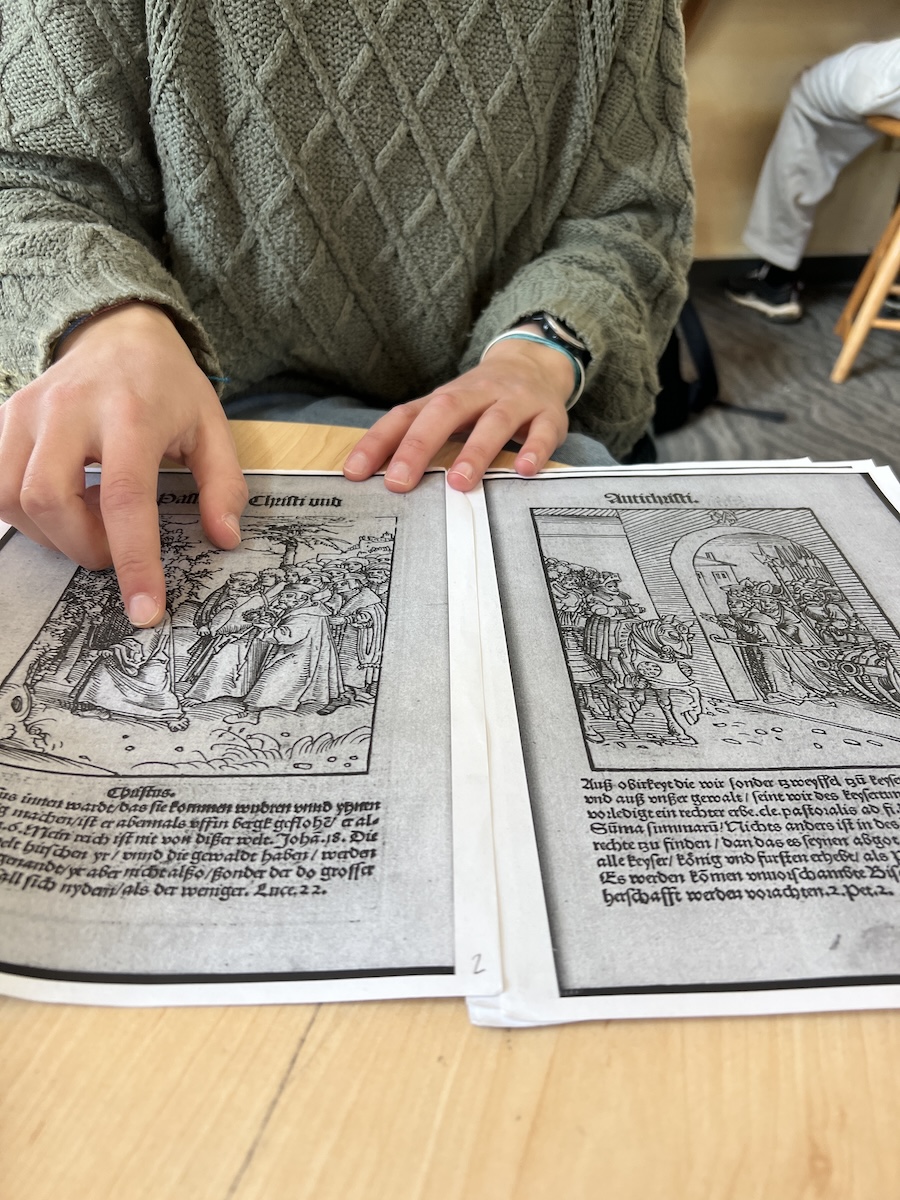
On the left side of the pamphlet are images of Christ, or “Christi.” Here Jesus leads a throng of people as he preaches in the wilderness. The opposite page depicts the Pope “walled off,” in a state of relative opulence compared with the humble Christ.
The senior said she was drawn to the self-designed project because it gave her a chance to learn more about an important period she had not studied in depth in her classes. “I was also interested in the interdisciplinary nature of the project. I have a wide range of interests,” she said with a laugh, “and this allows me to pull together a lot of them.”
Even physics, her minor? “People are always surprised by my German-and-physics combo, but both are very logical, which is why I like pairing them,” she said.
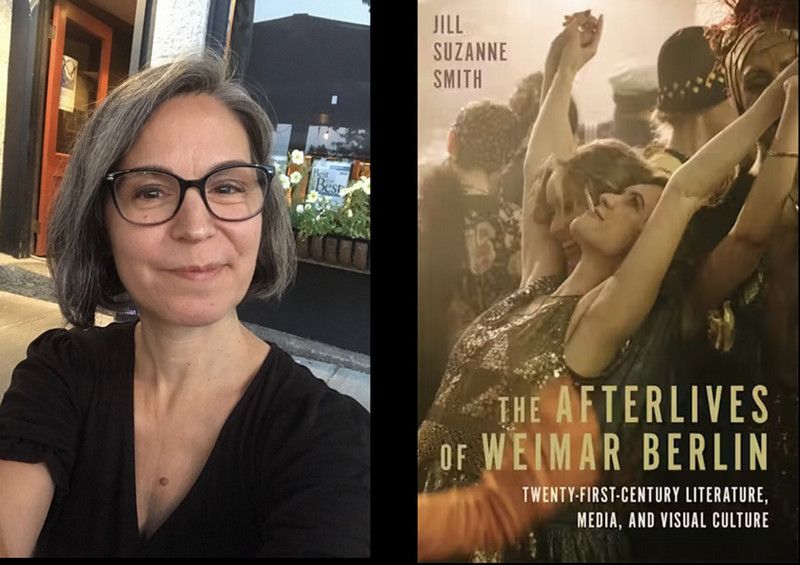
Her advisor, Associate Professor of German Jill Smith, helped Trafton translate the antiquated Middle to Early New High German text. Smith said that Trafton's project extends beyond of the boundaries of a Bowdoin classroom, and that she has enjoyed mentoring her ambitious project, which also falls outside her own area of expertise—German literature, culture, gender and sexuality, and Jewish studies from the late nineteenth century to today.
“Though I have taught texts by Martin Luther and early modern artworks by Albrecht Dürer in one of my 3000-level courses, it has been a welcome challenge for me to analyze the “Passional” in dialogue with Francie and to help her bring together research from art history, history, media studies, and religion, an endeavor that reveals just how interdisciplinary German studies can be,” Smith said.
The Pamphlet in Context
Trafton is asking several big questions of the Passional. First, she's examining how the context and history of the Reformation influenced the production of this specific piece of media. “What caused reformers to think this would be an effective tool for spreading their message?” she said.
People at the time were accustomed to seeing passionals, but ones focused on the lives and sacrifices of Christ and other saints. The Passional Christi und Antichristi would have been shocking, Trafton said.
She's also looking at the pamphlet through the lens of art history, studying the composition of images and associated text. “It turned the Pope's words against him,” Trafton said.
Lastly, she’s researching who might have read the leaflet and how far it spread among poorer and less educated segments of the population.
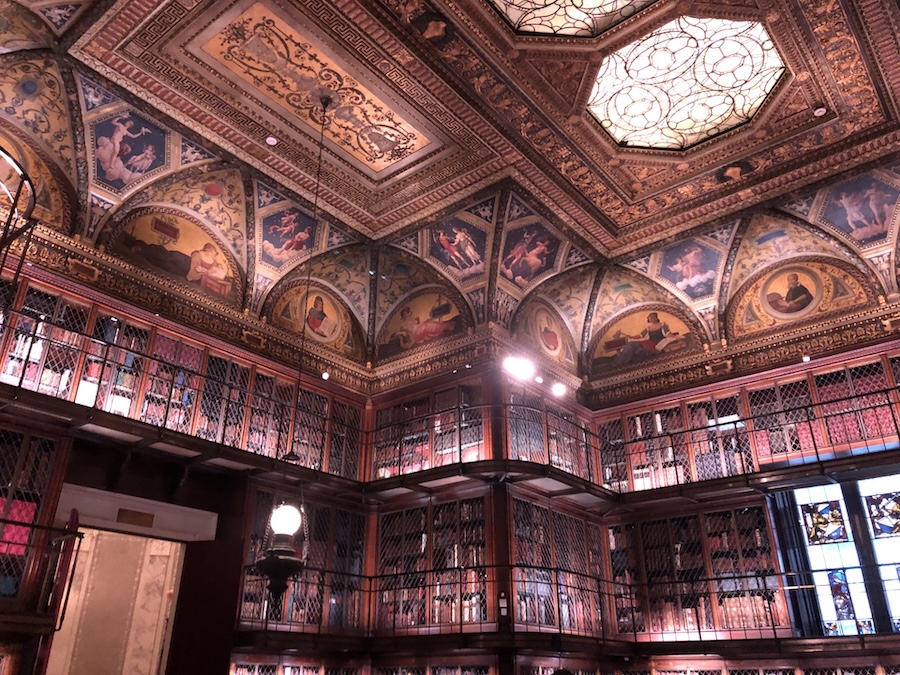
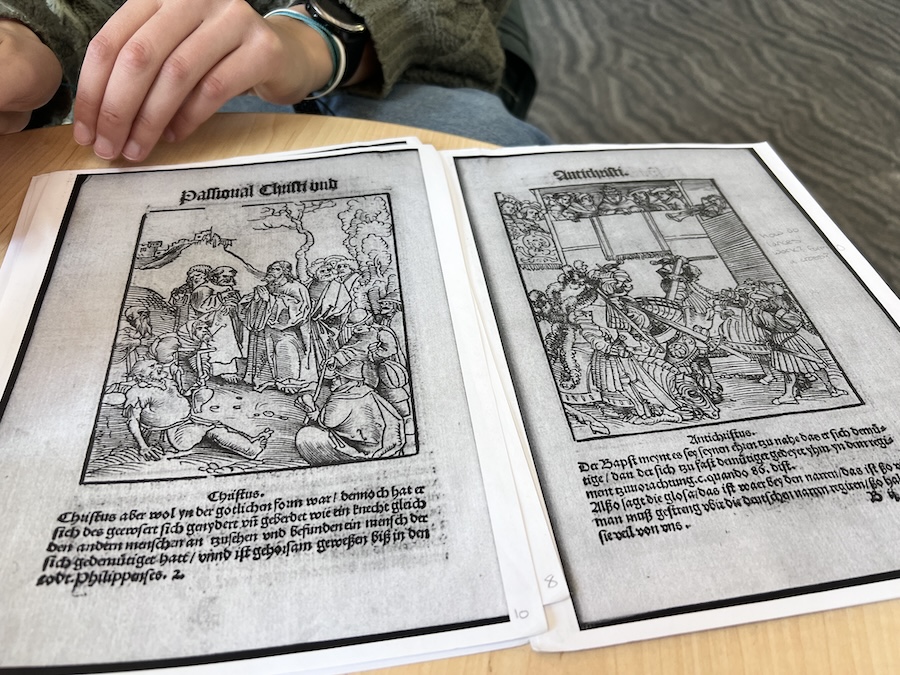
Trafton used her Grua-O’Connell research grant to travel to the Morgan Library and Museum in New York City this fall to see original copies of the passional. While she has printed out a reproduction for her day-to-day work, seeing the half-century-old versions was important to her.
“It was a piece of physical media and was intended to be held and read, so seeing it as people would have seen it was impactful,” she said. “I realized how big it was and how big the pages were. Also, the woodcuts looked a lot clearer and brighter—the contrast was stronger—and I could see the artist had used a lot of ink.”
Over the past year, she’s appreciated the chance to immerse herself in a complex study of her choosing, and to have thoughtful discussions with Smith, who “always has good insights.”
“I’ve really enjoyed getting the chance to think about one thing for a long time,” she said. “I thought I would get stuck and run out of ideas, but instead I have realized there is so much more to this than I initially thought. The more I think about it and research and learn, the more I find there is to connect.”
Biogeochemistry, with Professor of Earth and Oceanographic Science Philip Camill: “I liked this class for the same reasons I like studying physics; it was all about connections and how everything works together. Plus, it was writing intensive—we worked a lot on scientific writing, which was useful.”
The German department: “I’m not going to pick a specific class—I’ve really enjoyed all of them! I like seminars where you talk about your reading, and Professors Birgit Tautz and Jill Smith are good at facilitating that kind of conversation and pushing you to say something and work through the German.”
Black Magic: Esoteric Arts of Africa and Its Diaspora, with Deji Ogunnaike: “That was my first class in the religion department, and I had never thought about religion in this way before—how it’s part of so many aspects of life. It’s so much more than going to church or a house of worship; it’s ingrained in art, media—it influences the day-to-day so much.”
Each fall, the student fellowships and research office awards grants for up to $2,500 to students pursuing research for independent studies or honors projects during the academic year.
The awards are supported by endowed funds set up by donors who wish to enable faculty-mentored research across the disciplines.
This year, the office gave awards to thirty-four students—majors in Africana studies, anthropology, biology, chemistry, classics, computer science, digital and computational studies, earth and oceanographic science, education, English, environmental studies, German, government, history, neuroscience, or Romance languages.
Read about other student researchers in this series: Oliver Clachko ’26, Mingi Kang ’26, Alexa Comess ’26, Kaya Patel ’26, Will Tran ’26, Asher Savel ’26, Dylan Berr ’26, Larah Gutierrez-Camano ’26. and Kristin Hayes ’26.