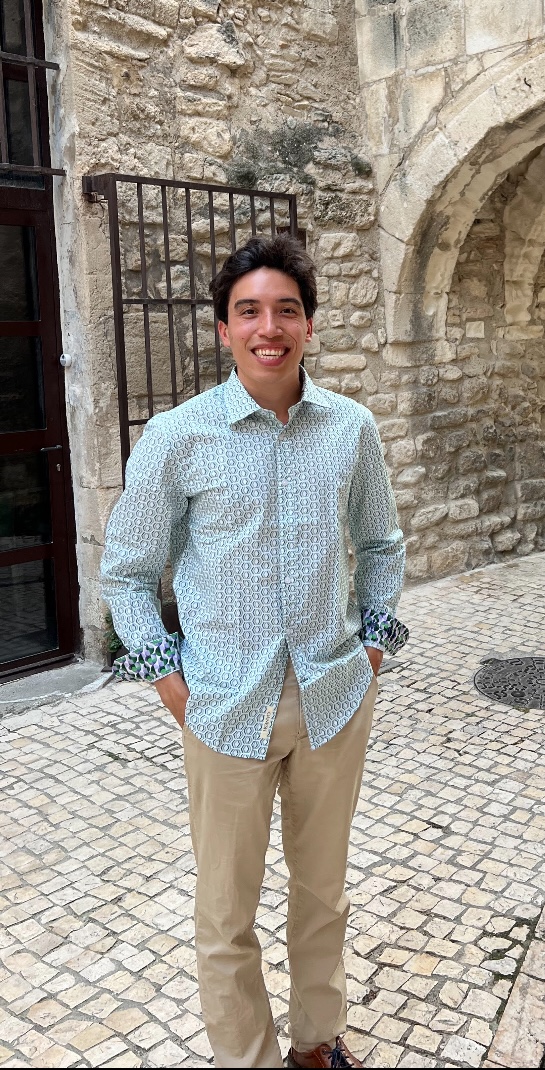
This profile is part of a series on students who have received fall research awards to pursue faculty-mentored, independent projects. Tran's research is supported by the Davis Fund.
In 2024, during a spring break training trip with the rowing team at "Camp Bob," Tran—an interdisciplinary scholar of history and politics—spent his downtime reading Nuclear War: A Scenario, by Annie Jacobsen.
“I couldn't sleep for a few days. I'm not going to lie,” Tran said. “I was just lying in bed, staring into the dark.”
The book, an investigation into “the heart of the nuclear military establishment,” stuck with him, helping to lay the groundwork for his future senior honors project on nuclear weapons.
More reading last year helped solidify his research plan, especially the book Russian Nuclear Orthodoxy: Religion, Politics, and Strategy, by Dmitry Adamsky, which he read shortly after finishing The Radiance of France: Nuclear Power and National Identity after World War II, by Gabrielle Hecht, about how the French government promoted nuclear power.
“I didn’t necessarily have a eureka moment, but I had an ‘oh my God, holy s–’ moment,” he said. “I realized that what the French government was pushing with nuclear power plants in the ’50s and ’60s was very similar to what Putin is trying to do now with nuclear weaponry and nuclear activities.”
Beyond Russia, Tran also notes similarities in the rhetoric and attitudes of leaders in North Korea, Iran, and Poland as they attempt to build up or acquire their own arsenals.
Each fall, the Office of Student Fellowships and Research office awards grants for up to $2,500 to students pursuing research for independent studies or honors projects during the academic year.
The awards are supported by endowed funds set up by donors who wish to enable faculty-mentored research across the disciplines.
This year, the office gave awards to thirty-four students—majors in Africana studies, anthropology, biology, chemistry, classics, computer science, digital and computational studies, earth and oceanographic science, education, English, environmental studies, German, government, history, neuroscience, or Romance languages.
In his thesis, he draws comparisons between France during the Cold War and Russia after the collapse of the Soviet Union, looking at how the two nations approached and promoted nuclear power. In other words, he said, “how they used them to justify government centralization, to increase national grandeur and national glory, and as a crutch for essentially claiming, ‘We are great nations, we are powerful nations.’”
Although he has a healthy fear of nuclear war, his research has reinforced the notion that atomic energy remains more “potent as a symbol than as a tool.”
“Nuclear weapons have this almost divine element,” he said. “They have the power to annihilate, the power to destroy. Traditionally that was reserved for divinity—for a God who could make something out of nothing, and turn something into nothing.”
What can keep someone up at night, he continued, is “that this power has been harnessed by nation-states that are incredibly fallible and incredibly subject to influence. It’s that dynamic—the nation-state with the power of the divine—that has pushed my thinking for quite some time.”
The project also grows out of Tran’s long-held desire to spend his senior year working on an independent thesis rooted in primary sources. “I wanted to get my hands dirty and to do something that let me make comparisons people haven’t made before,” he said.
Plus, “I wanted to do an honors project because it would give me a unique opportunity to move outside the classroom, outside the text, in a discipline [history] that is very much classroom- and text-focused.”
His fall research award will help him access primary sources by supporting a weeklong trip during winter break to Vienna, where he can study historical documents from Europe and Russia stored at the International Atomic Energy Agency.
This summer and fall, he’s been reading up to thirty hours a week of historical sources on his subject, as well as political, social, and anthropological theory. He credits his faculty committee—which includes Page Herrlinger, his primary thesis advisor, Meghan Roberts, and David Hecht—for keeping the process enjoyable.
Together, they’ve made this “some of the most fun I’ve had with history,” Tran said. His advisors treat him almost as a peer, he added, challenging him and asking harder questions than he’s used to in class.
“When I showed my committee my original proposal, they had a lot of intense questions for me. It was hard, but I grew so much.” The experience is good training for graduate school, which he hopes to attend in a couple of years to pursue a policy-oriented international relations degree, after perhaps teaching English in Vietnam.
Tran also expressed gratitude for Bowdoin's library and its interlibrary loan system, and the College's broader liberal arts infrastructure that “prioritizes a love of learning and incentivizes research with intersectionality.”
Among Tran's favorite classes at Bowdoin are these three:
- Civilizations and Barbarians, with David Gordon: A first-year writing seminar, the class “includes a lot of good readings and is discussion oriented. It was about contrasting us versus them, in a colonial context, literary context, and around immigration in America,” Tran said.
- The History of the Present, with Salar Mohandesi, “a history class explaining why the world is the way it is now, starting with the fall of the Berlin Wall to present day,” said Tran.
- Every Italian class he's taken! “It's a great department with great people.”
Read about other student researchers in this series: Mingi Kang ’26, Oliver Clachko ’26, Alexa Comess ’26, Kaya Patel ’26 and more to come!