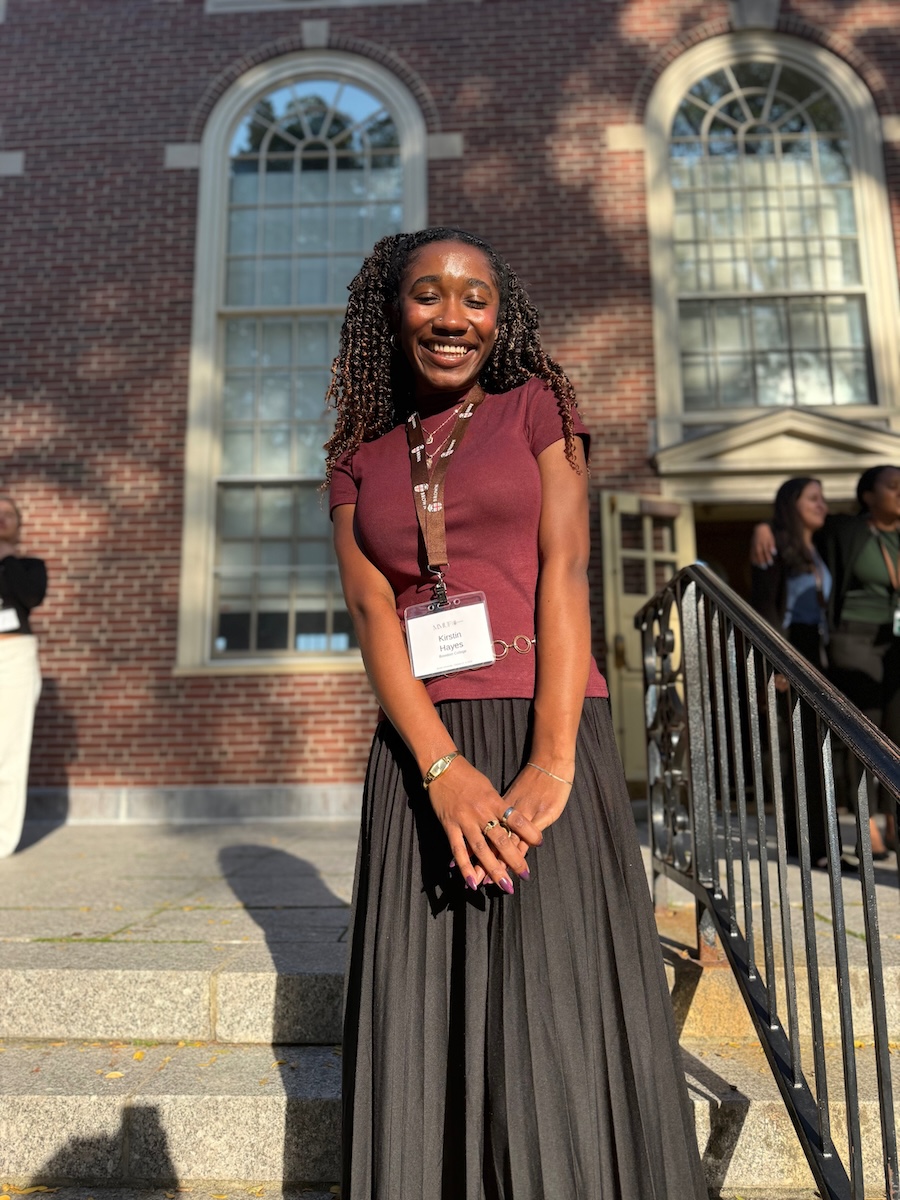
This profile is part of a series on students who have received fall research awards to pursue faculty-mentored, independent projects. Hayes's research is supported by the Peter J. Grua and Mary G. O’Connell Faculty/Student Research Fund.
When it came time to choose a research topic for her Mellon Mays Undergraduate Fellowship during her sophomore year, Hayes decided to look more closely at her mother’s family and their church.
“My mom grew up in the African Methodist Episcopal Church [AME], a tiny church in Alabama, and my uncle is an AME pastor,” she said. Her mother, one of eleven children, has siblings who belong to AME churches across the country.
While Hayes didn't grow up attending the church in her home city of Cincinnati, she would go to AMEC Sunday services with her grandparents when she visited them.
For the past two years, she has been investigating the history of the denomination, and is focusing her senior honors thesis on its record throughout the fraught post-Reconstruction, post-emancipation era from 1877 to 1900. “Some historians call this the nadir of American race relations, because there was a surge of racial violence and oppression during this time,” Hayes said.
As the church navigated a changing society, Hayes said its leadership was concerned with protecting its followers and helping them establish themselves as newly recognized citizens. She is asking questions such as how the church community conceptualized freedom and liberation through the lens of its religious beliefs, and “how this concept of racial uplift has shaped the modern-day AME church.”
Each fall, the Office of Student Fellowships and Research awards grants up to $2,500 to students pursuing research for independent studies or honors projects during the academic year.
The awards are supported by endowed funds set up by donors who wish to enable faculty-mentored research across the disciplines.
This year, the office gave awards to thirty-four students—majors in AAfricana studies, anthropology, biology, chemistry, classics, computer science, digital and computational studies, earth and oceanographic science, education, English, environmental studies, German, government, history, neuroscience, or Romance languages.
This semester, Hayes received a fall research award from Bowdoin to digitize and analyze materials she uncovered over the summer during visits to several AME archives in Philadelphia, where the church began. The oldest Black church in the country, it was founded by ordained minister Richard Allen after his church adopted segregationist policies.
Grounded in Methodist and Episcopalian traditions, the AME church ensured that Black worshippers could practice their faith free from oppression. While the religion spread throughout the country in the decades that followed, it took longer to take hold in the South.
“They had a hard time breaking into the South because one of the church’s main concerns was literacy, and they were teaching Black people how to read,” which was outlawed at the time, Hayes said. “Communal organizing was also threatening, so the AME couldn’t really establish itself in the South until after the Civil War.”
Hayes is especially interested in understanding the role of women in the AMEC during the late nineteenth century. “The men are the bishops and pastors, but when you look at the congregations, the women are making everything run,” she said.
Yet women receive almost no recognition in church archives, and she has found language in old documents suggesting they were tightly controlled within the church’s domain.
To illustrate this absence, she recalls reading a plaque on the back wall of Mother Emanuel Church in Charleston, South Carolina, that celebrates the accomplishments of a long-ago pastor. At the bottom, it notes that the memorial was commissioned by his wife—but she is not named. Since then, the only information Hayes has been able to uncover is the woman's name and where she is buried.
“I wonder why the women who kept the church running were so hidden,” Hayes said. “Is that invisibility a key part of what it meant to be an AME woman at the time?”
She finds this to be in contrast to religious customs rooted in Africa. “Within communities across the African diaspora, spiritual practices that survived the transatlantic slave trade” often amplify women’s power, she said. “That is the antithesis of how women exist in Christianity in America.”
As she works on her senior honors project, Hayes is also applying to PhD programs in Africana studies and history. She hopes to one day have a faculty position, to continue researching and teaching. “These are two things I have learned I love to do,” she said.
“When I came to Bowdoin, I didn’t know what being a professor was like, or that academia was even a possible career path,” she said. The Mellon Mays program and her Bowdoin advisors—especially Judith Casselberry and Bianca Williams—helped show her that the door was open to her.
At the same time, Hayes’s own research process has solidified her commitment to an academic career. “When I did my independent study junior year, I struggled with the question of whether, as an undergraduate, I could trust my own ideas,” she said. “I wasn’t confident in my voice or my insights.”
“But over the past year, through this project, I’ve developed my own voice as a scholar and as a person, and I've learned to trust it.”
Among the many classes Hayes has taken, these are among her favorites.
White Negroes, with Guy Mark Foster: “The class looks at literature about people who exist on the color line. It was so different than anything else I've ever taken. It helped me develop confidence in my thinking, because English classes are where I feel I know how to do a close reading of literature. It’s all so subjective, you can’t be wrong! I ended up employing the same tactics I got from this English class, and other English classes, to my research.”
Sex Work Archival Encounters, with Keona Katrice Ervin: "I love archival research, and the class is all about looking at sex workers, the history of sex work, and how archives encounter sex work. The class is focused on counter archiving, in other words, what do archives look like that are created by the people they’re meant to represent?"
Black Feminisms and Social Movements, with Bianca Williams: “This class introduced me to Black feminist literature and how Back feminism works in practice. How can Black feminism be enacted and how do you practice it on a day-by-day, hour-by-hour level?"