Since her first semester at Bowdoin, the neuroscience major has pursued a research agenda exploring how early-life adversity shapes later-life outcomes and behaviors.
This profile is part of a series on students who have received fall research awards to pursue faculty-mentored, independent projects. Patel's research is supported by the Peter J. Grua and Mary G. O’Connell Faculty/Student Research Fund.
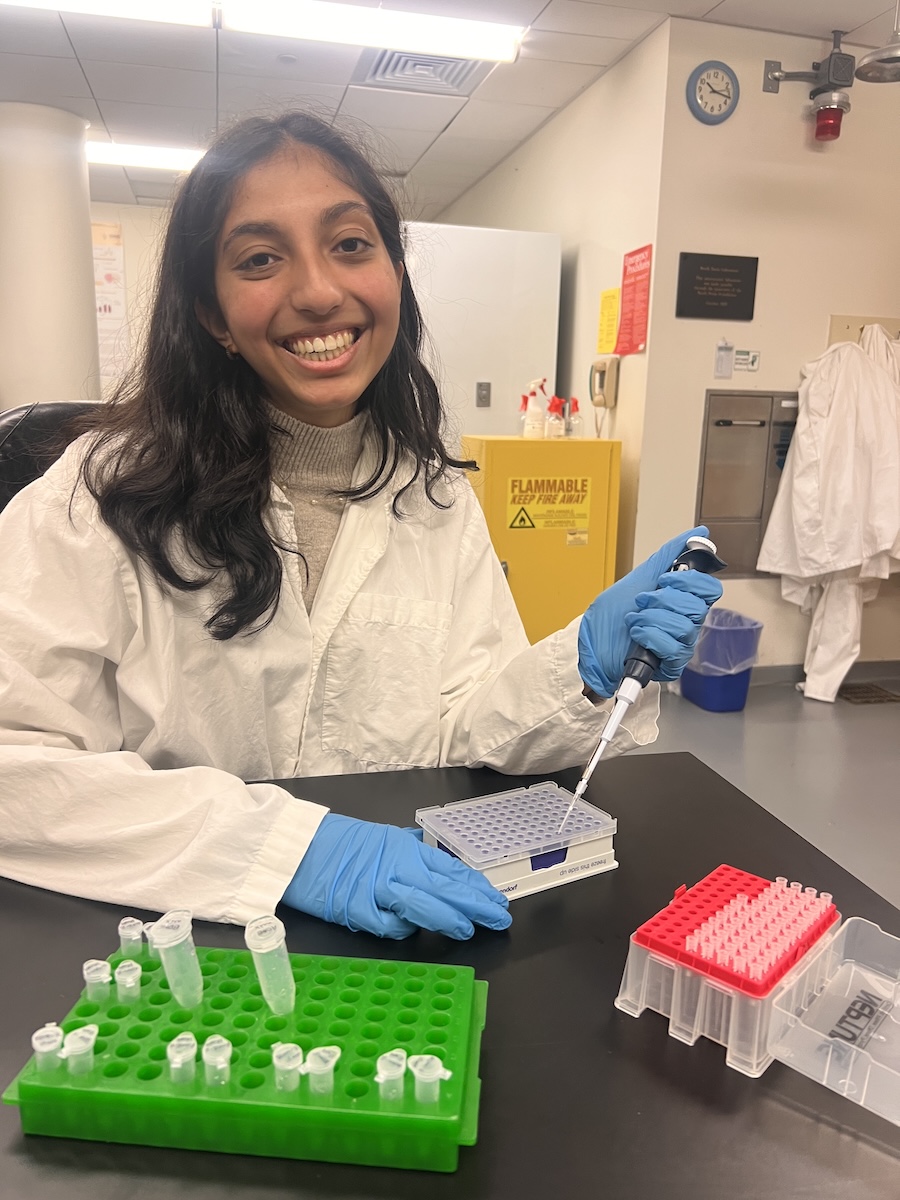
Building on this foundation, Patel is now working on an honors project—supported by a fall research award—to investigate whether ketamine can treat anxiety, which can be tied to long-lasting impacts from early-life stress.
The FDA recently approved the novel drug for treatment-resistant depression, but Patel notes that little data exists on its effectiveness for anxiety.
Patel is mentored by Assistant Professor of Psychology and Neuroscience Jennifer Honeycutt, whose lab broadly studies the effects of early-life adversity on emotional regulation, seeking to uncover the neural circuitry underlying disorders such as anxiety and depression.
Within this context, Patel is focusing on ketamine’s potential to counter the molecular mechanisms that drive anxiety. She's already had some positive outcomes in her analysis of behavior and RNA expression—particularly in females, who are disproportionately affected by anxiety and depression.
One of the lines of investigation in the Honeycutt lab, which Patel appreciates, is how the sexes respond differently to early stress in their lives. “Previously, people said this may be due to mental health stigma, and men not reporting as much, but I think we are seeing that there is a biological basis to this phenomenon,” she said.
Each fall, the Office of Student Fellowships and Research awards grants for up to $2,500 to students pursuing research for independent studies or honors projects during the academic year.
The awards are supported by endowed funds set up by donors who wish to enable faculty-mentored research across the disciplines.
This year, the office gave awards to thirty-four students—majors in Africana studies, anthropology, biology, chemistry, classics, computer science, digital and computational studies, earth and oceanographic science, education, English, environmental studies, German, government, history, neuroscience, or Romance languages.
“A lot of circuit-level and molecular changes are happening in females that aren’t happening in males, especially when they experience early-life adversity,” she added. “Then the trajectories are very different for males and females in how they respond to stress.”
Despite these apparent differences, Patel pointed out that examining sex differences within neuropsychiatric research remains rare. “I would like to continue looking at sex differences in my research and fill the pressing gap I’ve learned exists,” she said.
She has personally watched these differences play out in her own family, witnessing younger female relatives develop anxiety after puberty. “That's a motivation as well. I see this effect in real life, and it makes me want to address it.”
Patel is currently applying to graduate schools to continue studying the molecular and cellular underpinnings of mood disorders. “In general, I’d like to do research that eventually could be translational to drug development. Whether that involves ketamine or other drugs, I want to have an emphasis on finding treatments.”
Finding Her Way to Neuroscience at Bowdoin
Though Patel is committed to a career in neuroscience, she didn’t always know this would be her path. As a high school student growing up in Morristown, New Jersey, she thought she might study environmental chemistry.
But during her first semester at Bowdoin, she recalls wandering through the Fall Research Symposium on the Quad, an annual event where students present their summer work. She stopped at a poster by two neuroscience majors and said she was “blown away by their research on DNA methylation in early-life adversity,” referring to an epigentic mechanism that, responding to environmental factors, alters gene expression.
She reached out to their advisor to ask whether she could join the lab, and since then has worked as a research assistant to Honeycutt almost continuously, aside from one summer spent at the University of Connecticut School of Pharmacy through an NSF undergraduate research grant.
“I’ve gotten a lot of training at Bowdoin and in [the Honeycutt] lab that I don’t think would have been possible in many other places, especially not at bigger research institutions,” she said. In just three years, Patel has co-authored three papers—one published, one under review, and a third in progress—with Honeycutt and other Bowdoin students.
She credits Honeycutt for giving her the freedom to carve out her own research path and to take on a leadership role in the lab. “I have a lot of autonomy over what I do,” she said. “The fact that I’ve been able to do research since my first year and pursue independent projects has been amazing.”
Patel is majoring in neuroscience and minoring in chemistry. Among her many favorite classes at Bowdoin are these three:
Biochemistry & Molecular Mechanism, with Danielle Dube. “I think it's fascinating how amino acids and fundamental structures are responsible for broader biological changes, and I also started to see how we can manipulate biological systems for therapeutic purposes,” Patel said.
Neurophysiology, with Dan Powell. “I learned a lot in that class about the many mechanisms in neurons that allow the brain to be as complex as it is,” Patel said.
History of Modern Science, with David Hecht. “It was really cool to talk about the ethical implications of science and how scientific discoveries have been received,” she said (e.g., disregarded if authored by a woman, or blatantly racist.)
Read about other student researchers in this series: Oliver Clachko ’26, Mingi Kang ’26, Alexa Comess ’26, Will Tran ’26, and more to come!