Inside Dylan Berr's Effort to Understand Bowdoin’s Birds
By Rebecca Goldfine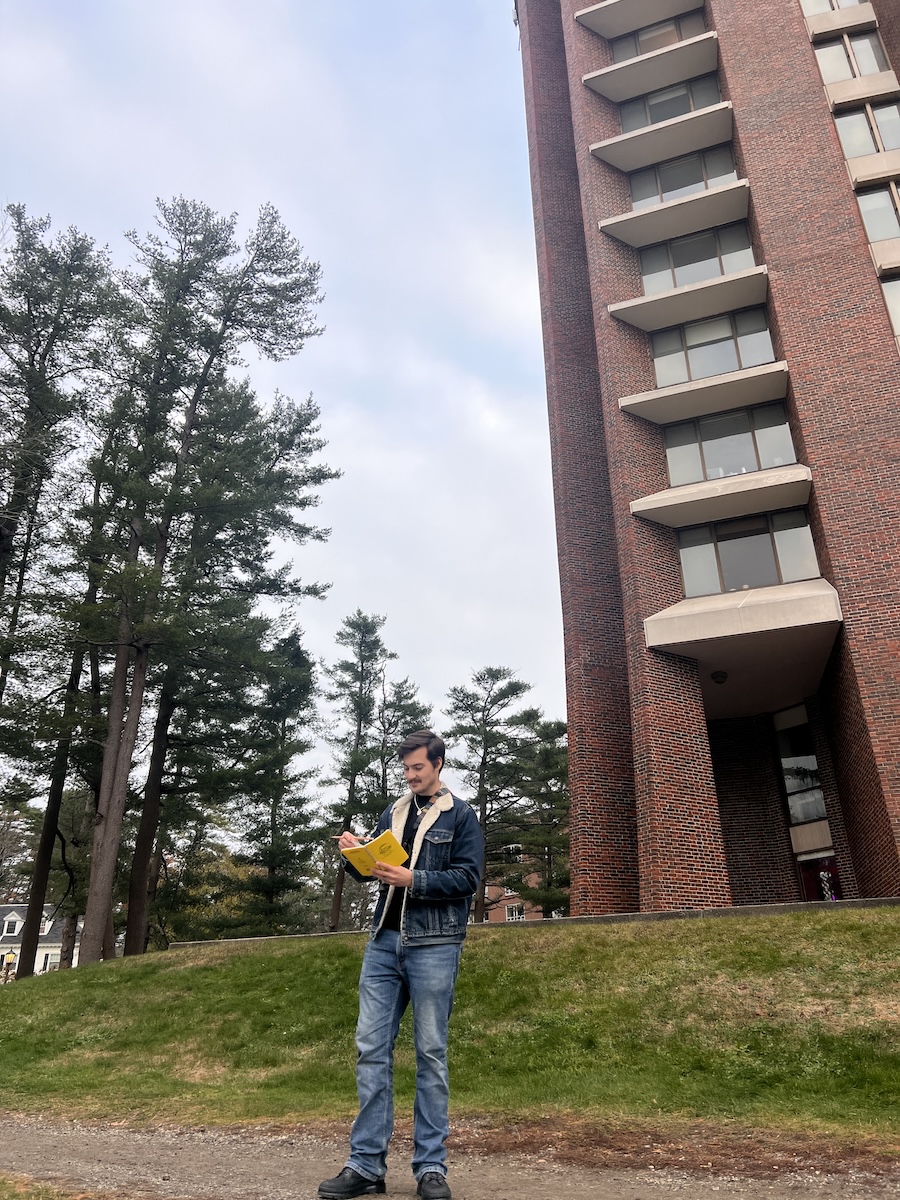
Throughout the fall, the biology major (and English minor) rose before sunrise three days a week to walk the same forty-five-minute route through campus.
He started at Coles Tower, listening for warblers and sparrows and watching for crows and vultures overhead. From there, he followed the pine-shaded path by the Edwards Center, looped past the Longfellow playground, paused at the edge habitat near the Roux Center, and finished in the mature pine stand—popular with red-breasted nuthatches and warblers—near the Arctic Museum and Coe Quad.
He repeated the same walk at dusk, noting all the birds he saw and heard, using a point-count techique to be as accurate as possible. The data he is collecting will help reveal how birds use the campus and where they may be most vulnerable.
“I chose to survey near buildings that are a high collision risk, because of the number of windows or their orientation on campus relative to the Atlantic flyway,” he said, referring to the route migratory birds take twice a year to reach northern breeding grounds or southern overwintering sites.
Overall, he is seeking to understand how birds interact with Bowdoin's built environment. “The project is not just about making the buildings more bird-safe,” he emphasized. “It’s also about understanding how species are using campus spaces and how we can support the birds moving through here.”
Berr's research is supported by the Peter J. Grua and Mary G. O'Connell Faculty/Student Research Fund, part of the Office of Student Fellowships' fall research grant program.
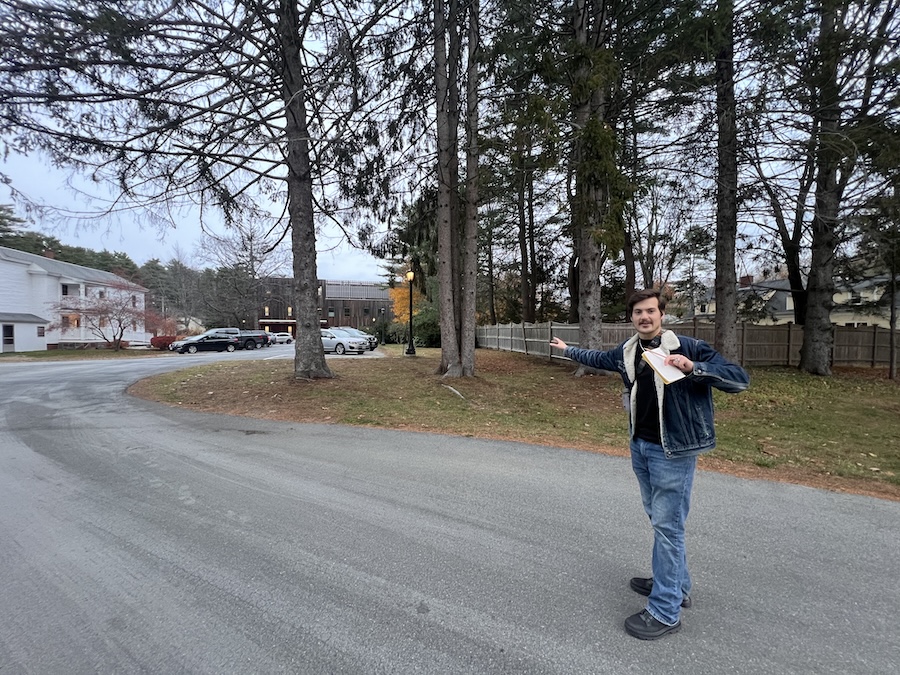
To improve his data collection, Berr received a fall research award from Bowdoin to purchase several bioacoustics devices called BirdWeather PUCs (Portable Universe Codec), which can record and analyze bird calls within a set distance. They’re sensitive enough to identify bird species, but they can also distinguish between individual calls and the types of calls and songs—such as territorial, mating, alarm, or flight. “It’s much more accurate than a person,” Berr said.
Berr is using these recordings and his own survey data—as well as information collected by two birders who began collecting bird-strike data in 2021, Sejal Prachand ’24 and Cora Dow ’25. With these stats, he's creating a detailed picture of which species visit campus and where they feed, flock, or nest.
The senior has been enamored with birds since he assisted a conservation study of black guillemots on Kent Island two summers ago. “I'm sure that the guillemots hated my nest checks, but some part of that exchange, paired with witnessing new life in their offspring, reinforced these feelings,” he said: “We can observe and quantify bird behaviors and patterns but are simultaneously unable to directly embody or live them. You can say that for any nonhuman being, but birds are just so open in this regard.”
On campus, he's been impressed with the species he’s encountered on his early-morning and evening surveys. He's spotted a bay-breasted warbler near Coe Quad and a flock of six ruby-crowned kinglets. “I always thought I had to get off campus to see these birds, but I’ve seen so many species right here,” he said.
“The project is...about understanding how species are using campus spaces and how we can support the birds moving through here.”
—Dylan Berr ’26
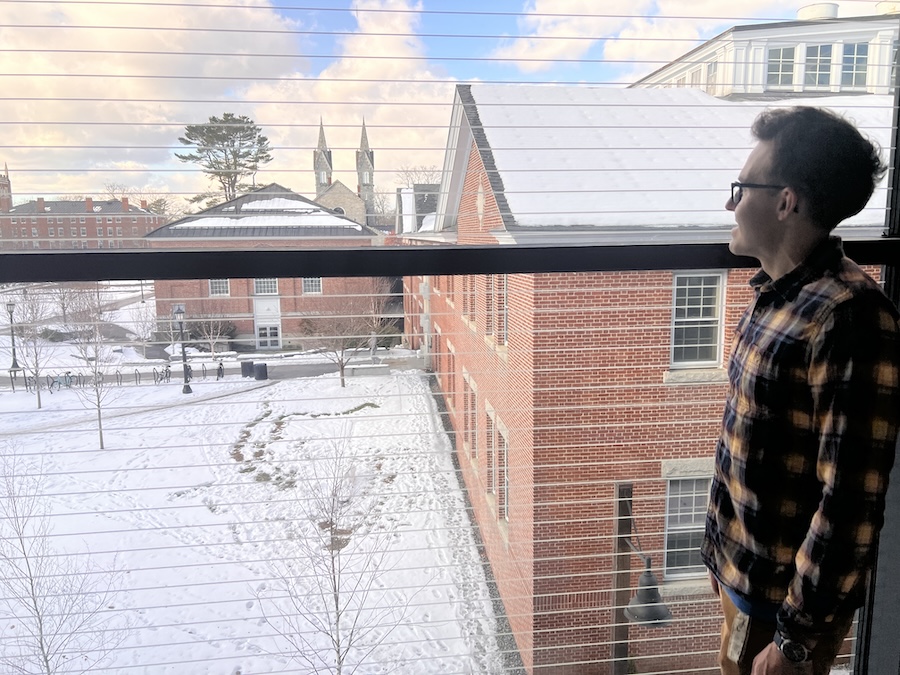
For the past few years, a small team of students and a faculty member have been working with Bowdoin facilities, Maine Audubon, and Portland Society for Architecture to make the campus safer for birds.
“Bird-window collisions are one of the leading causes of bird fatalities,” said professor Brandon Tate, who collaborated with Cora Dow ’25 and Sejal Prachand ’24 to get Bird Safe Bowdoin off the ground. “One billion birds die from crashing into windows, second only to deaths by cats.”
One remedy is to turn off indoor lights at nighttime and point outdoor lighting down, to minimize disorienting birds flying overhead.
Another solution is to make glass more visible to birds by applying a pattern, either with stickers or etched lines two inches apart. The Arctic Museum's signature window, facing the quad, is made of bird-safe glass. (See the photo of this window above, with Tate.)
Going forward, facilities is also working to integrate bird-safe features for façade design, site layout, exterior lighting, and interior lighting for major campus construction projects.
To gather more information about bird strikes, he has been working with Bowdoin facilities to set up security cameras at buildings like the Roux Center and the Visual Arts Center (VAC). He has also asked the College community to report any bird strikes they witness, whether they hear a collision or find a carcass.
“The cameras will help account for strikes at night—for birds that might fly off and succumb to injuries later—and also for scavengers, like turkey vultures, that might take birds that collided with windows,” he explained.
So far, Berr has found that most strikes occur at the VAC; he counted more than twenty-five this fall, many of them migratory warblers and sparrows. “They’re more susceptible because they’re on these massive fall migrations, versus resident birds that are used to being in this environment and probably have established foraging routes.”
Resident species, such as chickadees, nuthatches, cardinals, and tufted titmice, know where to find food, what predators to expect, and how to navigate the buildings. Migrant birds, which stop over for only a few days—or even hours—lack this familiarity. To compensate, they may follow resident birds, forming safer mixed flocks.
One of the biggest hazards migrants face is well-lit structures. “On their short or long journey home, depending on their species, many birds travel at night to avoid predation,” Berr said. “But artificial light and reflective windows can be disorienting. They may see windows as extensions of their surroundings.”
The Roux Center has taken steps to mitigate this by dimming its lights at night and lowering window shades, and Berr noted that far fewer bird strikes have been recorded there since these changes. The College has also installed bird-safe glass in the Arctic Museum and will be adopting bird-safe policies for major new building projects.
Brandon Tate, a visiting professor of chemistry and environmental studies, is advising Berr's project, and is the advisor for Bird Safe Bowdoin. He said Berr's research could help guide landscaping and construction decisions, such as including native plants, choosing less hazardous pest controls, and maintaining artificial nest sites.
“Our goal is to better understand how wildlife is interacting with and being affected by the physical features of our campus, because that information empowers us to make informed decisions moving forward,” Tate said.
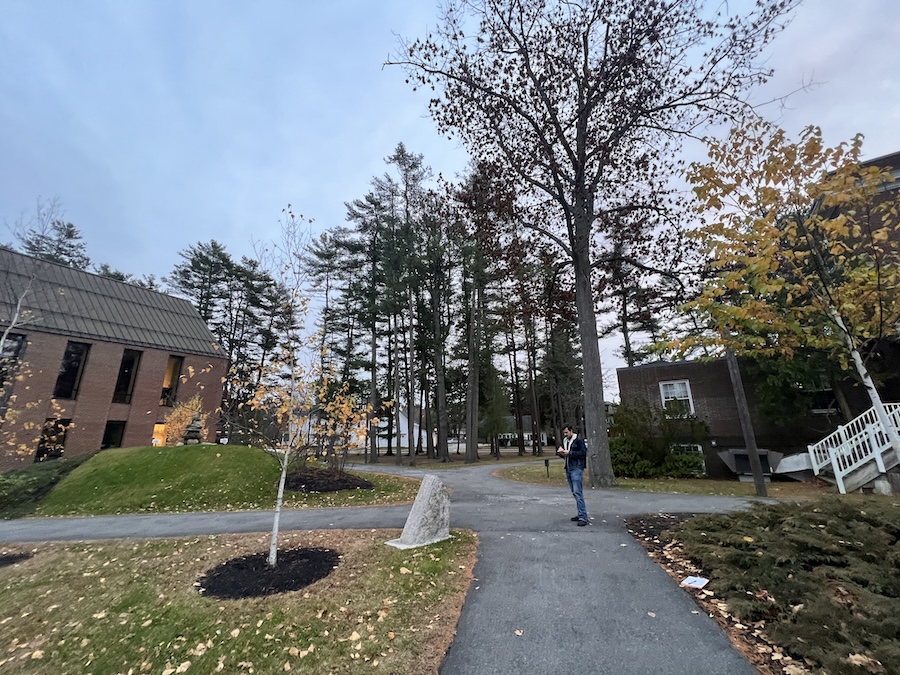
Next semester, Berr's research plans include digging deeper into campus ecology by studying local plant species to better understand Bowdoin’s microhabitats and their appeal to birds. For this work, he's integrating a dataset created by Dylan Petrillo ’26 that catalogs campus trees.
“I want to see how the maturity of these trees correlates with the species assemblages we see, and I also want to gather data on low-brush habitats,” Berr said.
He hopes future students might survey insect species at campus sites to learn what food sources birds rely on, as well as study in greater detail bird activity both around the trunks of trees and up high in their canopies, as if the tree, itself, was a microhabitat. “This would give us multiple levels of biodiversity in the surveys,” he said.
Berr will continue analyzing how campus bird distribution varies by date, time, temperature, weather conditions, and location. Already, his work points to two areas of high activity: the Roux Center and Coe Quad, both of which support higher-than-average species abundance and more tightly linked groups of birds. “This means we’re doing something right in terms of the vegetation in those areas,” he said.
Berr said that taking relatively small actions—such as planting bird-friendly or native species and installing bird-safe glass—can improve the lives of the nonhuman creatures around us. He also urges people to learn what is around them, for their own sake.
“When people take the time to explore the species in their area, it touches something—the pride of where they’re from, the place where they grew up. It touches every emotional relationship they’ve carved out,” he said.