This profile is part of a series on students who have received fall research awards to pursue faculty-mentored, independent projects. Gutierrez-Camano's research is supported by the Fritz C. A. Koelln Fund.
Though birthing girdles were once commonly used during deliveries to offer spiritual protection to women, only nine are thought to survive today, many having been destroyed during the Reformation.
Despite their rarity, a Bowdoin senior with eclectic interests in literature, medicine, animals, biochemistry, and obstetrics worked diligently to gain access to one for her honors project.
After debating whether to pursue a senior thesis in biochemistry or English—her two majors—Gutierrez-Camano decided to synthesize both into one unusual but compelling project. With funding from a Bowdoin fall research award, she is using proteomic and literary techniques to examine the “Takamiya MS 56” birthing girdle held at Yale University’s Beinecke Library.
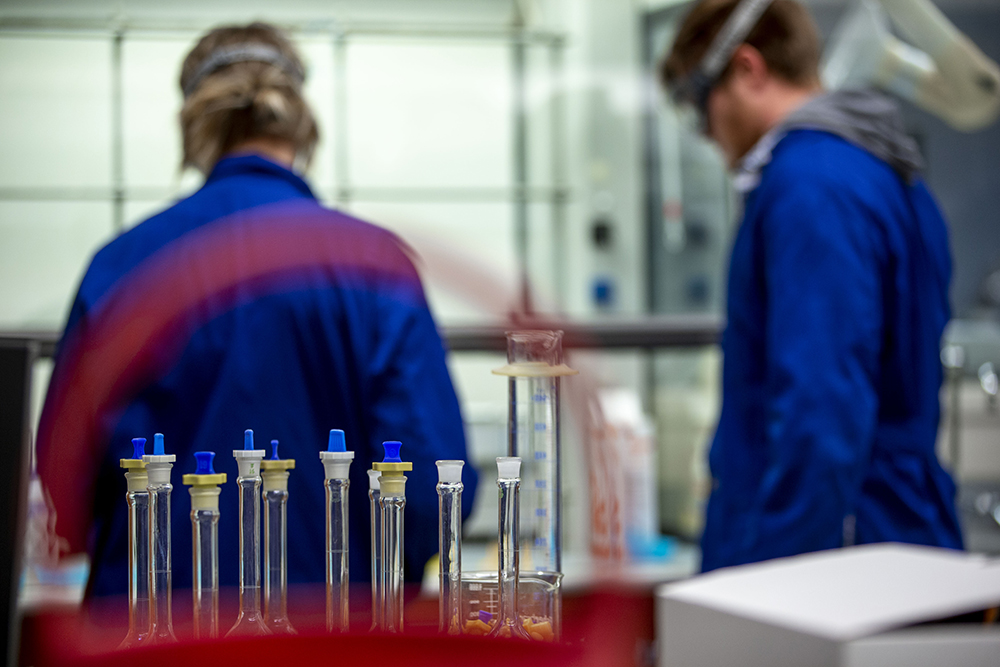
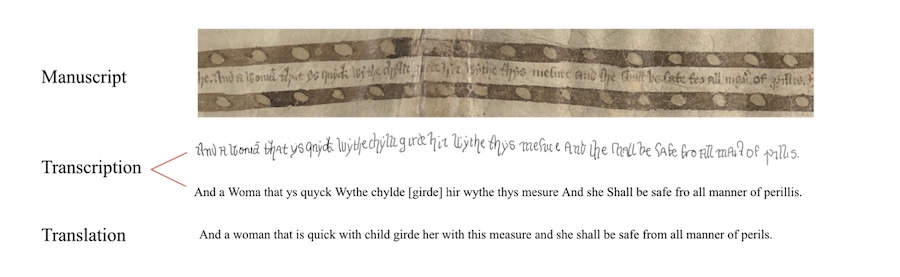
The laboratory side of her work focuses on testing for residual proteins from past deliveries, such as cervico-vaginal fluids that might remain on the parchment. The close reading involves transcribing, translating, and analyizing the girdle’s inscriptions and iconography.
In the Middle Ages, pregnant women from all classes—peasants and noblewomen—were often wrapped in these girdles or rolls during childbirth. The long, thin vellum parchments were decorated with imagery—saints, the Virgin Mary, crosses—and prayers, to bless the mother and child. “It was like a shield, a protective layer during childbirth,” Gutierrez-Camano explained.
Each fall, the Office Student Fellowships and Research awards grants up to $2,500 to students pursuing research for independent studies or honors projects.
The awards are supported by endowed funds set up by donors who wish to enable faculty-mentored research across the disciplines.
This year, the office gave awards to thirty-four students majoring in Africana studies, anthropology, biology, chemistry, classics, computer science, digital and computational studies, earth and oceanographic science, education, English, environmental studies, German, government, history, neuroscience, or Romance languages.
Although the rolls were covered with Christian symbolism and references, they are a blend of Christian and pagan traditions, banned when Protestant reformers argued that God's power could not reside within objects.
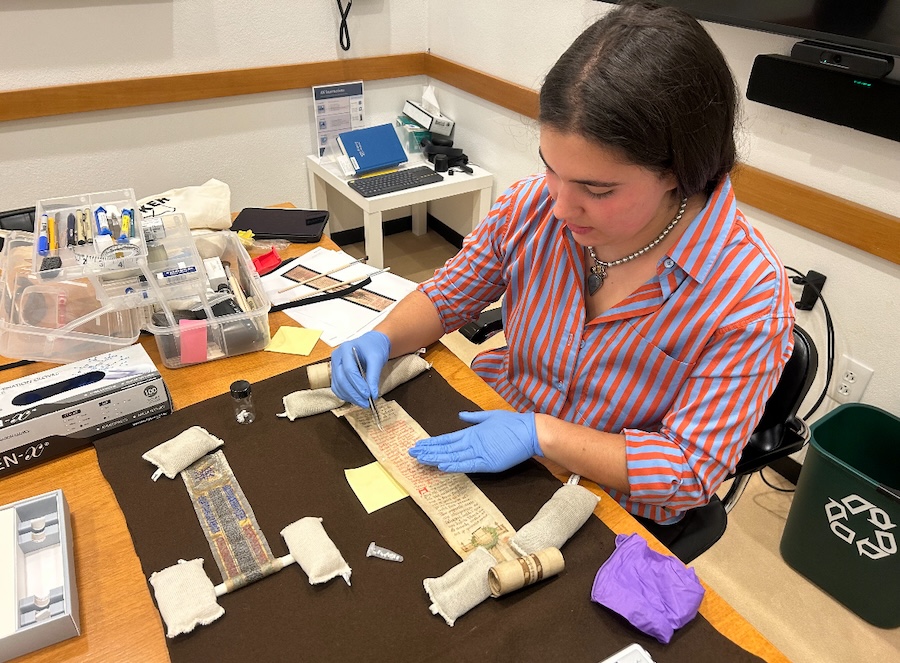
Earlier this year, Gutierrez-Camano asked rare-manuscript conservators and chemists at Beineke whether she could sample Takamiya MS 56 for traces of birthing fluids and other proteins. Different instruments can determine the source of the vellum—such as alf, goat, or sheep—as well as pick up traces of blood, plasma, or medicinals, like milk or honey.
“We were all in the Zoom meeting, and I gave the group my pitch,” Gutierrez-Camano recalled. “They were like, ‘This is so cool. Let’s do it.’”
Besides traveling to Yale to collect samples from the “very stained” girdle and to a Harvard lab to test them, Gutierrez-Camano is conducting a close reading of the Middle English and Latin text covering both sides of the parchment. Her advisor is Associate Professor of English Maggie Solberg, an expert in British medieval literature.
Though its exact origins are murky, Takamiya MS 56 offers clues into the lives and outlooks of medieval women. “They don’t know who owned it or where it is from, but the text contains many meditations on the words of Christ and comparisons of Christ’s martyrdom to the martyrdom of women in childbirth,” she said. Childbirth was a leading cause of death for women at the time.
Gutierrez-Camano is also interested in the girdle’s creative interplay of words and illustrations, leading to both “visual and verbal interaction.” The document was inscribed so it can be read vertically and also horizontally, the latter to be more legible as the woman reclined in bed.
In one “bleed-through” on the roll, a cross formed by a green crown of thorns is visible in the horizontal script on the opposite side, where you can see that it faintly encircles the word “women.” “It’s really beautiful,” Gutierrez-Camano said.
When her thesis is complete, she and Solberg will consider submitting it to a medieval women studies journal. “My honors will also be an exploration of what a scientific and literary paper could look like and what it means to examine proteins in tandem with prayers,” Gutierrez-Camano said.
Gutierrez-Camano, who grew up in New Jersey to Cuban-born parents, arrived at Bowdoin interested in the sciences and with a love for reading and writing. She became interested in care and medicine after a summer internship in a labor and delivery ward at a community hospital in New York's Hudson Valley.
“I thought I’d be on the sidelines, stocking shelves and helping with paperwork, but no—I was in there. I was holding legs, cheering patients on, and helping them push for hours. I loved it,” she said. “I loved the anger, the frustration, and also the grotesque. It was so cool to get into that space and into all of that.”
But she couldn’t neglect her attachment to books and writing. After taking a first-year seminar with now-retired Professor of English David Collings on English Romantic poetry, she decided to major in English as well.
“Because I had such a wonderful experience with the English department, I wanted to end my time at Bowdoin with the English department,” she said. “Science will always be part of my life; it is the toolbox that allows me to deepen my humanistic inquiries. English, however, has shaped my understanding of care and community health, how I approach medicine, and how I think about the role of academic knowledge in community interaction.”
Read about other student researchers in this series: Oliver Clachko ’26, Mingi Kang ’26, Alexa Comess ’26, Kaya Patel ’26, Will Tran ’26, Asher Savel ’26, and Dylan Berr ’26.