An environmental studies and government major is spending his senior year researching Maine’s groundbreaking food sovereignty law, which was passed in 2017 to protect people’s right to food and support small farmers.
This profile is part of a series on students who received fall research awards to pursue faculty-mentored, independent projects. Savel was supported by the Peter J. Grua and Mary G. O'Connell Faculty/Student Research Fund.
“I got interested in the Food Sovereignty Act because farmers are really important, and this is a piece of legislation that's supposed to serve them,” Savel said. “I want to see if it really does that.”
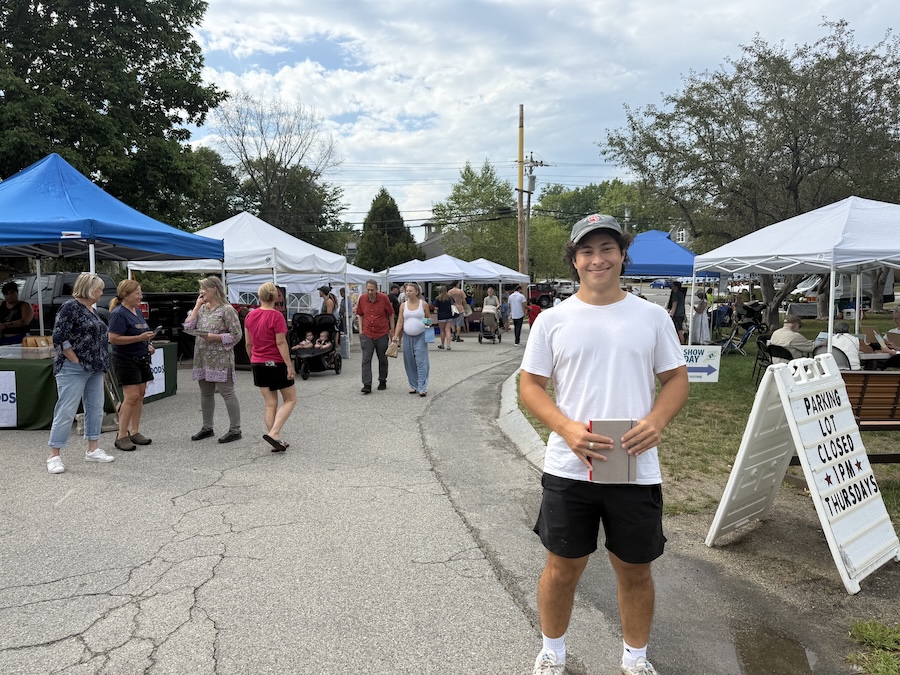
He received a fall research award from Bowdoin to help fund his travels across the state to visit farmers' markets and interview stakeholders.
Maine, often estimated to import 95 percent of its food, became the first state to enact a statewide food-sovereignty law. Four years later, voters approved an amendment enshrining the right to food in the state constitution.
These policies are designed to strengthen local control, Savel said, and to combat the “industrial corporatization and commodification of agriculture,” which he argues has led to lower-quality nourishment.
“Local food is more expensive because of our subsidized system,” he said. “The United States has continually subsidized durable foods that are high in carbs, high in fat, and high in sugar, because those are the foods that will keep people alive in times of crisis.”
Each fall, the Student Fellowships and Research office awards grants up to $2,500 to students pursuing research for independent studies or honors projects during the academic year.
The awards are supported by endowed funds set up by donors who wish to enable faculty-mentored research across the disciplines.
This year, the office gave awards to thirty-four students majoring in Africana studies, anthropology, biology, chemistry, classics, computer science, digital and computational studies, earth and oceanographic science, education, English, environmental studies, German, government, history, neuroscience, or Romance languages.
Maine’s Food Sovereignty Act makes it easier and less expensive for farmers and producers to sell vegetables, fruit, dairy, eggs, and value-added goods such as jams and pies by eliminating state regulations. While its mission is sound, Savel points to possible mixed outcomes: “some good effects and some bad effects across the state.”
The act gives municipalities the option to pass their own local ordinances. So far, 113 towns and cities have adopted laws allowing small-scale producers and farmers to sell food directly from farms or farm stands.
Mentored by Assistant Professor of Environmental Studies and Government Shana Starobin, Savel is trying to not only understand the law's impacts, he also wants to figure out why some municipalities pass local ordinances while others do not, and most likely never will—like Portland, Maine’s biggest and more progressive city.
In one of his case studies, he compares two nearby towns in southern Maine: Brunswick and Pownal. Brunswick has not passed a food sovereignty ordinance, while Pownal has.
“Brunswick is more agricultural than we think, but because it is wealthy and people here have a lot of food access, it wouldn’t necessarily benefit from a food sovereignty ordinance,” Savel said. “There are a lot of licensed farmers here already, and the act would increase their competition—allowing more small-scale producers to compete in the same area—and interfere with their market share.”
Also, if something goes wrong—“if one step in the food process is unsafe”—it could harm the reputation of all farmers, licensed and unlicensed, he added.
Largely due to these considerations, some statewide agricultural organizations, incuding the Maine Federation of Farmers' Markets, have come out against food sovereignty laws. The federation has worked for decades to build a positive reputation for farmers and is concerned that unregulated vendors could damage public perception, Savel explained.
He points to several factors that appear to drive communities to adopt food sovereignty laws. “The towns that tend to pass these, or did so early on, were small, agricultural, close-knit communities that essentially didn’t see a need for regulations and licensing because everyone knows each other,” Savel said.
Towns with food sovereignty policies are also, by and large, rural and remote, lacking easy access to grocery stores or other places to buy nourishing food. Portland, on the other hand, has abundant access to nutritious food through its many groceries and a wide network of licensed growers and producers, many of whom sell at local markets. Plus, it has a system in place to feed hungry people, with long-established nonprofits like Preble Street lessening the city's need to tackle food insecurity by making it easier for people to sell food.
Savel credits growing up in San Antonio, Texas, for his interest in food systems, an appreciation that deepened during his semester abroad in Florence, Italy.
“The biggest reason to visit San Antonio is its food traditions,” he said. “Food defines the culture there, it’s what people talk about, and a lot of culture is built around recipes with chilis, corn, eggs, and beans.”
In Italy, he was struck by how much local recipes are embedded in everyday life. “They have certified traditional recipes, passed down by families,” he said. “It is a food system where it's all about taking the time to enjoy quality, local ingredients. I thought, ‘Is this something we could build here to fight against the commodification of food that makes us one of the most obese and unhealthy countries in the world?'”
Overall, he sees value in Maine’s rights-based approach to food sovereignty legislation and hopes his project will add to more widespread understanding of its effects. He plans to submit his findings to an academic journal after completing his honors thesis next semester.
My “study will find the necessary conditions for these laws to be successful in US communities,” he writes in his grant application, and “offer insight into the broader potential of decentralized food governance across the US.”
Among many great classes, Savel said he particularly enjoyed the following three:
Talking to Farmers and Fishermen: Social Science Field Methods for Environmental Policy Research, with Shana Starobin. “It got me out there; it taught me how to interview people wth a kind, holistic view; and it made me socially bolder and less awkward! It's just having conversations with people.”
Urban Politics, with Ángel Saavedra Cisneros. “The class analyzed how municipal laws are put into practice and how stakeholders can effectively utilize their government or not. It got me thinking of town-level governance, which is one of the most potent movers of change in New England.”
Photography I, with Michael Kolster: “I think the class opens your mind to the different ways you can see the world.”