The inaugural cohort of Hastings Summer Fellows have been using and learning about various artificial intelligence (AI) tools during the break as they work faculty and staff on a wide range of projects, all of them aimed at making the world a better place.
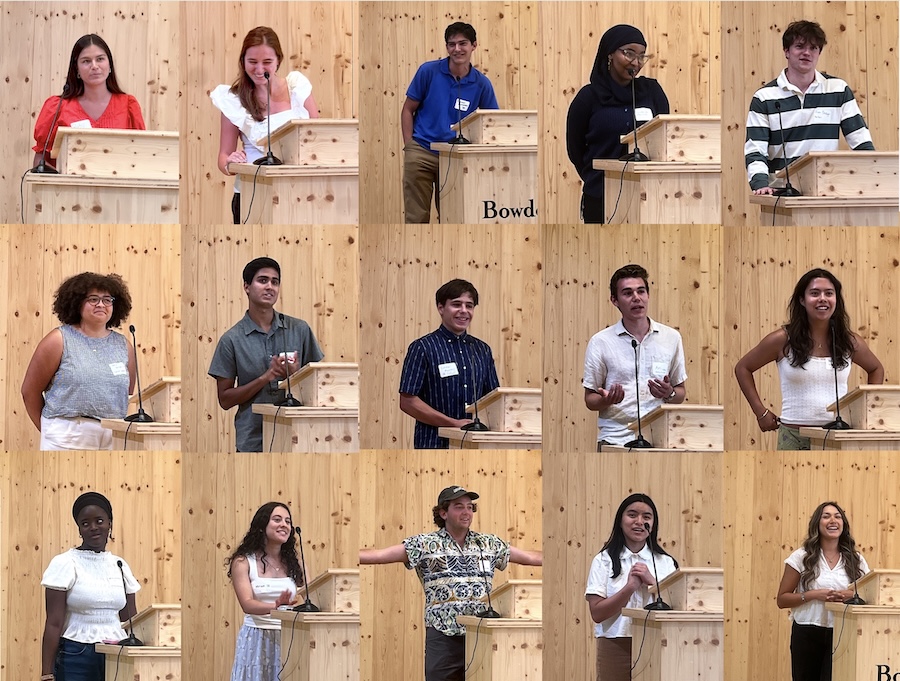
Five students are enrolled in the eight-week funded summer fellowship, launched this year as part of the Hastings Initiative for AI and Humanity (HIAIH).
The HIAIH began last year, thanks to a $50 million gift—the largest in Bowdoin’s 232-year history—from Netflix cofounder Reed Hastings ’83. The aim of the initiative is to ensure students graduate well prepared to lead in a world reshaped by this breakthrough technology.
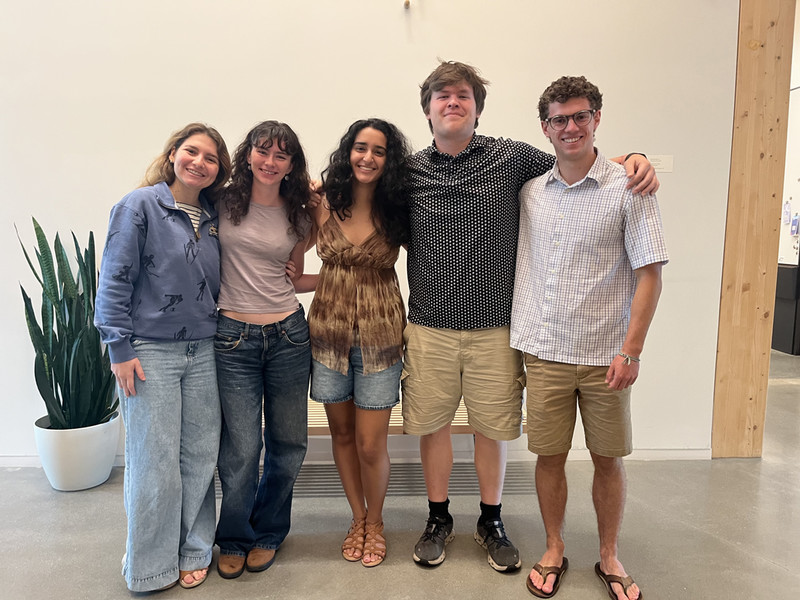
Meet the summer fellows and learn about their projects:
Camily Guimarães Carvalho ’29 is working on two initiatives helping Bowdoin faculty with their research:
She is assisting Peter M. Small Associate Professor of Economics Martin Abel expand his online project Ungated Research, a platform linking published economics articles to free working-paper versions. It uses AI to summarize and categorize the articles, thus helping researchers, such as those in low-income regions who may otherwise find their access blocked by a paywall. “Exploring creative software architectures to automate the identification of these working papers has been exciting,” said Carvalho.
She's also helping Hispanic studies faculty, including Professor of Romance Languages and Literatures Margaret Boyle, Assistant Professor of Romance Languages and Literatures Edie Adams, and Lecturer in Hispanic Studies Christian Puma Ninacuri, build an AI-powered Spanish-practice tool for students to use outside class, slated to pilot in elementary Spanish classes this fall. The aim is to support students with helpful advice on how to improve their skills so that they feel confident enough to speak, said Carvalho, an international student from Brazil. “The goal is not to substitute human connection but to provide students with a safe environment where, for a couple of minutes each day, they feel completely at ease making mistakes while the AI tracks areas for improvement and tests them, amplifying their learning process outside the classroom.”
In addition to these efforts, Carvalho, who intends to major in computer science and history, is working on a Hastings-funded personal project over the summer—the construction of an AI-powered database connecting low-income high school students in her native Brazil to a number of career-propelling opportunities to which they often do not have access in their under-resourced public schools. “Democratizing access to education is one of my passions, and it is definitely a meaningful use of artificial intelligence.”
Calvin Cecil ’28 and Sabina Gill ’29 are both working on a project under the guidance of Senior Lecturer in Russian, East European, and Eurasian Studies Reed Johnson, economist Martin Abel (see above), and Visiting Assistant Professor of Digital and Computational Studies Adrienne Kinney, who was hired in 2025 as part of the Hastings Initiative.
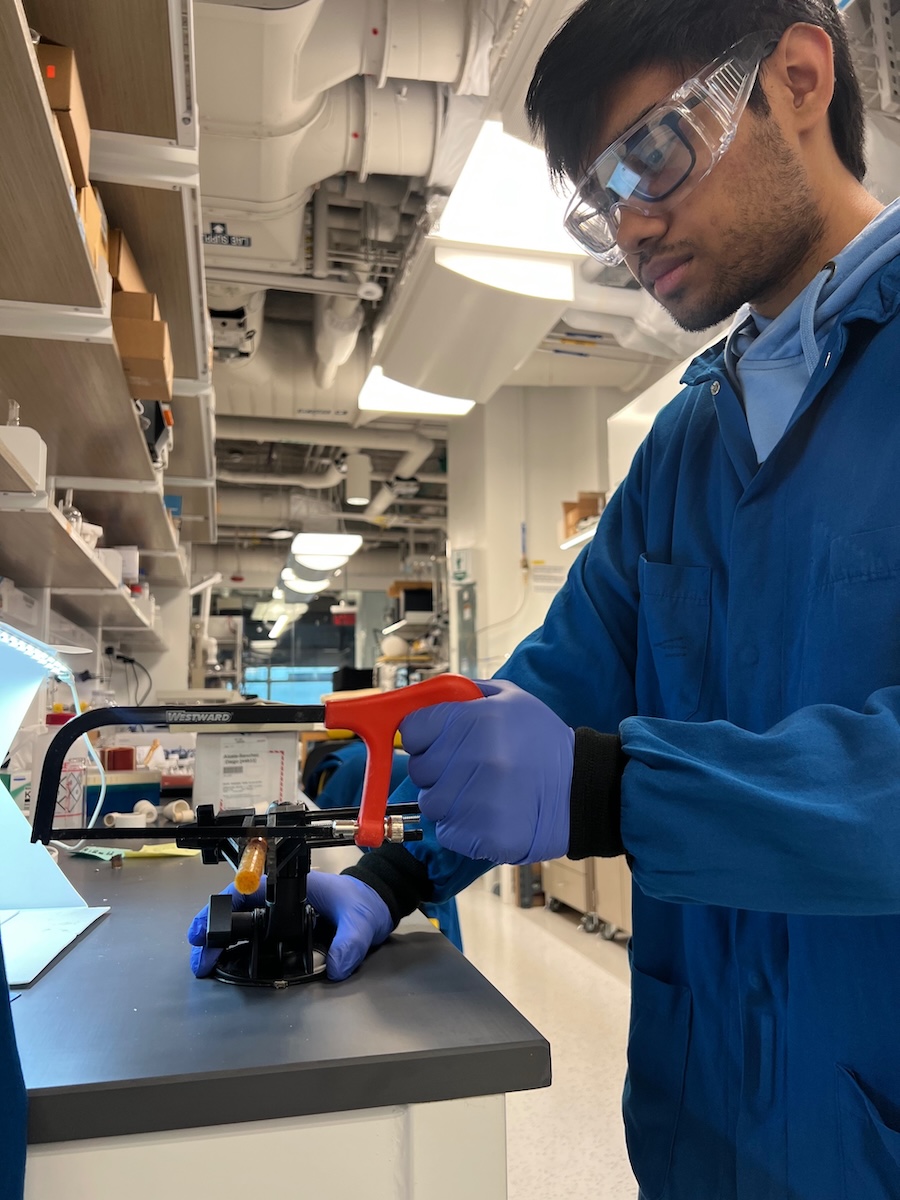
The project, which grew out of creative writing research Johnson and Abel have been involved with, is still in the development phase, and Cecil and Gill (alongside Andrew Mott ’26, who is not a Hastings fellow) have spent much of the summer setting up the technical side and getting the hardware ready to be rolled out. The aim is to help retired people record their life memories and recollections through a system they are developing. It works like this: It connects via special hardware to an AI-powered voice agent, which “interviews” the phone user using a series of questions or prompts and follow-up questions.
This creates an interview transcript, explains Cecil, which is cross-linked to other related information sources and updated after every conversation, enabling the participant to fact-check and edit the wiki as they see fit. The eventual result would be a self-published memoir. Writing and publishing an autobiography is inaccessible to most people, said the computer science and English major, “which is really sad because many valuable insights and memories are being forgotten.” Furthermore, he added, “the process of telling one’s own story is hugely fulfilling and human. So, this project seeks to allow more people to participate in that through the assistance of AI.”
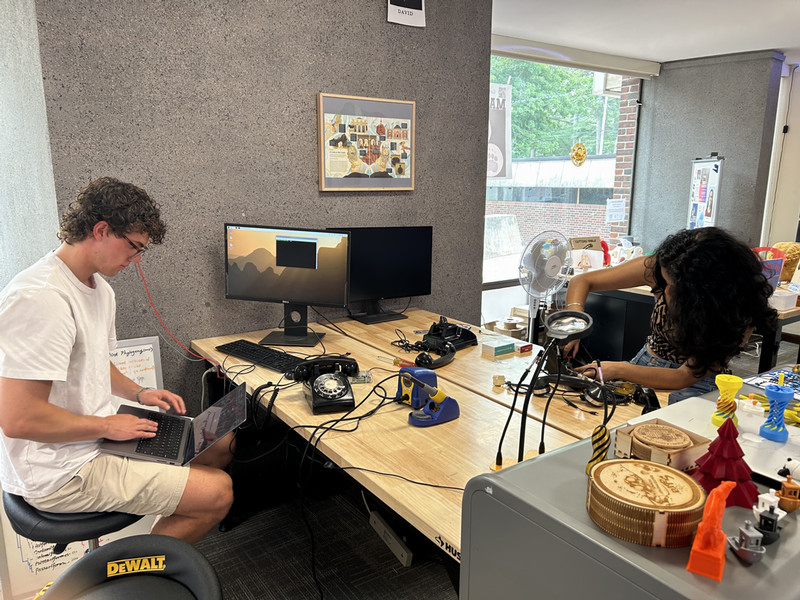
Gill, who is planning to major in computer science and economics, said she was drawn to the project because of its “human forward” nature. “It is not using generative AI to take away from human creativity. The story being told is entirely the subject's own, with AI as the mechanism that facilitates the conversation rather than shapes it,” she commented. “So much of the current conversation around generative AI focuses on what it can replace, but this project is about providing something to people who might not have otherwise had the chance to record their life story.”
Cecil and Gill say they have already started testing the product with a few participants, and the project is set to be scaled up in the fall. It’s important, they say, to remain aware of AI's limitations throughout the whole process, both in terms of creativity and its tendency to fabricate information, which is why human input remains central at every stage.
Aubrey Gifford ’28 has been working with Tina Chong, associate director of the Baldwin Center for Learning and Teaching, to build and pilot an AI "coach" app that helps students follow through on anti-procrastination goals, through daily check-ins and weekly reflections.
The aim, said the neuroscience and religion major, is to provide students with a comprehensive, evidence-based anti-procrastination program tailored specifically to each user's needs, and she hopes it will be ready by the fall.
Chong runs specialized anti-procrastination workshops on campus, and students who attend these, said Gifford, will gain access to a mobile app that allows them to continue implementing the strategies and concepts learned there. “The app is centered around goals that each student sets for themselves and includes features such as daily micro check-ins, weekly guided reflections, and an AI coach that delivers feedback in a way that best benefits the individual student, helping them achieve the goals they've set. I chose to work on this because I thought it was a cool opportunity to potentially see the tools that I work on directly benefit the student body.”
Henry Risch ’28 is assisting Professor of Economics Erik Nelson, who specializes in environmental economics, develop a public-facing interface for a greenhouse-gas-emissions tracking tool built on EPA and Department of Energy (DOE) data.
They are designing a research tool that uses AI to make the EPA's Greenhouse Gas Emissions Inventory—a comprehensive annual report that tracks US emissions— more accessible to the public and researchers. The project, said Risch, was motivated in part by recent actions from the current administration, including not publishing an annual inventory for the first time in thirty years, and dramatically scaling back the Greenhouse Gas Reporting Program that some eight thousand industrial facilities use to report emissions. The AI system, he explained, uses a tool that combines natural language processing with a searchable database of EPA documents, regularly updated fossil fuel use data from the DOE, and Python code, allowing users to ask questions about past and current emission rates in plain English and receive cited, validated answers.
“I was drawn to the project because it pushed me well outside my comfort zone,” said the environmental studies and economics major. “This work spans so many important subjects, like economics, environmental science, and software development, that I just couldn’t pass it up. As an environmental studies major, I've followed greenhouse gas reporting closely, so getting to work on the tools that could make that data more transparent and usable for researchers feels meaningful.
"Furthermore, to be able to use AI in a way that truly captures the College’s mission of pursuing the common good brings a lot of fulfillment to my work.”