Continuing our series of stories looking at artificial intelligence (AI), particularly generative AI, and how it’s taught across the curriculum, we’re going to focus on how one philosophy class approaches the issue.
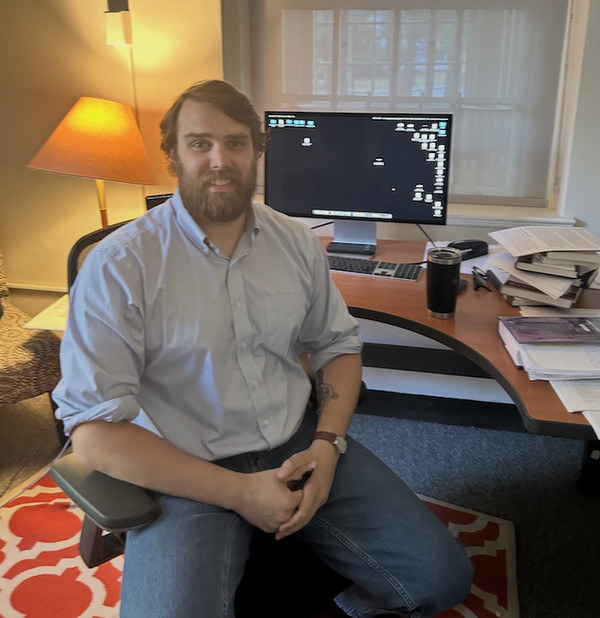
This semester, Postdoctoral Associate in AI and Humanity Collin Lucken has been teaching the self-designed course Minds and Machines: An Introduction to the Philosophy of Cognitive Science (PHIL 2400), which examines the philosophical underpinnings of science—particularly the study of the human mind.
It’s an area that is deeply intertwined with the concept of artificial intelligence and has been for a long time, says Lucken, who came to philosophy from a background in engineering and robotics and who was hired last year as part of the Hastings Initiative for AI and Humanity. Lucken took time out of his schedule to answer a few questions about the course.
What is cognitive science?
CL: Cognitive science is odd in that it doesn't have the kind of unified disciplinarity that most sciences do. The subject tends to exist across a handful of departments and disciplines—psychology, linguistics, computer science, philosophy, and even anthropology. It’s really a hodgepodge of theories and models and methods that are all roughly aimed at defining and explaining abstracts things like the human mind and intelligence.
So, the philosophy of cognitive science is….?
CL: Studying the philosophy of a particular science usually involves conceptual analysis of the central themes, which leads to several questions. In this case: What is cognition? Is it computation? Is it dynamical systems? What qualifies as evidence for hypotheses about the mind? If you make a simulation of a thinking agent, how much evidence could such a simulation give you about human cognition?
It’s also about studying the epistemological underpinnings of cognitive science and what its limits are. Some people think consciousness itself is not really something you can study scientifically. Others think you CAN study it scientifically. So, what would be the considerations one way or the other?
What prompted you to put the course Minds and Machines together, and what are its aims?
CL: We know we have minds, or we presume that we have them, right? So, what other kinds of things could have minds? For a while, people did not think animals had minds, then evolutionary theory came around, and it's like, “okay, well, if we're kind of part of the same process, it's likely that whatever they have going on is like a rudimentary version of what we have going on.” If you want to be theological about it, though, a mind is like a little slice of God in your brain, so what does this mean for animals? Do they have minds comparable to humans? Do they have souls? Philosophers like Rene Descartes (1596–1650) did not think so.
Which brings us onto machines and the debate around whether machines can have minds. Cognitive science got off the ground by applying a machine metaphor to minds, but as we discuss in the class, that move may not remain metaphorical much longer.


How central to the course is the idea of artificial intelligence?
CL: Artificial intelligence, as a concept, is there from beginning and is very closely linked to cognitive science. It massively predates generative AI—meaning the more autonomous ChatGPT-type stuff that creates its own content. In the class we talk and read about Charles Babbage (1791–1871). He was known as the “father of the computer,” who originated the concept of the digital, programmable, machine, where you input data and the machine makes a calculation and spits an answer back at you. We also look at the Macy Conferences on Cybernetics, which took place in the years after World War II, where scholars began to ask more sophisticated questions comparing cognitive functions to mechanical devices.
As to the debate around whether a machine could fully do all of the things a human mind does, it gets very thorny. The definitions of the words are so polysemous that to get a clear answer, you really have to talk about a particular person or a particular research program. For example, my students recently read a paper written in 1950 by the mathematician and logician Alan Turing, Computing, Machinery, and Intelligence, where he introduces the Turing test—a deep exploration of the question: Can a machine think?
At what point do you start to study the most up-to-date developments in generative AI?
CL: One of the goals of the class is to make sure that the students have good background understanding of the pre-generative AI era, what led to it and what’s different about tools like Chat GPT. We probably won’t start looking at generative AI until after Thanksgiving. That’s barely a month away now, but given how fast this field is evolving, who knows what further advances will have been made by then?
This is a philosophy class, so what I would really like the students to be sharpening are their basic liberal arts skills, using logical argumentation, concise sentences, and conceptual analysis. I would also really like them to be able to assess for themselves all the claims that are out there about AI. Does what you are hearing make sense? It’s all about asking the right questions.
“First I would suggest Gilbert Ryle’s Concept of Mind. It’s not about AI at all, but anyone curious about minds should read it first. It’s a wonderful book!
“Another non-AI book is my teacher Tony Chemero’s recent Intertwined Creatures. It’s short and very clear and has wonderful resources for resisting some of the more obnoxious AI narratives floating around.
“For some short fiction, I recommend Isaac Asimov’s The Last Question and Harlan Ellison’s I Have No Mouth, and I Must Scream."
Related Stories
-

-
-
 October 01, 2026The Hastings Initiative for AI and Humanity recently brought together four people whose lives center around creativity to consider an old question in light of new technology: What is creativity? And how might it change with the rise of artificial intelligence?