“We are now at an inflection point,” said Munmun De Choudhury, “because AI is no longer just a tool, but an active player.”
A leading researcher in computational social science and digital mental health, she came to campus on September 23, 2026, to talk about the increasingly important role that generative artificial intelligence is playing in the treatment of mental health.
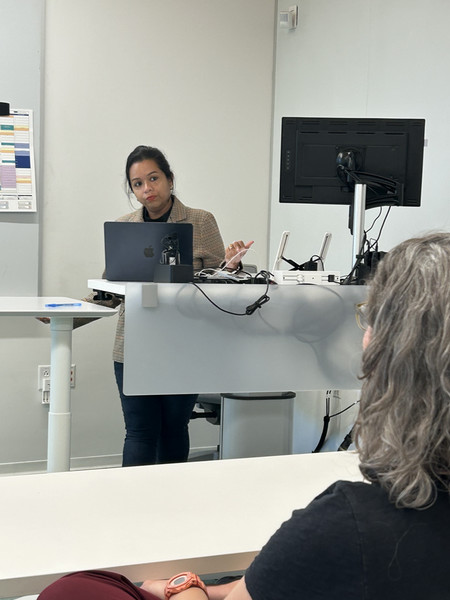
De Choudhury’s talk, “A Human and Humane Vision for AI and Mental Health,” was sponsored by the Hastings Initiative for AI and Humanity at Bowdoin College. Launched in March 2025, thanks to a $50 million gift from Netflix cofounder Reed Hastings ’83, the initiative aims to ensure students graduate well prepared to lead in a world reshaped by this breakthrough technology.
To be sure, said De Choudhury, the last ten years or so have seen considerable progress in tackling mental health issues. Some of this progress is due to the destigmatizing of the subject in much of the world, she explained, and some is due to technology, particularly the growth of social media apps, which can encourage people to be more open about their struggles. “The act of disclosing a condition on social media can have tremendous benefits. People find that just being able to talk to an invisible audience on a platform that is not going to be judgmental can allow them express what they're going through—something they may not be able to do elsewhere.”
Which bring us to the current inflection point, remarked De Choudhury, as advances in generative artificial intelligence drastically change our relationship with technology.
“This tech is now changing almost every day,” she stressed. The impact of AI tools like ChatGPT, which was introduced four years ago, means that platforms such as Reddit have gone from “a place where people can socially connect to a place where AI mediates those connections.” Consequently, today we are seeing AI as no longer simply a background tool, but often as a source of companionship and empathy, providing advice on life and what people might be going through.
While AI tools definitely have their uses in helping with mental health challenges and will doubtless continue to improve, said De Choudhury, they will never be able replace a human therapist because they will never have the same experience as a human. As people increasingly turn to AI for emotional support, she asked, what does it mean for a system without lived experience to become a trusted source of care? And when does support become dependence?
One area of concern De Choudhury highlighted was AI safety and the fact that, while it can be helpful for people to unburden themselves, even to a tech platform, “We still haven’t figured out what to do when a person expresses suicidal thoughts. Whose responsibility is it to take action? What should tech companies do?” We don’t yet have good answers to these questions, she observed.
"Freud said the very act of talking to another human being can be healing. So talking to a machine takes away a fundamental human aspect of what works and what humans are good at."
De Choudhury, who sits on a special task force advising the World Health Organization (WHO) Commission for Social Connection, said the future of AI and mental health should not be about making AI more human. “It should be about using AI in ways that preserve what is human about mental health and care.” Central to her current research is an awareness of the dangers of using technology to replace human empathy. An AI therapist, she warned, does not provide the friction or the pushback that a human does, instead being more likely to behave sycophantically, providing approval or even flattery to the subject, as opposed to the objective truth. “Friction is important for social relationships. When we experience friction, it strengthens us psychologically,” commented De Choudhury, “whereas AI can erode the fundamental notion of how we connect with each other.”
Sarah and James Bowdoin Professor of Digital and Computational Studies Eric Chown was among those in attendance at De Choudhury’s lecture. “One of the things I really liked about the talk was that she didn’t stake out either an ‘AI is bad’ or ‘AI is great’ kind of position. She carefully guided us through the research that shows that AI is very useful in some ways and clearly harmful in others,” said Chown, who is faculty director of the Hastings Initiative.
“As a DCS professor, I especially liked her discussion of what is lost when someone talks to an AI ‘therapist’—human connection of course, which is critical to mental health. I’m very worried that people feel the need to turn to AI for help with mental health, not only because using AI that way is potentially so dangerous, but also because it seems like a failure in our larger society. AI and mental health have become so intertwined,” he added, “that it is really imperative to start having more conversations about them.”
Related Stories
-
-
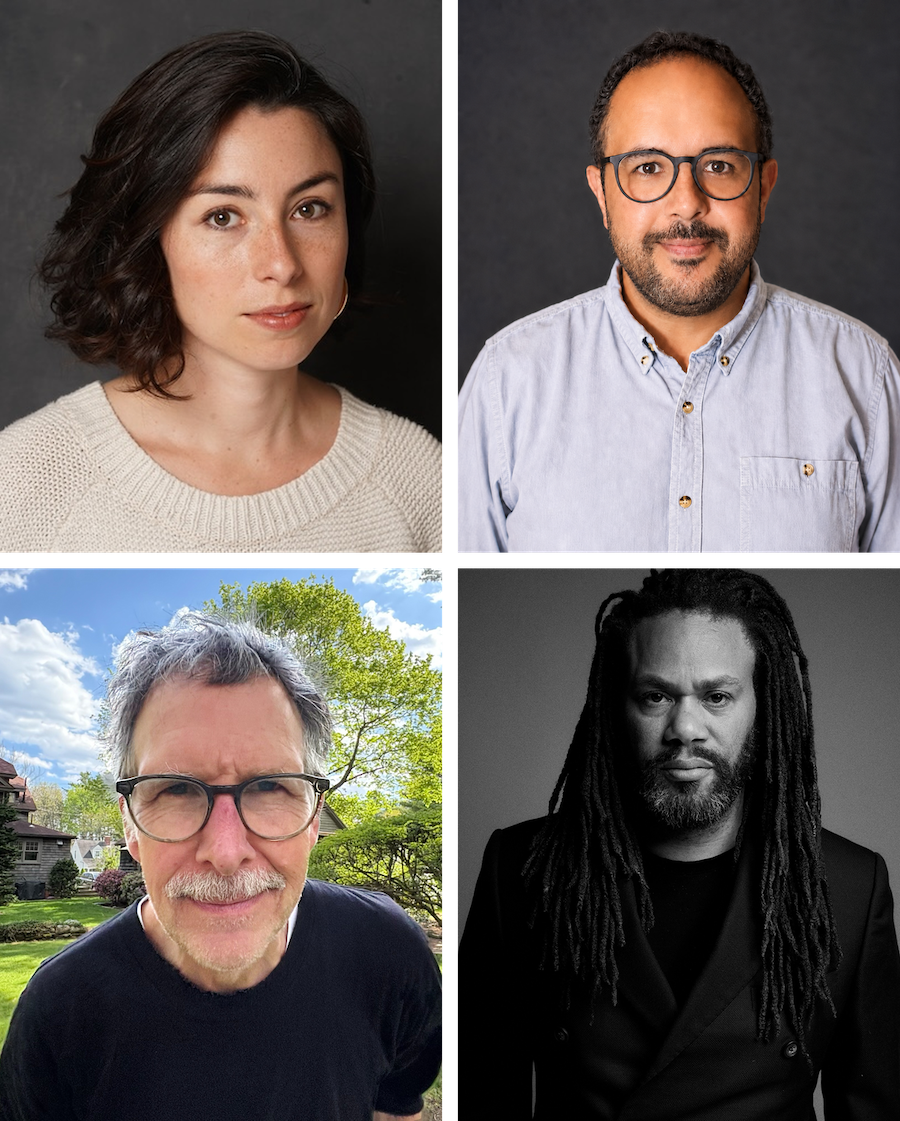 October 01, 2026The Hastings Initiative for AI and Humanity recently brought together four people whose lives center around creativity to consider an old question in light of new technology: What is creativity? And how might it change with the rise of artificial intelligence?
 -