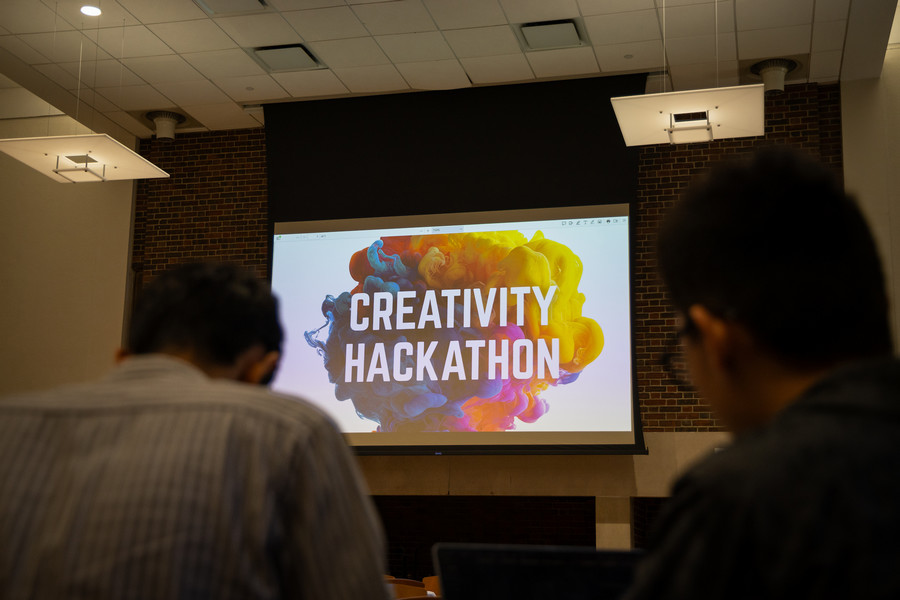
The Hastings Initiative for AI and Humanity recently brought together four people whose lives center around creativity to consider an old question in light of new technology: What is creativity? And how might it change with the rise of artificial intelligence?
The conversation, held in Daggett Lounge on September 29 and open to students, staff, and faculty, reflected the Hastings Intiative's focus this year on creativity.
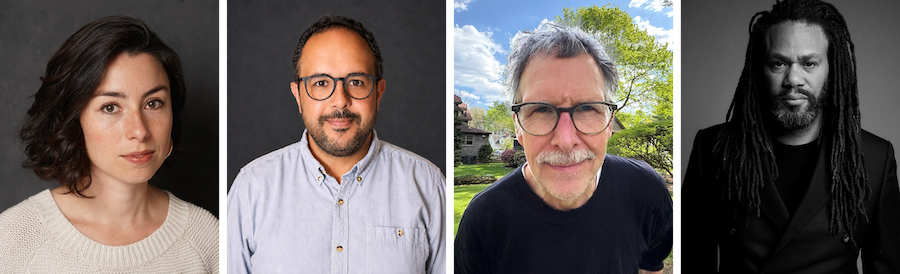
The four panelists work in different media—prose, music, photography, and film. They included Assistant Professor of English Jordan Kisner; Bowdoin's A. LeRoy Greason Assistant Professor in the Creative Arts Badie Khaleghian; Bowdoin's Richard E. Steele Professor of Studio Art Michael Kolster; and special guest Franklin Leonard, Bowdoin's inaugural Herman S. Dreer Leadership Fellow. An influential film and television executive, Leonard is the founder of The Black List.
Over the course of the hourlong exchange, they described how they have used—or avoided—AI in their work, considered what defines creativity, and explored how artificial intelligence might transform the arts and us.
Kisner, an essayist and reporter who teaches creative writing at Bowdoin, was emphatic: “I do not use AI in my practice.”
“AI works against our field, our craft, and to some extent our natural creative capacity,” she said.
Beyond her concerns about AI generating hallucinated information, Kisner said she worries that the technology can subtley push people toward more homogeneous ideas and language. She cited research finding that people who engaged with AI produced a narrower range of ideas in response to prompts than those who worked without it.
Composer and multimedia artist Khaleghian acknowledged that unlike Kisner, he uses machines to make his art. Technology, he added, has long transformed how music is made and shared, starting with the first recording device in the nineteenth century. Before we could capture music to replay it—these days often in our ear pods—people had to be with musicians in the spaces where they performed.
Likening AI to those recording devices, he said both technologies have served to sever creator from creation.
He then noted that to decide whether artificial intelligence can be creative, we first need to understand creativity and intelligence. He referred to the book The Runaway Species: How Human Creativity Remakes the World, to talk about creativity as a process of bending, blending, and breaking ideas and forms inherited from the past.
Intelligence, meanwhile, “means for me as an artist, framing the problem, recognizing what matters, anticipating consequences, and deciding when something should stay, be transformed, or be deleted,” he said.
Photographer Kolster pointed to one essential quality that for him distinguishes human creativity from AI: uncertainty. “I haven't been able to find uncertainty in the way LLMs [large language models] are set up, though I think uncertainty fuels a lot of human creativity and human life.”
Embracing mystery and reaching beyond fact and reason, he said, drives scientists and artists. Both seek to discover what exists beyond our knowledge or to create something new. “We judge the value of science by the ignorance it defines,” he said.
Translating this process of exploration and discovery into a form others can experience is also fundamental to human creativity, Leonard suggested. “I believe the purpose of art is to explicate on some level what it means to be human and to articulate that to another human being,” he said.
AI, by its nature, cannot do that. He also described the technology as fundamentally backward-looking, because it draws on what has already been created. “It’s not reflective of all that can be made,” he said.
Leonard said he does not believe AI will write the next generation-defining novel or great film. But he does expect it to fuel an explosion of written material, leaving humans with another challenge: discerning what in that vast output is actually worthwhile.
“How do we as humans wade into this superabundance of material and find the good things?” he asked.
A gleam of positivity in this norm-shattering time, he continued, is the way AI is pushing us to have conversations like this one: where we strive to understand and appreciate human creativity and its role in our lives.
Kolster couldn't help inserting a little joke here. We will only do that, he said, “if the electrical grid survives.”