From Vision to Impact: One Year of the Hastings Initiative for AI and Humanity
By Bowdoin NewsWithin the College, the rise of artificial intelligence has not just prompted new programs, it has sharpened a long-standing institutional question: what kind of education prepares students to navigate complexity, ambiguity, and rapid technological change?
“We need more than ever students who understand ethics, who understand complexity, contingency, who welcome and learn from multiple perspectives, who resist flattened-out explanations,” said Bowdoin College President Safa Zaki at her inauguration in October 2023.
One of the central arguments of that address and part of her overall vision is that the proliferation of artificial intelligence (AI) makes a liberal arts education more relevant than ever. A psychologist and cognitive scientist, Zaki has long been engaged with the kinds of questions artificial intelligence raises about what it means to be human.

Speaking more recently with a group of alumni, Zaki said she “can't go an hour of a day without thinking about human cognition.” It is something that has made her acutely aware of the core questions AI asks of society: “What does it mean to be human? What does it mean to have inequity?”
To address these issues, she stressed, “we need to lean into the power of the full liberal arts.” Zaki’s leadership in this area has shaped Bowdoin’s vision for engaging with AI—one she describes as “grounded in the power of the liberal arts and drawn from the widest range of disciplines and the fullest scope of knowledge.”
A major step in articulating this vision is the Hastings Initiative for AI and Humanity, which was launched a year ago, on March 24, 2025, thanks to a $50 million gift—the largest in Bowdoin’s 232-year history—from Netflix cofounder Reed Hastings ’83. The aim of the initiative is to ensure students graduate well prepared to lead in a world reshaped by this breakthrough technology.
-
 Bowdoin is proud to announce a $50 million gift—the largest in our 231-year history—from Netflix cofounder Reed Hastings ’83 to launch the Hastings Initiative for AI and Humanity.
 Read more from The New York Times:
“Netflix’s Reed Hastings Gives $50 Million to Bowdoin for A.I. Program”
“This gift,” said President Zaki, “has allowed us to begin this work in earnest.”
Realizing the Vision
When asked to describe the full potential of artificial intelligence, Eric Chown, faculty director of the Hastings Initiative, likes to draw inspiration from an ancient Greek scholar. “Archimedes once said, ‘Give me a place to stand, and a lever long enough, and I shall move the earth.’ Well, AI is a very long lever indeed.”
The technology is capable of so much, both good and bad, that it is imperative we learn how to harness it for the common good, says Chown, who is also the Sarah and James Bowdoin Professor of Digital and Computational Studies.
“On the one hand, it presents so many opportunities for individuals to do things that weren’t possible even a few years ago, or even a few months ago! And, on the other, it brings so much potential for harm by amplifying inequities and contributing to environmental problems.
“It is essential that we equip our students to learn how to engage with AI productively,” asserted Chown. “Sometimes that means using it wisely, sometimes it means critiquing it, or suggesting new guardrails to help ensure it isn’t abused. The Hastings Initiative gives Bowdoin a huge leg up toward providing students the education and opportunities they need to not only be productive citizens in this new world, but also to be leaders that can help shape it.”
The Ethics of AI
Bowdoin makes available to students, faculty, and staff a number of AI tools. To help students consider the ethical implications of using generative AI beyond basic terms of agreement, a team comprising students, faculty, and staff from Information Technology, the library, and the Baldwin Center for Learning and Teaching worked with faculty governance to create the course Ethical Considerations—Using Generative AI Responsibly at Bowdoin and Beyond.
The course, which is required of students looking to access Bowdoin’s AI tools, includes eight interactive chapters that help students look critically at the ethical issues involved and engage thoughtfully when deciding to use generative AI. Post-course surveys of students show a significant increase in participants’ consideration of ethical issues. All faculty and staff are welcome to take the course and are encouraged to do so. Other institutions have expressed a strong interest in the course and have requested permission to use it with their own students.
Grants
Joe Gaetano ’27 wants to make it easier for nonprofits to find and connect with sources of funding. With the help of a grant from the Hastings Initiative, he is developing an app using Anthropic’s Claude Code to streamline the fundraising process and ease pressure on already lean investment teams.
“My interest in doing this started in the class Technology and The Common Good, where we worked with nonprofit organizations and got to hear real feedback on what organizations are struggling with today,” said Gaetano.
He is one of several students using Hastings grants, worth up to $1,000, to create meaningful change using AI technology:
 Others include Athalia Esty ’26 and Subi Kalra ’26, both pursuing honors projects under Assistant Professor of Economics Martin Abel, who is a member of the Hastings Initiative Advisory Committee. Esty’s project explores gender differences and competitive pressure in AI adoption while Kalra is conducting an experiment to see how people change their beliefs and behavior in response to information about the environmental impacts of AI.
- Prathit Kurup ’26 and Andrew Mott ’26 organized a recent workshop to help students to understand and enhance their usage of generative AI tools and thoughtfully to consider the implications of AI as liberal arts students.
- As of part of his senior honors project, Mingi Kang ’26 is developing a novel algorithm. Called Convolutional Nearest Neighbors, it aims to bridge the two dominant concepts in artificial intelligence, an idea that has significant implications for the development of more efficient artificial intelligence systems.
Additionally, the initiative has enabled the College to hire six students as Hastings ambassadors, which has the dual use of helping to further the education of those six students while they help to educate the campus. At the end of the spring semester, an additional five students will be taken on as Hastings Summer Fellows and spend time working on AI-related projects.
Many faculty members are also using Hastings grants to further their AI-related research. By the end of the first year, the Hastings Initiative had funded more than thirty faculty grants, ranging from $165 up to $5,000. The College has now embarked on a second round of faculty funding.
New Hires
- Ten new faculty positions are being funded across multiple disciplines. These include anthropology, biology, computer science, earth and oceanographic science, education, government and legal studies, Latin American, Caribbean, and Latinx studies, mathematics, neuroscience, and philosophy.
- The initiative has also supported two postdoctoral and two postbaccalaureate fellows.
Collaboration
Bowdoin has reached out to a number of schools to collaborate on events. Professor Chown, for example, has launched a webinar series with faculty from Carleton, Colby, and Connecticut Colleges. “I meet regularly with those schools to discuss ways we can share ideas and resources,” says Chown, who is also planning to organize a conference at Bowdoin later this year, bringing in more expertise from other liberal arts schools.
On the student level, the Hastings Initiative hosted a “hackathon” on the Bowdoin campus in October 2025, also bringing in students from Bates and Colby, giving them the chance to use AI tools to tackle a number of challenges—one team, for example, designed an app to help people reduce their carbon footprint—and to get advice from outside experts.
Another of the initiative’s notable features is the Environmental Impact Hub, which explores the hidden cost of AI and the increasing toll that the technology’s energy demands are taking on the environment.
Education
- The initiative sponsors a wide range of programming, including guest speakers, symposia, and workshops.
- Upcoming events include an April 15 alumni conversation Human First, focused on leadership skills AI cannot replace.
- Visiting speakers have included MIT researcher Joy Buolamwini, author Brian Christian, World Bank economist Elif Nisa, and Sam Nordberg ’99, exploring topics from algorithmic bias to AI in health care.
- An early April workshop led by Leo Anthony Celi (MIT/Harvard) will focus on health data and fairness.
- Ongoing opportunities include weekly drop-in sessions on LibreChat, Bowdoin’s secure AI platform, open to faculty and staff.
Looking Back, Looking Forward
“This first year of the initiative was exceptionally fruitful,” said Assistant Professor of Digital and Computational Studies Fernando Nascimento, who sits on the initiative’s faculty advisory committee and whose research includes the intersections of digital technology and ethics. “We’ve seen many new research projects, innovative ways to involve students in the ethical discussions on AI, several insightful conversations with external experts, and a fantastic winter workshop for faculty. These efforts,” he added, “reinforce the initiative's original impetus of inviting the entire Bowdoin community to critically engage and shape this technology, through the liberal arts."
Looking ahead, Zaki is clear about the scale of the moment. “The coming tsunami is huge, and we need to be ready,” she said, reflecting on how Bowdoin can lead in a world being rapidly reshaped by AI.
That leadership, she emphasized, begins with students. “The best way that Bowdoin leads is by graduating students that go out and make a difference in the world.” Through the Hastings Initiative, she added, the College is helping to secure that future “by clarifying the role of the liberal arts in this changing world.”
-
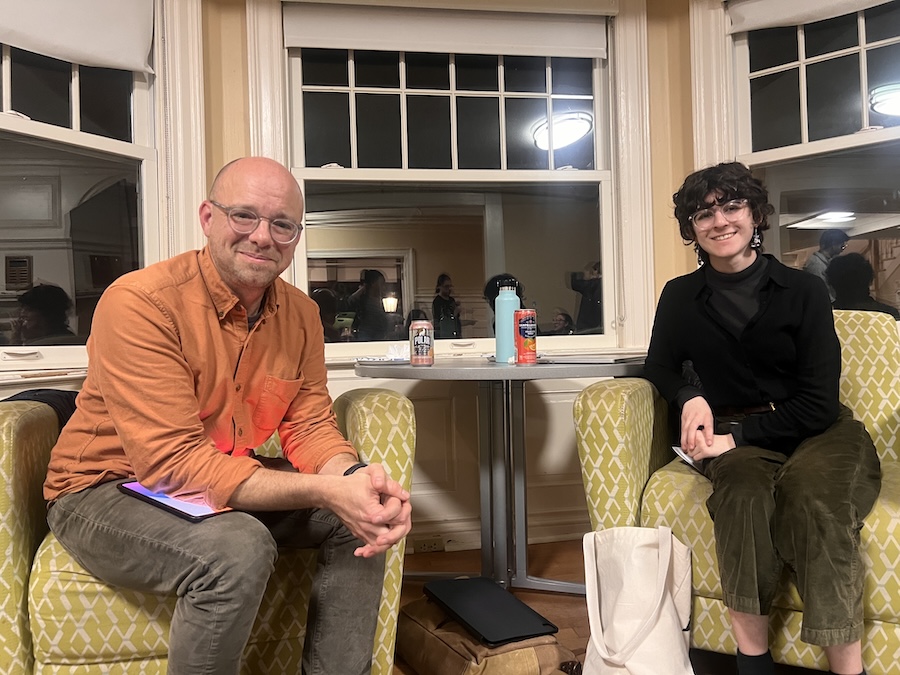 Students recently gathered for a facilitated discussion in Baxter House to explore AI’s impact on creativity, expressing both open-mindedness and apprehension about the technology's role in the future of art.
 -
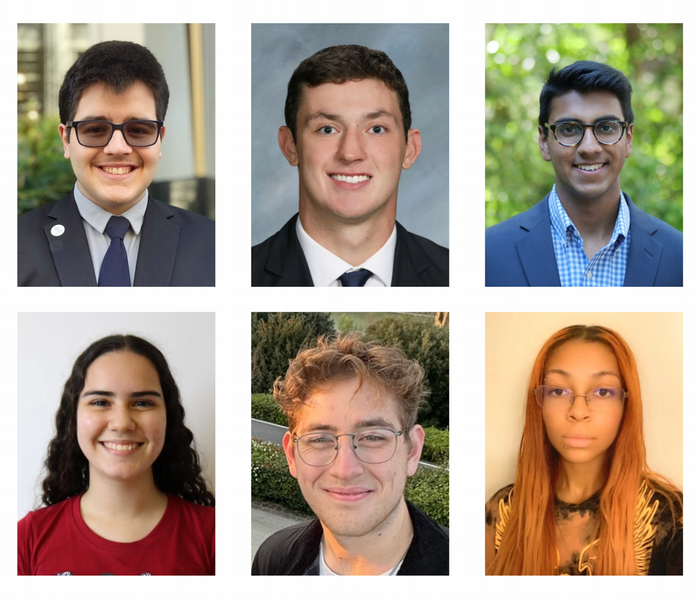 The six students will play a crucial role as peer educators, acting as a bridge between the student body and the Hastings Initiative team. They will support programming, outreach, and resource development designed to help their fellow Polar Bears engage thoughtfully with artificial intelligence and its ethical implications.
-
 A nationwide project involving faculty from fifteen colleges and universities aims to design new courses that address the ethical implications of artificial intelligence technologies.
 -
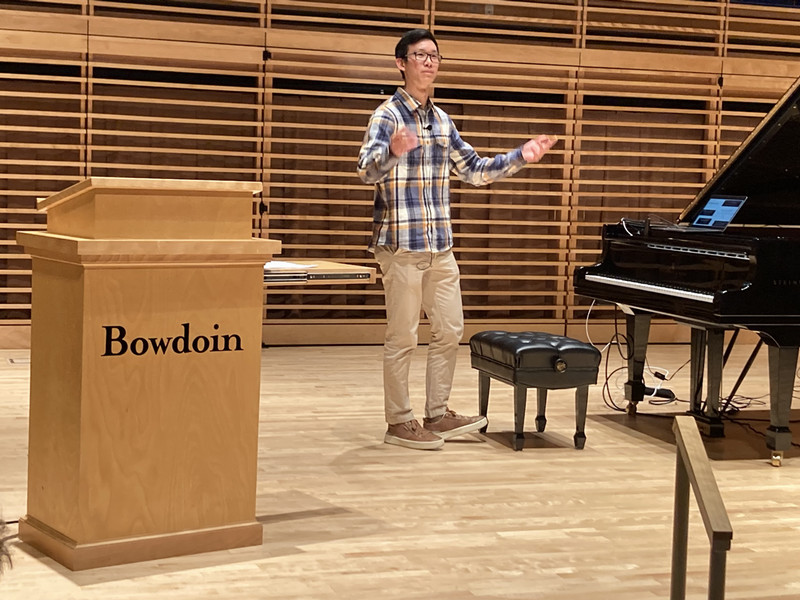 Music and artificial intelligence (AI) both provide modern students with tools for exploration and creativity, says math and computer science major Brian Liu ’25, who is also a gifted concert pianist.