Two outside experts recently shared their insight into the fast-changing world of artificial intelligence. In separate events, they looked at the impact of AI on health care and how embracing the humanities can help prepare students for a world dominated by AI.
The guests were brought to campus in mid-February as part of the Hastings Initiative for AI and Humanity, launched by the College last year thanks to a $50 million gift from Netflix cofounder Reed Hastings ’83, with the aim of ensuring that students graduate well prepared to lead in a world reshaped by AI.
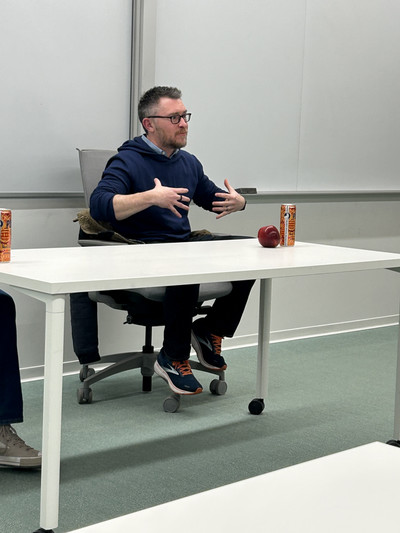
Dr. Sam Nordberg ’99, chair of psychiatry and behavioral health at Atrius Health and Reliant Medical Group, joined students, many of them on a premed track, for an informal chat exploring how AI is transforming health care.
Nordberg’s own career path took a somewhat circuitous route, he explained. After majoring in economics and computer science at Bowdoin, Nordberg chose a financial career and landed a Wall Street job that found him in the north tower of the World Trade Center on 9/11. “My life took a big turn,” he said. “I remember being under a table and thinking ‘If I get out of this, I’m going to go do something with my life.’ That’s not a knock on finance careers,” added Nordberg, “I really enjoyed the work I was doing, but I wanted to find something that meant more to me.”
Nordberg subsequently worked as an EMT in New York City, where he saw how inadequate the system was for treating people with mental health problems, and this set him on his current career path, he explained. Now, in his role as a prominent clinical psychologist and behavioral health specialist, Nordberg plays a key part in managing the primary care of about a million patients in Massachusetts (that’s about one in six of the population). “We do everything but the hospital,” he explained.
The US health care system is in crisis, however, he warned, due to spiraling costs and mounting demand for its services. “We are hopelessly outgunned when it comes to managing, in particular, the mental health needs of our patients. Post-pandemic mental health in the United States has gotten consistently worse, and anxiety disorders now represent a massive number of of folks in the US—about 20 percent of us.”
This is where AI is coming in to play and can offer real hope, said Nordberg, and it’s a solution increasingly embraced by the program he works on. “We are starting to build more and more either direct care or physician support technologies using AI and digital tools.” These tools, if properly applied, he stressed, can play a key part in diagnosing, treating, and managing health care needs at a much-reduced cost, while also easing the strain on overworked doctors and therapists.
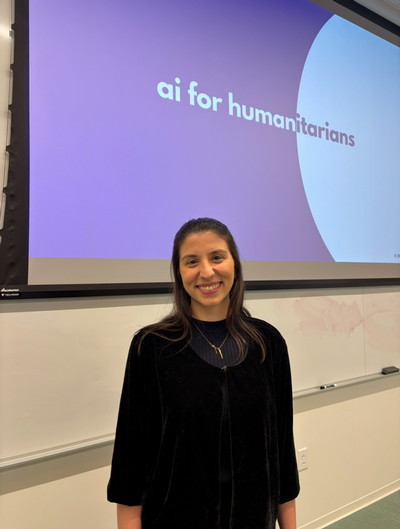
Elif Nisa Polat works at the World Bank Group, where she manages the organization’s transition to AI systems. She delivered a formal lecture to the Bowdoin community titled “Your Humanities Training Prepared You for This Moment.”
Polat shared her journey from studying international relations to building AI products for global institutions, emphasizing how humanities training prepares students for the AI transition and how to make career choices that fit their lives.
“I believe magic happens when the humanities meets with AI,” Polat told the audience. In this regard, she added, Bowdoin students are fortunate in that they are able to major in two completely different disciplines and can therefore speak to two different worlds. “You have no idea how lucky you are,” Polat told them. “I believe that humanities graduates have an advantage in securing jobs in AI, because you need to know how to communicate.”
She also observed that, thanks to AI, “For the first time in the history of software development, nontechnical folks can build software.” Thanks to AI tools like Anthropic’s Claude, it is now possible to design a range of online products, but, Polat stressed, it’s very important that students know what questions to ask and what prompts to use, which comes back, again, to having knowledge and communication skills. “If you’re a good writer, you know what to ask, so you can really use the tool effectively.”
The bottom line, she concluded, was this: “AI is way too important to leave in the hands of software developers alone. People who study ethics, history, anthropology, politics—people who understand what it means to be human—also need to play a role.”
(With additional reporting from Delaney Jones ’26)
An online panel discussion looking at AI and the liberal arts took place early in February featuring Sarah and James Bowdoin Professor of Digital and Computational Studies Eric Chown, who is also the faculty director for the Hastings Initiative. He was joined by colleagues from Colby College and Connecticut College. The panelists explored collaborative approaches to AI integration across liberal arts campuses and the challenges of assessing student performance in the age of artificial intelligence.
“One of the ways the liberal arts has a real advantage in terms of coping with AI,” said Chown, “is we have smaller classes, we have more face-to-face time with students, and that’s really the heart of getting to know what someone can do. I think it really boils down to those face-to-face conversations.” Listen to the webinar.