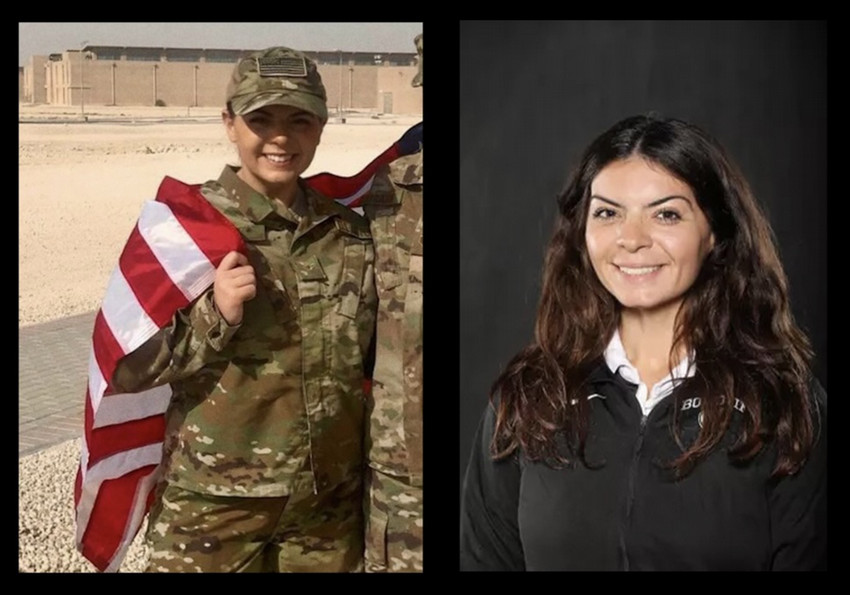
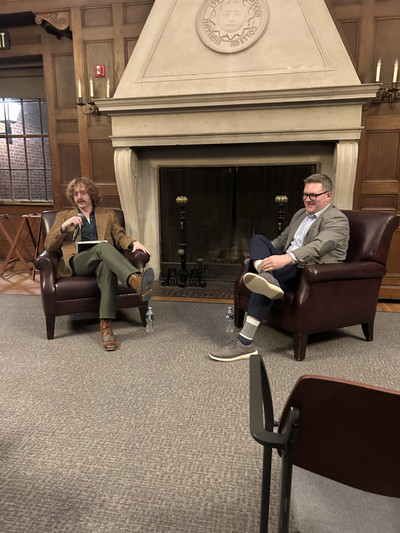
The newly formed Bowdoin Student Veterans Group recently invited former US Marine John Boerstler onto campus for a community conversation in Moulton Union’s Main Lounge.
The event, titled “Enlisting Perspectives,” took the form of a conversation between Boerstler and fellow USMC veteran Daniel Hennelly ’26 about Boerstler’s transition from the military to college to a career in public service, offering some leadership tips on along the way.
“I joined the Marines because I wanted to do something different, have some adventures,” recalled Boerstler, “but I was only seventeen, so my dad had to sign the papers.” The papers were signed, he said, on the understanding that he would go on to college. Boerstler’s military career saw him deploy as an infantry unit leader, serving tours in Iraq and East Africa. Also, keeping the promise he had made to his father, he enrolled at Texas A&M University, earning a bachelor’s in political science before heading to Washington, DC, to work as a congressional staffer.
Like Bowdoin, Texas A&M is a very community-centered institution, fostering a true sense of belonging, explained Boerstler, and in this regard, transitioning out of college is not unlike transitioning out of the military, where you are also part of a close-knit team. “For four years, everything is provided: accommodation, food, friends, work, it’s all there—then it’s gone.” That, he stressed, is why connecting with networking entities, be they alumni organizations or veterans’ groups, can be helpful in managing the transition to life “on the outside.”
After electoral defeat put an end to his stint on the Hill in 2009, Boerstler, determined to continue in public service (“I’m a sucker for service”), returned to his native Texas, where he was an advisor to two mayors of Houston. He went from working on federal policy issues to “trying to coordinate basic needs like trash pickup,” he reflected. During this time, Boerstler also threw himself into veterans’ issues, founding the Lone Star Veterans Association in 2009, and it was in his capacity as a veterans’ advocate that Boerstler first met Daniel Hennelly, recalled the latter. “Without John’s help when I got out of the Marines ten years ago, there’s a good chance I wouldn’t be where I am now,” said the Bowdoin senior.
After obtaining a master’s in public administration, Boerstler went on to work in the nonprofit sector, working on veterans’ issues, among other things. He is also a recipient of both the Eisenhower and Marshall Memorial Fellowships, having traveled globally to compare and develop military to civilian reintegration systems. This involved a three-year project in Ukraine to assist in the country’s development of their Ministry of Veterans Affairs. In 2021, Boerstler was appointed the chief experience officer and assistant secretary at the United States Department of Veterans Affairs, a post he held for nearly four years. He now works in the private sector, holding a senior position at a global software company.
Following the conversation with Hennelly, Boerstler took questions from the audience, which included a number of Bowdoin’s student veterans. One of them talked about the difficulty he sometimes has in communicating his military experiences to those around him and the disconnect that can happen when people from a military background return to the civilian world. This reminded Boerstler of advice he got from a retired army major about how to modify his résumé for civilian employers. “This guy was like, ‘Dude, your résumé smells like combat,’ [because] I had listed all the weapons systems I was qualified in,” something that Boerstler realized would mean little to a potential civilian employer—in fact it might even scare them! Boerstler set about translating his résumé into more everyday language, stressing the project management skills that being an infantry squad leader requires, “Because, if you’re a sergeant or above, you’re a project manager,” having managed millions of dollars’ worth of government equipment and been in charge of a number of people in challenging situations.
On the subject of integrating veterans into college classrooms, Boerstler urged faculty to get the most out of them: “Push them to talk; they probably have perspectives and experiences that everyone could benefit from hearing.”
When asked about leadership, and what lessons he had learned from his military experience, Boerstler said that as a Marine sergeant he sometimes had to yell at people but tried to avoid it as much as possible. “Just be good to people,” he said. Other important lessons: “Exercise every morning and change your socks at least once a day, maybe twice.”
More information on Bowdoin's veteran and active service member benefits.