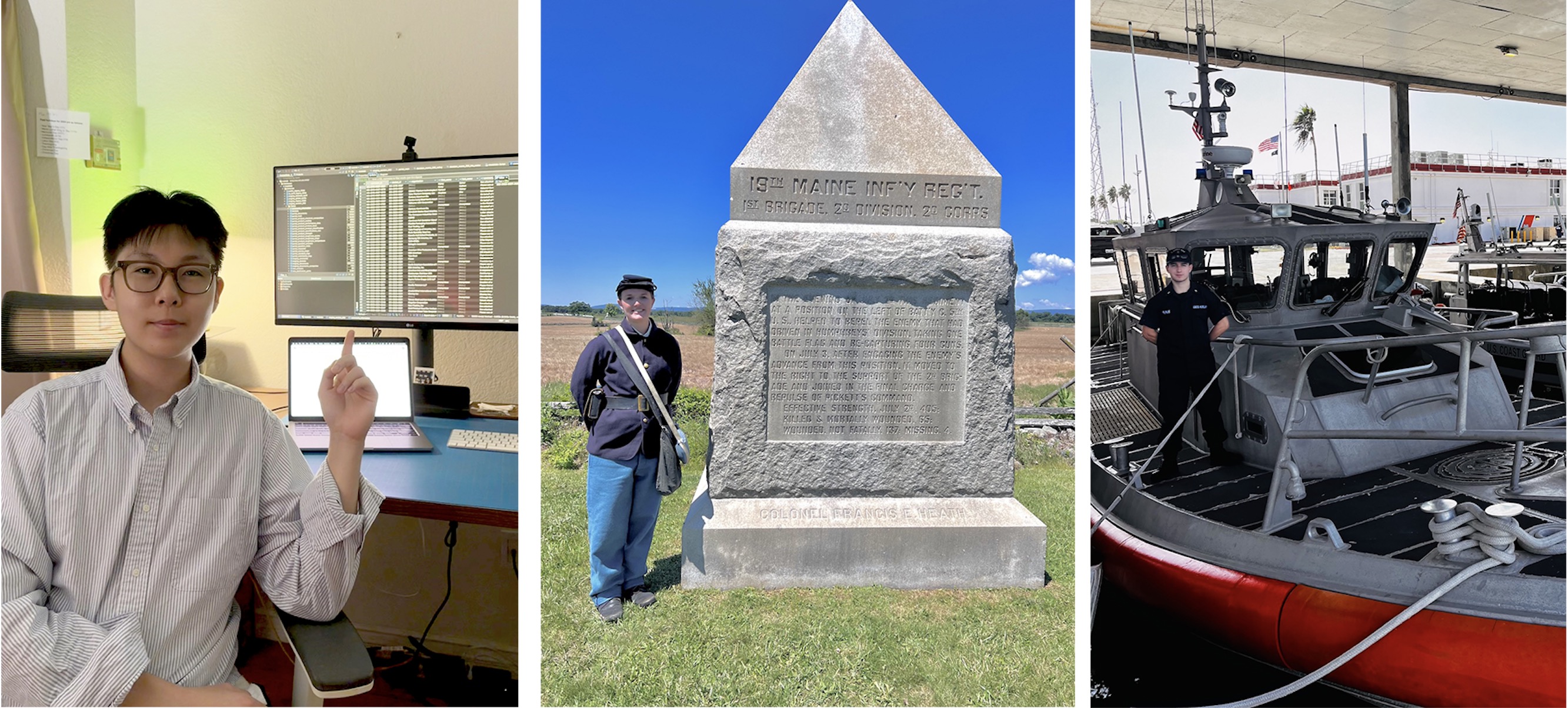
Bowdoin undergraduates have been pursuing a wide range of funded academic projects over the break. In all, 180 students have received research fellowships this summer, some whom are undertaking their work on campus, while others have been in the field—all of them advised by a faculty member.
They are among the 456 Polar Bears who have secured funding during the break to pursue internships and fellowships.
In the concluding part of a series of summer fellowship profiles, we hear from a philosopher, a biologist, and a historian.
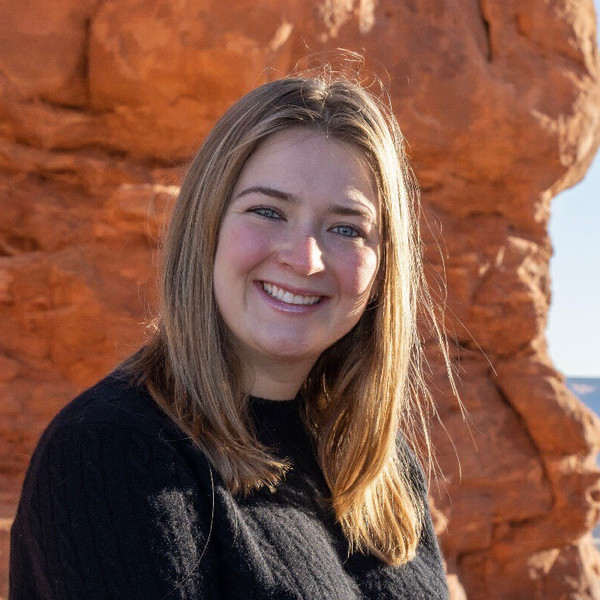
Amaya Nicklas ’27
Fellowship name: Surdna Foundation Undergraduate Research Fellowship Program
Faculty advisor: Assistant Professor of Philosophy Aliosha Barranco Lopez
Project title: "Fringe" Beliefs in Epistemically Polluted Environments
What makes a political belief brief rational? How should you respond when someone expresses a belief you might dismiss as outlandish, such as the belief that lizard people control the deep state?
Nicklas been drawing on political science and psychology research to evaluate how we respond to these beliefs and how we should respond to them. There is a large interdisciplinary debate, she explained, about just how rational and evidence-responsive these beliefs are, which has been furthered by recent scholarship using conversations with large language models to influence outlandish political beliefs. “In my project, I am examining the ethics and means of influencing such beliefs, whether through AI or human interaction. As a government and philosophy double major, I am fascinated by the ethics of political discourse and the (ir)rationality of political belief change,” said Nicklas.
She argues that people judge outlandish political beliefs as irrational while remaining ignorant of their own (similar) reasoning processes. “This judgment is therefore misplaced, and it inhibits effective dialogue by exacerbating affective polarization. Effective interventions are nonjudgmental; deep canvassing work and conversations with chatbots are effective examples. Understanding our own flawed reasoning leads to more empathy and ultimately more effective dialogue!”
Jasper Thomas ’28
Fellowship name: Student Faculty Research Grant Fellowship
Faculty advisor: Associate Professor of Biology and Director of the Bowdoin College Scientific Station on Kent Island Patricia Jones
Project title: Using New Technologies to Understand Social Behavior in Seabirds on Kent Island
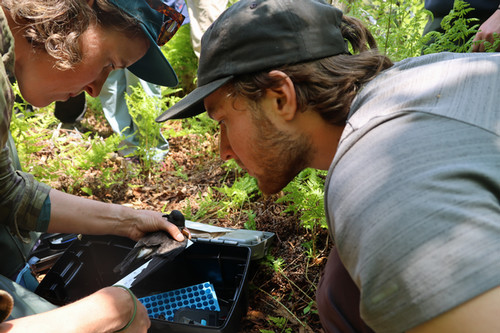
Thomas’s fellowship took him to the Bowdoin Scientific Station on Kent Island in the Bay of Fundy to study Leach's storm-petrels. These are pelagic tube-nosed seabirds, he explained, that nest in burrows on remote, predator-free islands, such as Kent Island, where there are more than 21,000 breeding pairs. They spend the entire winter at sea. Part of Thomas’s work involved carefully reaching into burrows looking for birds to band and eggs to measure—contributing to a dataset that goes back more than seventy years (one of the longest continuous ecological research projects in the world).
For his independent project, Thomas worked with RFID (radio-frequency identification) devices that can remotely sense when birds enter and leave a burrow with minimal disturbance. The aim, he explained, is to study why they visit other pairs' burrows. “This may inform us about the social behavior of Leach’s storm-petrels, their long-term mate choice decisions, and reproductive success. My time on Kent has been a wonderful opportunity to explore field research in a super collaborative community, and I've learned so much from the people around me as well as immersion in the environment itself.”
Noah Rossin ’27
Fellowship name: Theodore Samuel Danzig '22 Memorial Fellowship
Faculty advisor: Associate Professor of Government Jeffrey Selinger
Project title: Paths into Dixie: Racial Orders, Political Development, and the Consequences of White Supremacist Autocratization in the American South.
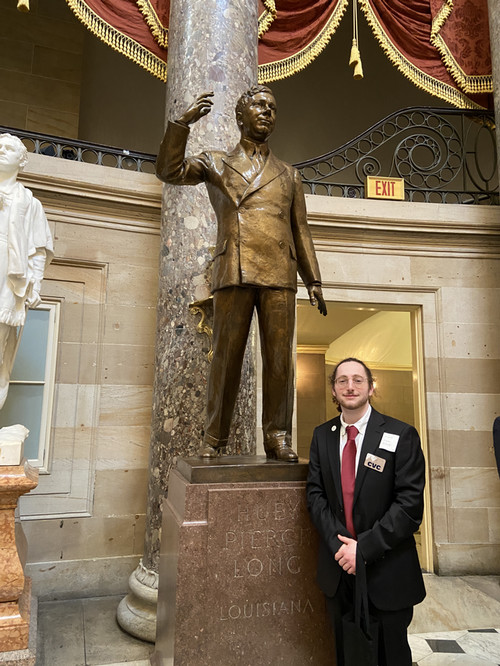
Rossin is exploring how different former Confederate states in the South implemented the violent restoration of white supremacist rule after Reconstruction. He has been looking particularly at the period between 1890 and 1910 and the divergent policy outcomes their distinct approaches to consolidating power and public opinion produced.
For his fellowship, Rossin focused specifically on North Carolina, analyzing newspapers, popular media, legislative discussion, and politicians’ speeches, exploring how political actors in the South constructed the political, cultural, and electoral infrastructure to ensure white supremacist institutions dominated public life. Rossin intends to pursue this subject further for his honors project and plans to examine two other states in similar detail—Mississippi and Georgia. He hopes such analysis will help him to better understand how political systems transition out of democracy and to inform contemporary social and institutional policy that can address these ongoing ills.
“I primarily spent my time as a fellow performing a comprehensive review of relevant secondary literature, from foundational works on the ‘long’ civil rights era and structural inequality to Southern history to broader political development,” said Rossin. “In doing so, I developed the ontological framework that will inform my methodology, leaving me with a strong foundation with which to pursue my honors project and later apply to graduate programs in political science.”