In Their Words: Spindleworks Artists on Celebrating Independence!
By Bowdoin College Museum of Art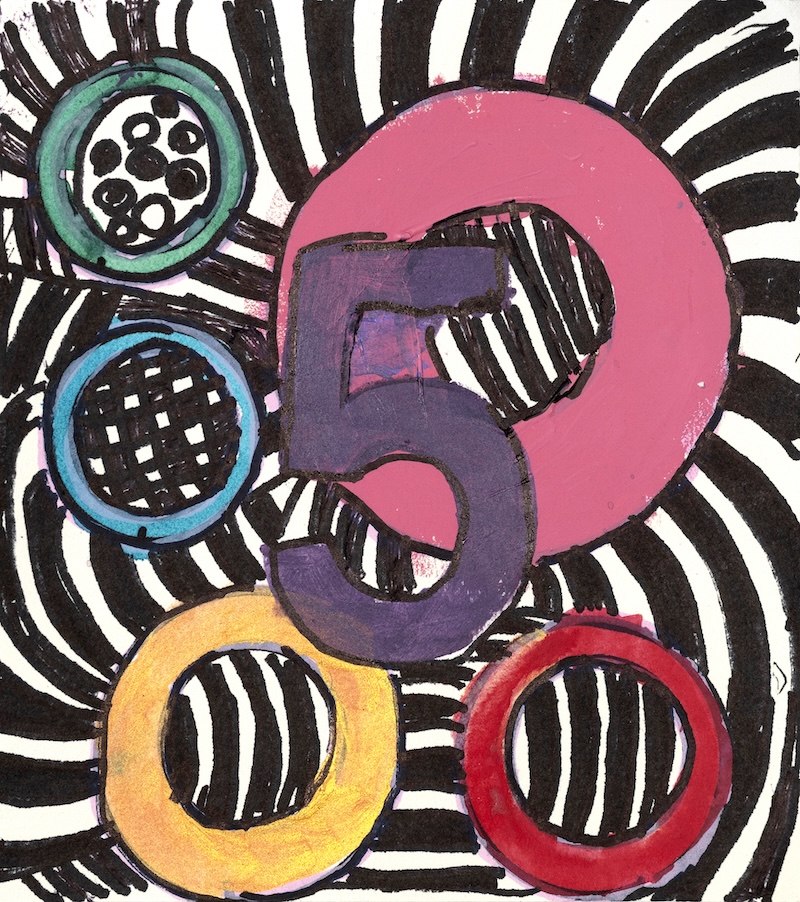
Nancy Scott, 50, 2026, marker on paper, 5 3/4 x 6 1/2 in. © Nancy Scott. Photography by Tim Greenway.
This May, the Bowdoin College Museum of Art (BCMA) will open Celebrating Independence! Fifty Years of Spindleworks, 1976–2026, an exhibition honoring Spindleworks Art Center’s five decades of creative community. We sat down with four Spindleworks artists—Robin Albert, Linnea Karlsson, Butch Schram, and Nancy Scott—along with artist mentors Deirdre Barton and Sara Cox, to hear about the art they create and what keeps them coming back to Spindleworks. Exhibition co-curators Anne Collins Goodyear and Mya Benally ’26 also share their reflections. The transcript has been condensed and edited for clarity.
The show is called “Celebrating Independence.” What does independence mean to you?
Nancy: I like how my work is. I have been coming here [to Spindleworks] for 26 years.
Linnea: I just love coming here because it's family. And I can show my hardheaded dad what I can do instead of focusing on what I can't.
Sara: So you're an independent artist, celebrating it!
Linnea: With a little help! I want to prove to that dad of mine that I can do it. Whether he likes it or not. Actually, the reason why we moved to Maine was to find a safe spot, and Spindleworks nailed it—checked the boxes and everything. So I'm hoping they stay open forever.
Robin: I go walking to the food store, the toy store, and the ice cream place.
Sara: So you're independent and you just go do those things you want to do.
Robin: Yes!
Butch: Well, the 50th anniversary is our congratulations to all of us. We want to keep this building forever.
Can you tell us about yourself and the kind of art you make?
Butch: I made a Lone Ranger cookie jar out of clay. And I made a Jim West cookie jar. And I made a Captain America. And I'm going to make a cookie jar of Spider-Man. And I'm going to make some more dolls—Bonanza and the Golden Girls dolls. And I make wallets. I make a lot of everything I want to make.
Nancy: I do weaving, painting, poetry, drawing. I am a very good writer.
Linnea: I do painting. I do clay. I do poetry—lots and lots of poetry. I've done drawing, as you can see. And sometimes I'll dream about the art and I'm like, "Okay, I'll make that happen." And then boom, I get it done. With a little help.
Robin: I make painting, and fashion—I make jewelry out of tires.
Sara: She's really good at it!
Is there a piece in the exhibition that you're especially excited about?
Butch: The Lone Ranger cookie jar. I like making cookie jars out of clay. I'm excited about being here. I like coming to Spindleworks. And I like to make a lot of art—cookie jars and dolls and wallets and fashions and everything. This is my favorite place to come.
Nancy: I designed the “50”—it's on a poster and I painted it because I'm actually turning 50. I did that with paint markers and Sharpie.
Linnea: (holding up an illustration) These are Wakanda Colors. If they ever had a flag, it'd be this color. Wakanda is basically technology-controlled, half of the country, and the other half, the people do their own stuff. So it's like a balance, basically. And I did this to honor actor Chadwick Boseman, AKA the True Black Panther. And don't mess with the women warriors either. It's a must-watch.
Robin: (holding up her work) The pocket.
When visitors come to see your work this summer at the museum, what do you hope they will take away?
Butch: That they take away our art stuff. And we get paid for it!
Linnea: They will see what people with disabilities can do. Not being judged.
Robin: The money—I want to make my own shop.
Sara: You want to open your own shop? What kind of shop?
Robin: A sewing shop!
What makes the Spindleworks studio special?
Sara: One thing you can see is that people are really following their interests and it gives people a voice to express their creativity and the ability to collaborate with other artists in the community. Once artists start coming here, they usually continue to come for a long time. Like Nancy, who has been coming to Spindleworks for 26 years.
We have a lot of relationships with the community. Gary Lawless, who owns Gulf of Maine Books, is publishing a poetry anthology of Spindleworks poetry for this exhibition. He's published three full books previously and two smaller pamphlets from the beginning when there were maybe only eight artists here. Now there are 44 artists at Spindleworks in Brunswick and about 17 at our other location in Gardiner.
One of our artists volunteers at Gulf of Maine Books one afternoon a week. They create window displays—thematic displays for a holiday or for a rally or something. The relationship works both ways where it helps the bookshop and helps the artist—it's been a great collaboration.
We're called mentors here instead of teachers. The artists are mentors too. When a new artist comes in, they can go to their peer who has a particular skill and say, "Can you show me how to crochet or thread this?" It's about reciprocating and sharing with one another. We're all constantly learning from one another as a collective community.
Deirdre: I wish every town, village, city in the world had a Spindleworks, because I feel like it gives people identity and place. And when you have that, you are a valued member of your community and of the world. For some of these people, this is their air. If you're a dancer, you need to dance; if you're a writer, an artist—this is their air. They finally have a place where they can be themselves and express themselves. You see them grow and try new things all the time, and you can get teary sometimes because it's just amazing. We're in awe all the time of what happens here. It's magic.
Sara and I, at the end of the day, we'll look at each other and say, “Did you see that? Did you know what just happened? Oh my gosh, that's so amazing.” It's really special.
From the perspective of the Bowdoin College Museum of Art, what has stood out to you about working with Spindleworks artists?
Anne: One of the things that strikes me is that many of the artworks tell stories. For example, I think about Wakanda Colors and the Jim West cookie jar and the prank books. These different creative practices really feed new creative ideas. And how much sharing and collaboration happens here.
Mya: Anne and I started coming here for artist interviews last July, and Butch was actually one of the first artists we interviewed that day. I think we were immediately impressed by the caliber of creativity and the artists’ mastery of their mediums. The humor that comes from Nancy Scott's work—the prank books—is so clever. And then Butch's love for Jim West and the wild wild west—I immediately connected with that because I grew up watching Westerns. When I saw his Jim West cookie jar, I was like, "It's him!" (laughs)
And then Linnea and I were talking about Black Panther because that's actually one of my favorite movies. I also like to sew, so when I was looking at the pocket that Robin made, I was like, "That's so smart because it's so intentional!” It’s things you don't think about every day, but all these artists pick up on all of it.
Robin: It is never boring here!
Linnea: I'm hoping this stays open for another 50 years and so on. Or even a hundred if we're lucky!
Celebrating Independence! Fifty Years of Spindleworks, 1976–2026 will be on view May 20 through August 16, 2026 at the BCMA. Established fifty years ago, Spindleworks Art Center, based in Brunswick, Maine, is a nationally recognized progressive art studio that has become a vibrant part of the local community. This exhibition celebrates the vision of the artists whose work in a broad range of creative practices, from painting and sculpture to poetry and dance to weaving and new media art, provides a source of enduring inspiration and revelation.


