Object of the Month: Quillwork Basket by Maime Trudeau Migwans
By Bowdoin College Museum of Art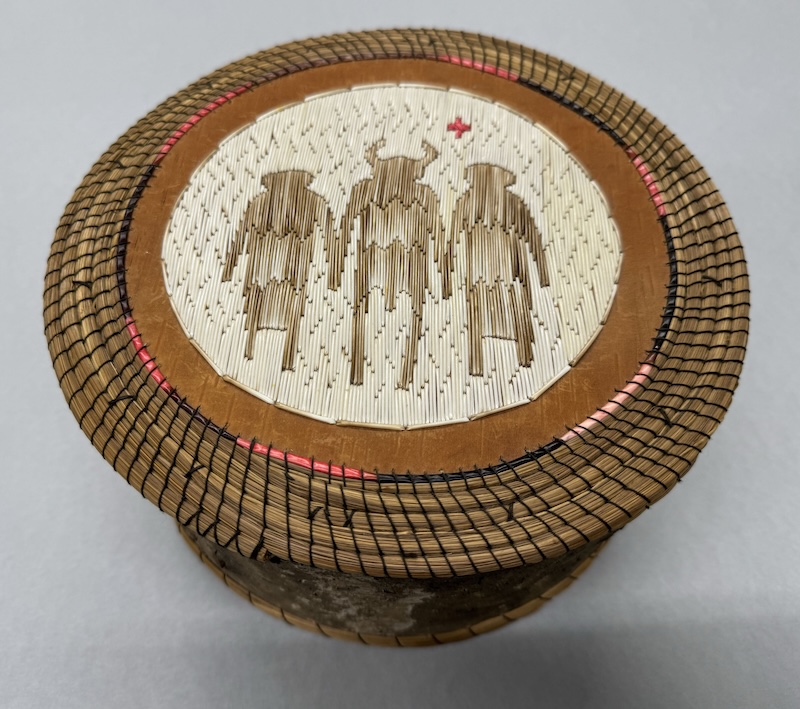
Maime Trudeau Migwans (1925-1999), shaman design by Carl Beam (1943-2005), Quillwork Basket, dated February 8, 1990, birch bark; porcupine quills, sweet grass, thread. Bowdoin College Museum of Art, Brunswick, Maine. Museum Purchase, Jane H. and Charles E. Parker, Jr. Art Acquisition Fund, 2024.31
Acquired in 2024, an exceptional basket by Maime Trudeau Migwans, one of Canada's foremost woman artists of the twentieth century, expands the Bowdoin College Museum of Art's holdings of Indigenous art. Quillwork Basket, signed and dated on the bottom in stitched white porcupine quills, represents traditional basketmaking of the Anishinaabe and Odawa, Indigenous communities who have inhabited the Great Lakes region in what is now Canada and the United States. Migwans’s baskets are distinctive in their use of quillwork and interpretation of traditional Woodland imagery.
Quills most used in basketry are those of the North American porcupine. Hollow and two- to three-inches long, they are lightly attached to the animal's skin. Because a porcupine is covered in roughly 30,000 quills, one animal provides ample raw material. However, preparing quills for use is labor-intensive. They can only be harvested in the spring before the quills fill with an oily fluid. Carefully plucked one-by-one, they are sorted by size and color – from brownish yellow to black and white. Natural dyes from roots, ferns, berries, or bark were used to add color until commercial dyes became available. Prior to weaving, the quills are made pliable with water or saliva. Once in place and dry, their positions become fixed. How the quills are stitched is central to the design. For example, they can be flattened but more decorative stitches can be created by folding or tufting the quills. Migwans flattened her quills; her light brown shaman figures are highlighted against the flat white ground, the stitching of which creates additional patterning. The black and red quills framing the roundel further enhance the figures and red star above.
Traditional Woodland imagery includes flora (orchids, roses, trillium) and fauna (beavers, eagles, herons). Migwans developed designs for her baskets with her nephew Carl Beam (1943–2005), Canada's esteemed twentieth century artist. He derived the cover's distinctive motif of shamans from ancient pictographs found in northeastern Lake Superior.
Born at Wiikwemkoong First Nation, Manitoulin Island, Ontario, Migwans watched her mother make baskets and weave porcupine quills. Many patterns were passed down via birchbark stencils from her grandmother and mother, with whom Migwans trained. When the stencils wore out, they were retraced on whatever material was handy. In this way, even cardboard cereal boxes helped transmit Anishinaabe cultural heritage. Migwans turned to basketmaking to support her children and grandchildren after the death of her husband in 1979. Following the powwow trail and visiting casinos and trading posts, she successfully found a market for her work. In 1983, after she was featured in an exhibition at the Ojibwe Cultural Foundation, M'Chigeeng First Nation, Manitoulin Island, her baskets were acquired by the British Museum and the Canadian Museum of History, among others. Migwans taught basketry and quillwork to many family members; her stencils and tools survive in the collection of her granddaughter G'Mewin Fox, also a noted quillwork artist.
Basketry and other forms of weaving are major cultural forms within Native American tribes from prehistoric times, and the BCMA has been building its collection in recent years. For example, a generous anonymous gift made in 2018 expanded the Museum’s holdings of nineteenth and early twentieth century splint ash fancy and utilitarian baskets made within the Wabanaki Confederacy. The BCMA has also acquired the work of contemporary Wabanaki basket makers. Penobscot artist Barry Dana etched his birchbark basket (2017.46.1), and Geo Soctomah Neptune combined traditional basketry with the Wabanaki creation story in his Apikcilu Binds the Sun (2021.33). Penobscot Theresa Secord's Pasokos (Sturgeon) Basket (2023.40), a traditional form woven on her family's 100-year-old molds, celebrates the return of the sturgeon to waters of the Wabanaki homeland. Passamaquoddy Jeremy Frey’s black-ash basket Permanence (2023.41) is a tour de force of twenty-first century basketmaking. Migwans's basket expands representation to Anishinaabe traditions of the Great Lakes while supporting the Museum's goals to better represent women and Indigenous artists.
Look for Maime Migwans’s Quillwork Basket on view in Currents: Art Since 1900 alongside Secord’s Pasokos (Sturgeon) Basket. Theresa Secord observes that “most baskets of this vintage, with extensive quill work, are in Canadian museums. More typical examples that we see here represent decorative symbology and animal imagery. Maime’s box, together with her nephew Carl’s design, offers a rare glimpse into the spiritual world view of the Anishinaabe.” Visitors can also see Barry Dana’s Basket, Jeremy Frey’s Permanence, and Geo Soctomah Neptune's Apikcilu Binds the Sun on view in USA @ 250 through November 8, 2026.
Laura F. SpragueSenior Consulting Curator