Artist Gerald Clarke on his Spring Residency at Bowdoin
By Bowdoin College Museum of Art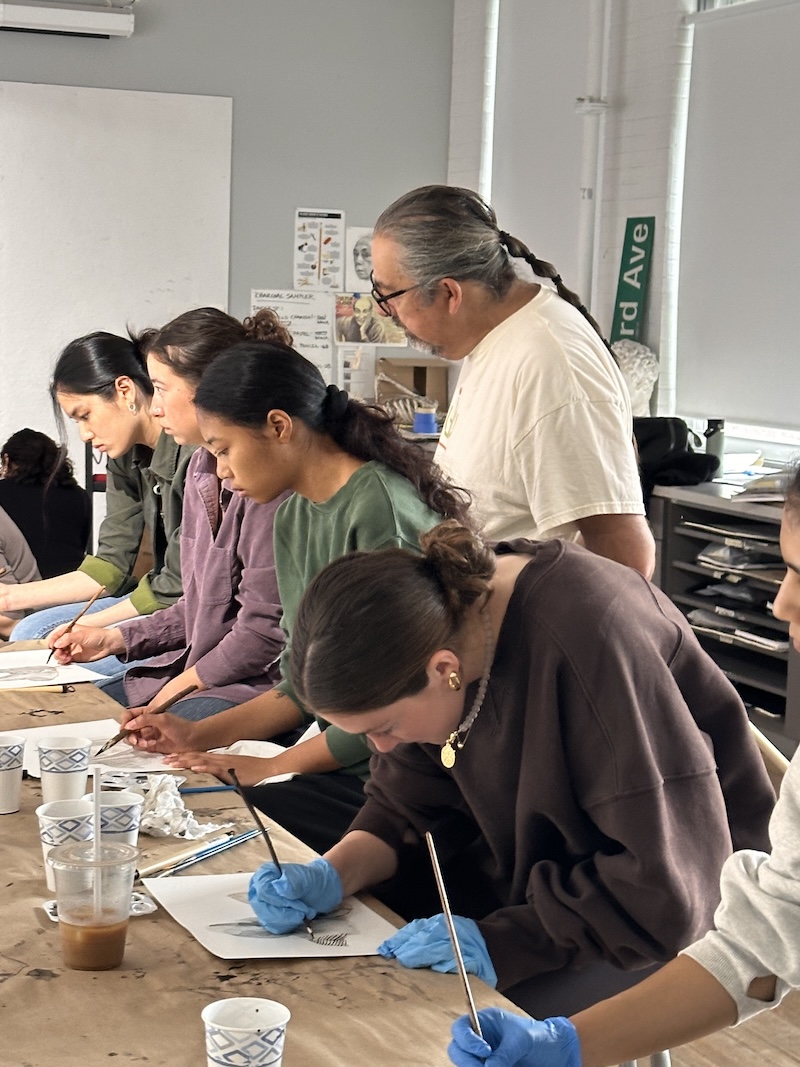
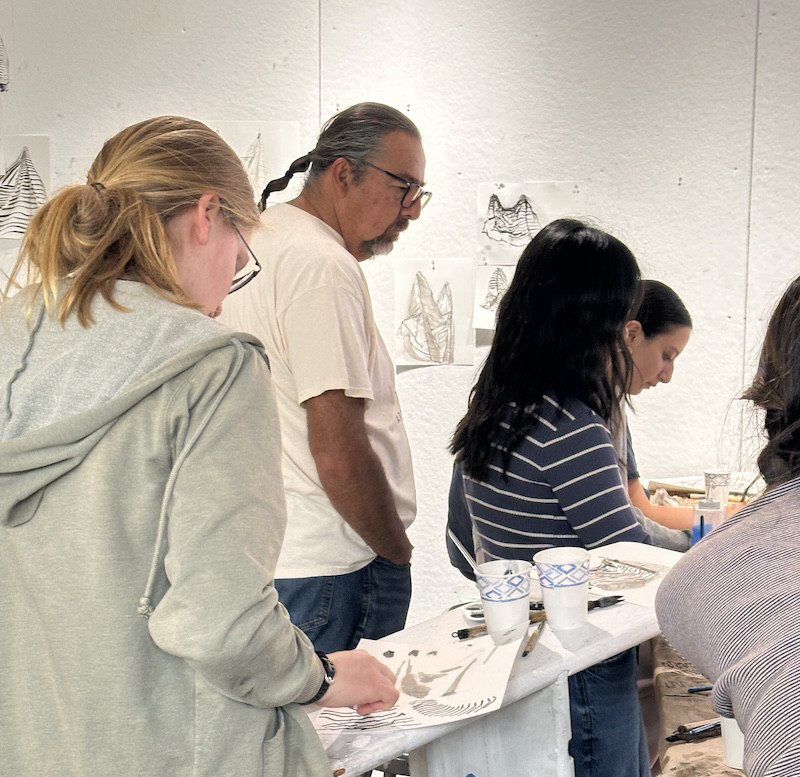
Artist Gerald Clarke visits classes in the Visual Arts Department.
Artist Gerald Clarke joined the Bowdoin community this past Spring as the most recent halley k harrisburg ’90 and Michael Rosenfeld Artist-in-Residence. In the following conversation, we discuss Clarke’s experience and takeaways during his time at Bowdoin. The transcript has been condensed and edited for clarity.
Claire Stone (CS): It’s been a few months since we’ve had the chance to talk to you and since then, you were the halley k harrisburg and Michel Rosenfeld Artist-in-Residence at Bowdoin College. What did you work on during your recent residency?
Gerald Clarke (GC): The major thing I did is that I ordered a CNC machine, which is a computer controlled cutting machine, and cut foam in different text and shapes, exploring and thinking about the possibilities of what the machine is and how I could use it in the future. I was pushing myself and trying new things, being uncomfortable, and failing a lot. I didn’t come away with any finished artworks at all, but I did come away with tons of ideas and ways that I could use this kind of technology to add to my toolbox of capabilities. I left the machine at the Maker Lab at the end of the residency—I wanted to leave it for students to use and experiment with.
CS: Did you have students come in that were inspired by this way of printmaking when you were working?
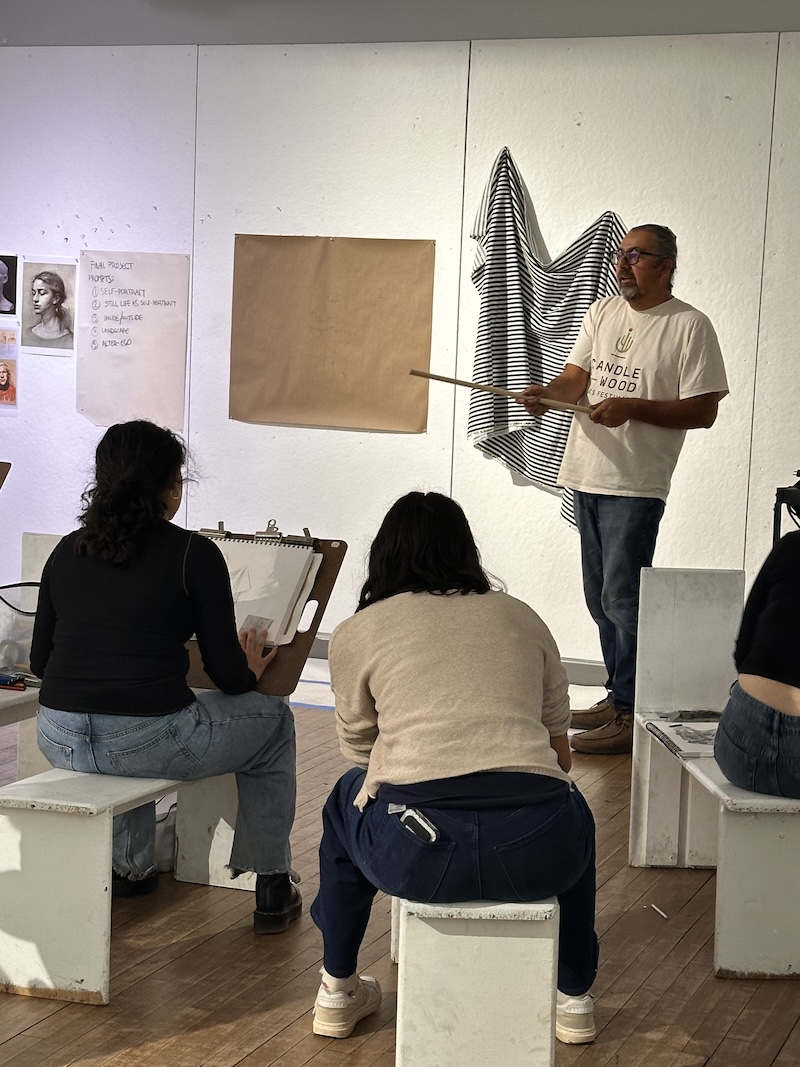
GC: Most of my interactions with students were when I would do classroom visits in the art department. I really enjoyed that, getting in on those critiques. I sat in on Professor James Mullen's drawing class, for example, and came up with an assignment for them. I didn’t have many students wander on their own into the studio space, I think maybe because I kept the studio door closed—the machine was loud!
CS: Oh, cool—what was that assignment in Professor Mullen’s class?
GC: I brought a four-yard-long piece of black and white widely striped cloth into the classroom, and we pinned it on the wall as a different way of approaching drawing drapery. Some students liked it and I think some students hated it, which I think is good. We're all drawn towards certain ways of working. I've always said that college doesn't make you smarter, but it exposes you to all kinds of different perspectives and approaches to creating work. I thought their drawings turned out well.
CS: Were there any other experiences with teaching you were able to do besides the drawing class?
GC: I visited the sculpture class, and I would go down periodically just to see how they're doing. One of my favorite things was to walk around the art department at night because most everyone was gone. I could look at their projects and see how they're coming along, the decisions they're making; it was cool that way. I visited the senior class after their gallery opening to hear their statement about what they're doing, their work, and contributed my own questions. I enjoyed that immensely as I don't teach studio arts anymore. I teach ethnic studies, and so it was nice to be back into a studio art realm of teaching.
CS: I really like the perspective that you have that failure is one of the best ways of learning, which you noted in your last interview with us. What was a failure you had this semester that you learned from?
GC: Well, I was cutting out these foam blocks, and I was attempting to try to use those to do a multicolor relief print. Each time you print a different color, they have to correspond, or register. After making the images of graffiti texts on Photoshop, I found it was tough to make it where all the plates corresponded in a way that would work when placing the printed foam blocks. That was a learning process!
CS: Would you say your time at Bowdoin was mostly looking into the technique of working with the foam material and CNC machine, or did you also explore the content of what you portrayed?
GC: The cutting would take about six hours, so I had time to read and think. One of the areas of thinking I explored was inspired by a guest lecture supported by both the departments of Cinema Studies and Anthropology. The professor hosting made connections between Indigenous connections to land and the movies to highlight themes that related to people of color. It was very cool.
CS: Do you think that inspired your work or any of your work in the future? Or did you just store it away as an interesting perspective?
GC: All the above. Inspiration is anything goes. Sometimes inspiration is a positive one, sometimes it's a negative one. Right now, Indigenous art and Native American art is very hot in the contemporary art world. And while I'm pleased to see that because contemporary Native American art has been ignored for so long, at the same time, it feels extractive to me. They're pulling these artists from their communities and showing them in various world museums. It seems kind of extractive to me because here, in my family's traditional home on the Indian reservation where my family has lived for centuries, it's very important to me that I have my studio in this specific place, within this specific community.
CS: Did you feel like you grew and expanded your understanding of yourself as an artist working with foam, a different medium, in Maine?
GC: I think so. But it wasn't simply just in the studio, it was also in the environment of Brunswick. One weekend I took the train down to Portland, and another weekend I took the train all the way to Boston. We don't really have train service [out West] like you all do in the East, and I really enjoyed that experience and people watching. I also really liked the sense of community on the campus. I loved eating in the dining hall and seeing community in action. Those things influenced me and ended up in my work. I just started a brand-new sculpture using that same kind of foam. It's going to be a giant rubber stamp in a gallery show I'm having up in Portland, Oregon in August.
CS: Is that part of your land acknowledgement project?
GC: Yeah, it is connected. I did a residency before I came to Bowdoin in Vancouver, British Columbia in the fall, and I met tribal people up there. One regret I have is I didn't get to interact very much with local tribal people here in Brunswick. Tribal lands in British Columbia are also considered unceded, which means there was never a treaty or anything, and instead [the government] basically took the land. All of California is unceded, and so that word unceded finds itself in a lot of land acknowledgements in these kinds of places. And so, I really focused on this idea of being unceded.
CS: That's really interesting. Besides the work for this Portland, Oregon show, as well as another in Los Angeles, California, what do the next few months look like for you in terms of creating?
GC: The Portland show will be all new work, which is an extension of the print attempts I was making and playing around with at Bowdoin, all related to graffiti text and this word "unceded." My residency at Bowdoin prepared me for doing these new prints and then getting ready for this show.
CS: Were there any other highlights as part of your residency experience?
GC: Well, I think a highlight was my second day when I got to do the public lecture at the end of March. halley k harrisburg and Michel Rosenfeld were there, and it was great getting to meet them. I'm so impressed and humbled by their generosity of enhancing the Bowdoin experience by supporting such a program. I'm grateful to halley and Michael and happy to be a part of it. And again, I have a deep appreciation and fondness for Bowdoin and the Bowdoin community. I had a blast when I was there, and now I'm going to go to the studio and get to work!
CS: That's wonderful. Good luck on your shows in LA and Portland!
To learn more about Clarke's practice, visit geraldclarkeart.com.
Claire Stone ’28Communications Intern