Gerald Clarke to Begin as Next halley k harrisburg ’90 and Michael Rosenfeld Artist-in-Residence
By Bowdoin College Museum of Art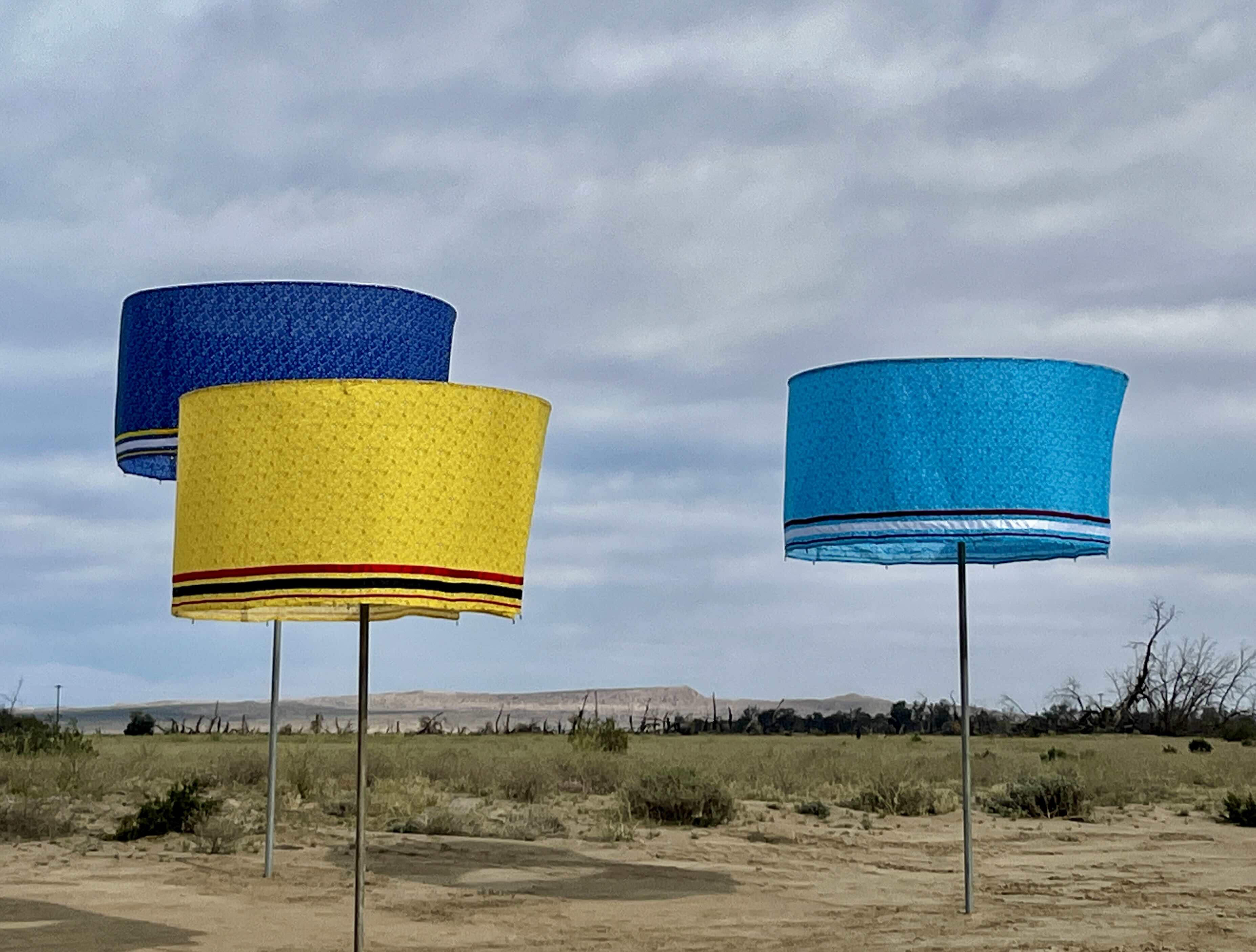
Gerald Clarke, an enrolled citizen of the Cahuilla Band of Indians, is a visual artist, educator, tribal leader, and cultural practitioner. Clarke will join the Bowdoin community this Spring as the next halley k harrisburg ’90 and Michael Rosenfeld Artist-in-Residence. In the following conversation, we discuss Clarke’s background, artistic practice, and hopes for the upcoming residency. The transcript has been condensed and edited for clarity.
Amanda Skinner (AS): We are excited for you to be returning to Bowdoin to be in residence as the halley k harrisburg '90 and Michael Rosenfeld Artist-in-Residence, starting in late March and continuing through much of April. For those who don’t yet know you, can you share more about where you will be joining us from?
Gerald Clarke (GC): I live on the Cahuilla Indian Reservation, where my family has been for generations. The Indians here in California were like the first cowboys when the Spanish showed up with their livestock, and the men in my tribe and my family have participated in cattle ranching ever since. In the twentieth century, we started doing our own. My grandpa and then my dad ran our family’s ranch, and then I took over. At this point I’ve been running my family’s cattle ranch for 20 something years. I’m also a college professor the University of California Riverside and I'm an artist. With those latter roles, it's easy to start living in your head too much. But I think that the ranch grounds me very well in the landscape, and I have to pay attention to things like the weather and the rainfall.
One of the things I like about making art is the physical component—moving materials, making things, building things, constructing, which is life on the ranch. We had a fire here last summer, and we lost 6,000 feet of fence. So I've got to rebuild fence. But that work and the work I do in the studio, it feels good to me. It's my reward. I like to be physically active.
AS: How would you describe your artistic practice right now? What materials, questions, or themes are most central to your work at this moment?
GC: I wasn't “college material,” or at least that's what I was told in school. But I chased a girl who went off to college. So, I too ended up going to college and tried different majors and things. Because of growing up poor and working and building things, I’ve always been good with my hands and so I ended up majoring in art. I ended up going to graduate school and had a traditional Western arts education. I've been making art now for over 30 years, and my practice has certainly evolved. And so right now, the sky's the limit. When I meet people on a plane, for example, they’ll ask me, "What do you do?” And I say, “Oh, I'm an artist.” The second question is always, “Well, what's your medium?” And my answer is always the same—I tell them kitchen sink. My medium is anything I can get my hands on.
AS: It sounds like there’s a lot of freedom in that. What are your current projects?
GC: Right now, I'm sewing. I bought a sewing machine, taught myself how to use it, and now I'm sewing these big fabric curtain type things. And so, like I said, the sky's the limit. I feel so much freedom. When I talked to the students at Bowdoin when I visited in November, I told them that I didn't go to art school to make art—I went to art school to prepare myself for a lifetime of making art. And I just tried all kinds of different mediums and classes.
My professors were not happy with me. They said I was going to be a jack of all trades and a master of none, but I thought that was a shortsighted perspective. I've never had a lack of ideas. When I get an idea, the first thing I do is write these lists of all things that could be related to this idea. And then I might make a list of colors that might represent that idea. I might make a list of materials that best represent that idea. And then I go through this kind of elimination process. I figure out what will be most efficient and most successful in expressing whatever idea I want to express.
So right now, my practice is wide open. Everything's on the table. Because I teach, I have a separate income, and I don't rely at all on selling work. That gives me total freedom to just do whatever I want to.
AS: That's awesome. So, with the sewing project you’re currently working on, you said sewing is new to you?
GC: Yep! I’ve never sewn before. I'm a traditional singer and my daughters are dancers, and they wear these long skirts that have bright colored ribbons that are sewn around them. And when the women are all dancing, it’s a beautiful to see these colorful skirts moving in unison. And so I'm doing these large hoops (pictured) that are around 10 feet around, and the cloth with the ribbons is going to hang from them. They're going to be 16 feet up in the air hanging down, installed out in the desert. What I want is the wind to mimic this kind of dance movement and pay homage to the women in the tribe in the past as well as the present and the future.
AS: That sounds like a beautiful way to honor the women in your tribe.
GC: Well, I'm a girl dad. I love it.
AS: Love to hear that! Going back to your point about the default questions people will ask you, "What do you do? What's your medium?" It does seem to be that in the arts people specialize in one medium. But it’s interesting to hear about how you consider your practice “wide open”—it feels like there's a clear analogy to the landscape you are working in.
GC: Well, I think it's hurt my art career. I've not been very successful in getting support from commercial galleries because commercial galleries want a predictable product. And if I'm doing a bronze sculpture one week and then sewing the next week, they don't know what to do with me. And so oftentimes opportunities for me have been in museums, nonprofit galleries, university galleries, things like that. Part of it is that it keeps it interesting for me to keep changing the equation. I don't want to be in that same band from the '70s playing that same song 40 years later. I like to change.
AS: It’s good to keep things interesting and to be open to change. What drew you to halley k harrisburg ’90 and Michael Rosenfeld residency at Bowdoin College and what feels different about making work here?
GC: I have to admit, I did not realize that Bowdoin College had such a long history. I was shocked when I learned more about it. Several years ago, I was in residence with Michael Kolster, Professor of Art at Bowdoin, at the Ucross Foundation in Wyoming. And then last year he reached out to me, said, "Hey, we have this artist from residency program. Would you be interested in applying?" I happen to be on sabbatical this year from my teaching. And so I was like, “Wow, it feels like the planets are aligning and I'd have time to do this.” It worked out for me to come in April in part because I don't have to feed cows. Our winter is basically finished here by mid-March.
AS: That is living in alignment with the seasons. So when you get here in April, are there certain things you are hoping to learn, explore, or shift in your practice during your residency?
GC: With Indigenous people, our culture is developed in relationship to a very specific landscape. I live in my family's traditional home here on the reservation, and I feel very grounded and centered. But I also like to go to new places to force myself to think outside of what I might normally think about. And then of course, I really like colleges and universities and experiencing all the different expertise that is present on a campus.I've been a college professor for 30 years and the secret is we still learn from our students. Nobody talks about it, but we do.
AS: It’s true!
GC: My goal while I’m at Bowdoin is to do a series of prints. And I am not a printmaker. Oftentimes when I do make a "print," it's some kind of weird, hybridized version of traditional printmaking where I’m just making it up as I go. I’ll certainly be relying on the guidance of Carrie Scanga, Professor of Art, while I’m there. And I'm hoping that the students will want to check out what I'm doing and maybe get inspired or want to learn more. I'm not Oz where I'm trying to hide my process behind the curtain. I'm totally open because it teaches me.
AS: So what would being successful in this residency program here at Bowdoin look like for you?
GC: I have two shows scheduled for August, one in Los Angeles and one in Portland, Oregon. Ideally, I'd like to come away from the residency with a few works that I can include in both those shows. But I admit that I make a lot of bad art and people always think that's a strange thing to say, but I tell my students, "If you're not failing at least half the time, you're not trying hard enough. You’re playing it safe.” I know that sounds strange, but I tell my students, “Don't make art, don't focus on making art. Do what you do, do it well, do it with consciousness and responsibility and respect, and then put it out in the world and call it your art.”
And so while I hope to get some good works from my stay at Bowdoin, I might just get a lot of failures. But that doesn't mean the residency would be a failure because I will learn. Western society has stigmatized failure as being this bad thing, but it's one of the best ways of learning. And I think that openness to failure and my creative approach in general is a very indigenous way of working, a very Cahuilla way of working.
AS: There is so much wisdom in what you are saying. Thank you so much for chatting with me today. Was there anything you wanted to add?
GC: I'm just really pleased with the invitation to come there and spend some time at Bowdoin. It's humbling, and I try to stay humble, and I appreciate any opportunities that are afforded to me. I've often introduced myself as a 30-year emerging artist just because I haven't had a lot of exposure and part of it's my practice, but I'm well known in my community and for me that's really important.
AS: Community is everything!
To learn more about Clarke's practice, visit geraldclarkeart.com.
Amanda SkinnerAssistant Director of Museum Communcations