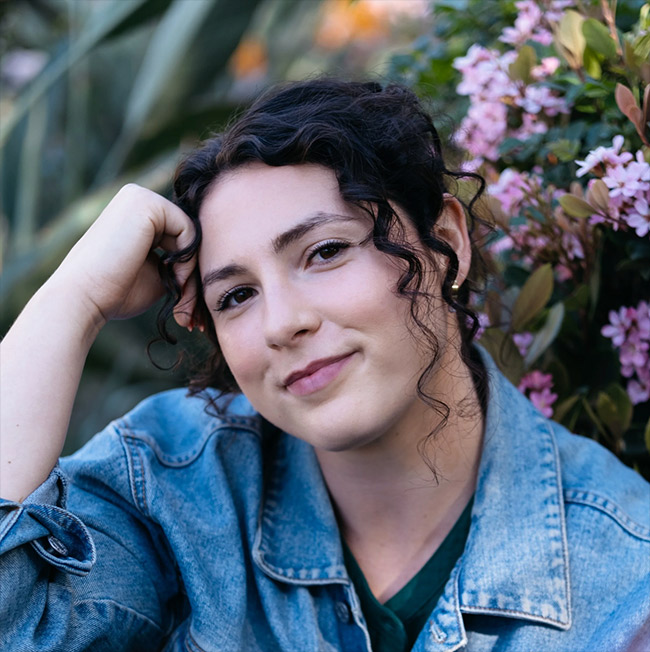
“In an era marked by ecological disruption and global instability, we are called to attend not only to what matters, but to matter itself,” Tsui writes in the program.
When asked in an interview why she wanted to host the “Matters that Matter: Material Agency and Ecological Entanglements from China and Beyond” symposium, Tsui didn’t answer. Instead, she turned her computer monitor around to share a movie trailer. “I'm going to use this trailer to speak for me,” she said.
The three-minute preview of director Chris Jordan’s Albatross documentary makes glaringly obvious—with beautiful, intimate, unsettling imagery—the agonizing impact that plastic garbage is having on the seabirds and their chicks.
“I was deeply moved from the very beginning,” Tsui recalled. That first encounter led her to learn more about albatrosses and Midway Atoll, the remote setting of the film. She began writing, and she decided to organize a conference that matters, on matter, at Bowdoin this fall.
The symposium marks Tsui’s final year of teaching after twenty-five years at Bowdoin. The event serves as a culmination of a career dedicated to cinema, the environment, and academic collaboration.
Much of her recent work hinges on a question: “Do we have the courage to face the realities of our time and to allow ourselves to feel deeply enough so that it transforms us and our future?” she asks.
Violence in the Pacific
As she learned more about albatrosses, Tsui also became fascinated with the history of Midway Atoll, which consists of three islands that lie “midway” between North America and Asia. It was the site of bombings during World War II, a casualty of hostilities between Japan and the US.
The atoll is also critical habitat for seabirds, including about 70 percent of the world’s Laysan albatross population and nearly 40 percent of the global population of black-footed albatross.
Tsui draws a connection between the wartime violence inflicted on Midway and a different form of human intrusion that continues today: pollution. More than 1.5 million albatross return to the atoll during breeding season, and they are being slowly killed by bits of colorful plastic they ingest from the ocean, which they inadvertently feed to their chicks. Jordan says his team encountered thousands of dead young albatrosses with stomachs filled with plastic.
“It is a slow death caused by slow violence,” Tsui said. “Even from afar, our actions continue to invade and violate this fragile place.” Bottle caps, toothbrushes, lighters, even razors—they end up floating in the ocean. “The beauty of the birds is they’re dedicated to their babies and to their partners,” Tsui said. “They empty their stomach so they can fill up with food for their baby, but in the end, they poison them.”
Jordan’s film depicts death and suffering, but also details from the albatrosses’ life cycle, including their mating dances and greetings. Tsui said the film's intention is not to make you feel like a villain, but to “find the beauty of nonhuman species. They are beautiful. They are graceful.”
Students reacting to the film mentioned how effective the imagery was at stirring them emotionally, and mused about the ties between beauty, love, grief, and environmental responsibility.
“I found the scenes showing the human-like interactions and connections between the albatrosses generated an emotional connection between the birds and the viewer, which made the images of the birds suffering and dying from human waste even sadder,” senior Rio Hanson ’27 said.
Hanson continued: “It was shocking to consider that these deaths are entirely human-caused, yet they are occurring on an island with little-to-no human presence. This showed me the true extent of the damage our consumerist tendencies are causing, and how much of that harm occurs far outside our vision and knowledge.”
Jordan, in his Zoom presentation at the symposium, said he sees his film as an example of “bearing witness,” which he called one of the most powerful acts a human can do. “There's this transformative thing that can happen in that moment: We feel their suffering. We take on their suffering. And we wonder, why do I feel so much?”
The answer, he said, is love. You love what you are seeing, and what you are losing.
That moment of bearing witness, he continued, connects us to our essential state of being—“which is to be in love with life and to be in love with all beings.”
Sophomore James Willett ’29 said he responded in particular to this theme in the film, saying that “universal love and bearing witness can be connected to any spirituality.”
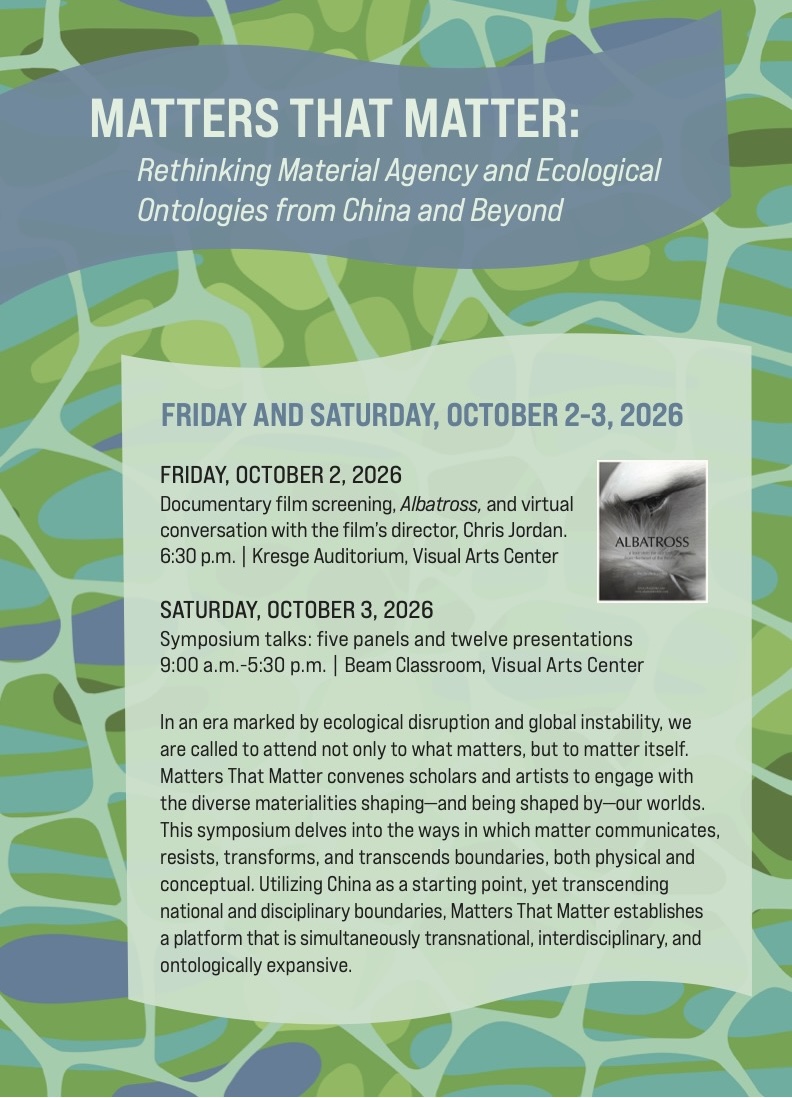
Matters that Matter
The symposium drew directly from Tsui’s recent book, Ecological and Environmental Turns: (Re)mapping China’s Sociocultural Landscape through Ecocinema. Published in 2025, the book examines films that challenge human-centered ways of seeing the world and explore the relationships among people, animals, and the environment.
“I want to invite people to move beyond a human-centered worldview and to recognize the profound connections between human and nonhuman worlds,” she said.
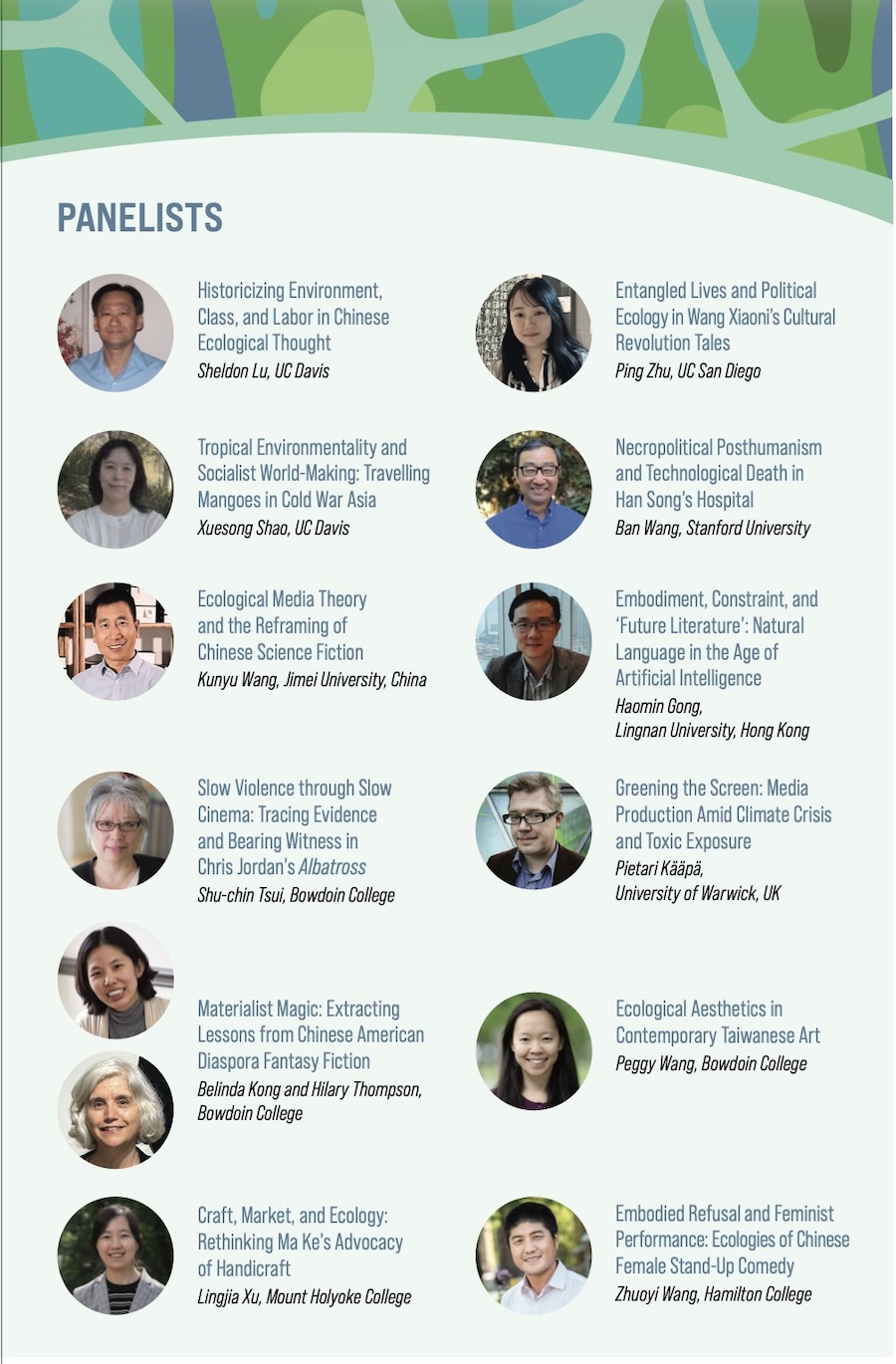
The symposium followed a multidisciplinary structure. Bringing together a dozen professors from universities across the world, the weekend’s events included student/faculty discussions, a screening of Albatross, a virtual conversation with the film's director, and a standup environmental comedy routine.
The scholars are specialists in diverse fields from history to literature to art, and included two Bowdoin College professors, art historian Peggy Wang and English and Asian studies professor Belinda Kong, along with Tsui.
Wang, an expert in Asian art history, shared her research on several Taiwanese ecological artists, including Chen Cheng-po, Tsai Pou-Ching, and Eleng Luluan, whose contrasting art works use language and ecology to challenge a singular narrative. She hopes the impact of her studies will encourage others to look more closely at Taiwanese art history, which she argued has been understudied.
Kong spoke about her partnership with Bowdoin English professor Hilary Thompson, who are both experts in literature and have an interest in Asian fantasy fiction. In a presentation titled “Materialistic Magic: Extracting Lessons from Chinese American Diaspora Fantasy Fiction,” she spoke of the historically Western-centric view of fantasy fiction, and how it has gradually expanded to include Asian fantasy fiction.
She discussed writers R.F. Kuang, S.L. Huang, Marie Liu, Ebony Elizabeth Thomas, and Amy Stornaiuolo, whose work “represents a diversity of perspectives” in Asian American fantasy fiction. “A lot of writers of color are reclaiming this genre,” Kong said.
Tsui's presentation at the symposium focused on the movie Albatross, speaking about the body of the albatross as a “living archive.”
Tsui’s hope is that, through the symposium, her writing, and her classes, students and the greater Bowdoin community can learn to look beyond the human world to appreciate and protect the wider, wilder world.
“We must respect nature, because our fate is inseparable from the fate of the Earth.”