As the “center left child of New Deal Democrats,” television producer and writer David Simon definitely counts himself as a political progressive—but experience has also taught him the dangers of sticking too rigidly to any single ideology.
His years as a crime reporter in Baltimore, he said, led Simon to a realization: “As I reported on actual problems, nothing fit cleanly.” Applying a fixed ideology—whether as a liberal, a libertarian, or a conservative—to a range of challenges does not work.
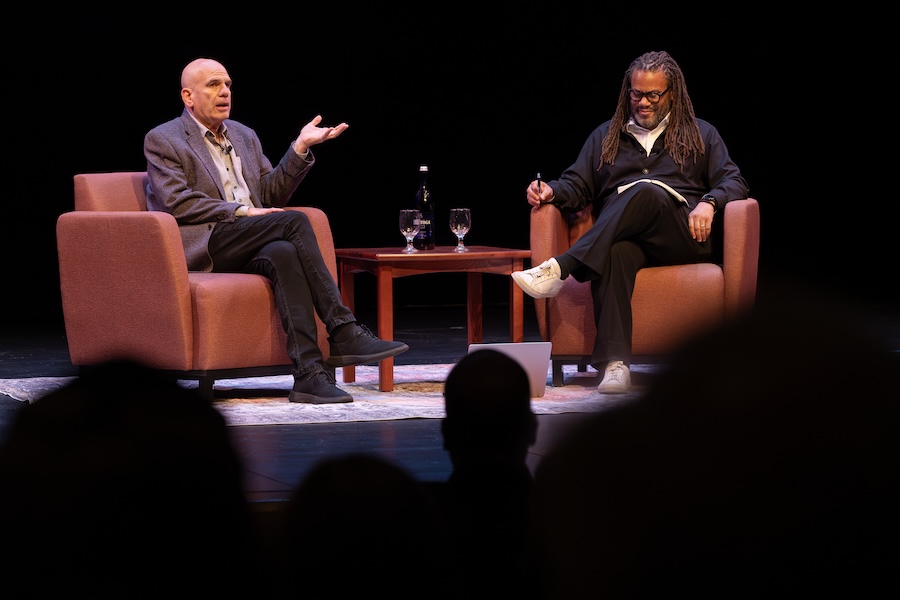
“I thought certain things until I saw certain things, and so I found that if you're going to make an argument for change in one direction, you're obligated to give room to the counter argument if the counter argument is credible.” You may end up with the same viewpoint you started out with, he stressed, but “you need that middle ground in order to have any meaning.”
Simon, whose journalistic experiences greatly informed his television work, was on campus to deliver the Kenneth V. Santagata Memorial Lecture, which this year took the form of a conversation in Pickard Theater on Monday, September 28. Asking the questions was Bowdoin College's inaugural Herman S. Dreer Leadership Fellow Franklin Leonard, founder and CEO of The Black List, a platform that has transformed the way emerging screenwriters are discovered and how their work reaches the film and television industry.
Simon is best known as the main creative force behind The Wire (2002–2008), considered by many critics to be one of the greatest TV series ever made. Set in Baltimore, the show chronicles many aspects of life in the city, with a focus on crime and corruption. Simon’s subsequent television credits include Generation Kill, Treme, Show Me A Hero, The Deuce, and The Plot Against America. Simon’s most recent project, We Own This City, is a six-hour limited series chronicling the rise and fall of the Baltimore Police Department's Gun Trace Task Force, examining the corruption and moral collapse that befell an American city in which the policies of drug prohibition and mass arrest were championed at the expense of actual police work.
A range of subjects were discussed during Simon’s conversation with Leonard, including artificial intelligence, the criminal justice system, and the challenges of putting together a TV show—dealing with studio bosses, financiers, and writers. Many discussions and arguments with writers take place before a show is made, he said. “That’s how it becomes a grown-up enterprise. Stories aren’t simple!”
Throughout the discussion, Simon would return to the recurring theme of occupying the middle space and empathizing with both sides of an argument. He used The Wire as an example. “[The show] is a tract against the drug war,” he told Leonard. “It's against drug prohibition, it's an argument against mass incarceration, against the militarization of police work.” A lot of these things, he remarked, would put him “in good favor” with progressives.
However, said Simon, his experiences of inner city life also demonstrated to him the importance of a police force and a prison system—a position that set him at odds with some on the libertarian and progressive left who talk about abolishing prisons and defunding the police. Such people, he said, are more committed to their ideologies than they are to solving problems.
“We could do with a little bit more ‘both sides-ing’ and a little less screaming at each other across the threshold,” observed Simon. “I've come to believe that one of the great disasters of this century so far is the sheer mass of people who think that they can answer everything with the same paragraph.”