Running Through Fire: Legendary Track Coach Inspires Movie
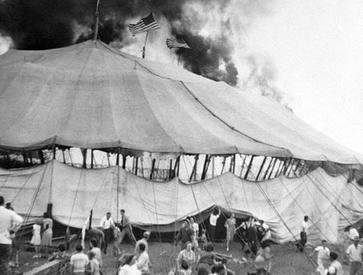
By Tom PorterIn 1944, six-year-old Jerry LeVasseur got caught in one of the deadliest events to occur on US soil: the Hartford circus fire in Connecticut. The conflagration erupted when the tent caught fire during an afternoon performance of the Ringling Brothers and Barnum & Bailey Circus.
The fire claimed the lives of nearly 170 people, including Jerry’s mother. Hundreds more were injured, among them Jerry, whose wounds are still visible more than eight decades later.
“Jerry survived because he was shielded from the flames by his mother and by the bottleneck of people trying to escape,” said filmmaker Andrew McGowan ’19, who is currently producing a documentary about LeVasseur.
“He was in the hospital for six months afterward and has memories of overhearing the doctors saying that they didn't think he was going to make it!” The young LeVasseur suffered burns to much of his body and lost fingers on both hands, said McGowan.
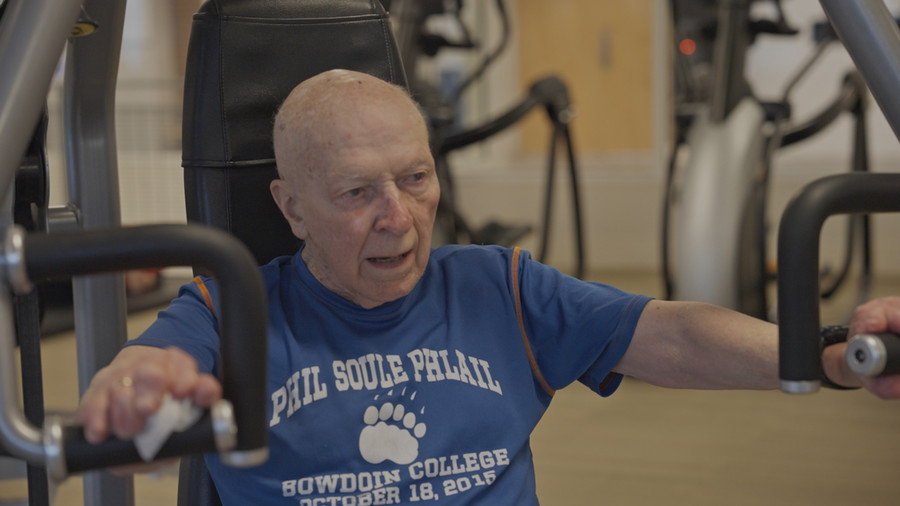
Not only did LeVasseur “make it,” but he overcame his injuries to become a lifelong athlete—he still competes today in his late eighties. As a retiree, LeVasseur began volunteering part-time as a track coach at Bowdoin, a post he held for nearly twenty years, until 2022. McGowan first encountered Coach LeVasseur when he was a student athlete on the track team. “As I got to know Jerry, I always figured his life would make an incredible documentary film.”
Despite the trauma he suffered, both physical and mental, LeVasseur went on to captain his high school football and basketball teams, continuing to play sports in college, where he competed in track and field events and played soccer. As he pursued a career in accounting, LeVasseur added skiing, snowshoeing, softball, tennis, and professional sled-dog racing to his sports repertoire.
“He raced sled dogs for thirty years in New England. While he was raising his family in Connecticut, he would travel up to competitive events in Maine and upstate New York, coaching canines and humans alike and winning championship titles across the region.”
“He was in the hospital for six months afterward and has memories of overhearing the doctors saying that they didn't think he was going to make it!”
—Andrew McGowan on Jerry LeVasseur
In his mid-forties, LaVasseur discovered the joy of competitive distance running, explained McGowan. “He did a lot of 5Ks and 10Ks, plus a couple marathons. He also competed on the track, running the mile and the 1500-meter race. He later took up steeple chase, sprints, long jump, and triple jump.”
After retiring to Maine and becoming a volunteer coach, LeVasseur continued to compete. As the years progressed, the distances inevitably got shorter, although LaVasseur’s commitment and work rate remains undiminished. “He'll still enter road races and distance events,” said McGowan, “but he walks them or jogs them. He does go ‘all out’ for 50-meter and 100-meter dashes, however, and still does long jump and triple jump. For the past four decades, Jerry has traveled the world as an athlete, winning national titles and breaking records in his age groups, most recently in the 80-plus and 85-plus age categories.”
McGowan, who went on to pursue an MFA at the UCLA School of Theater, Film, and Television after graduating from Bowdoin, is also a contributing writer at Variety magazine and self-confessed “geek” for all things cinematic, having gained additional experience as a producer, screenwriter, production coordinator, and animator. The LeVasseur documentary, which does not yet have a title, is being funded via a crowd-source campaign and will be McGowan’s live-action directorial debut. He expects the film to be completed and released in 2027.


The film tells LeVasseur’s story through extensive interviews with family members and fellow athletes, including Olympic gold medalist Joan Benoit Samuelson ’79—a friend of LeVasseur’s and a legend in Maine athletic circles. Other members of the Bowdoin community featured in the movie include long-time former Bowdoin track coach Peter Slovenski and a number of track and field alumni who were coached by LaVasseur. McGowan is also grateful to the several Bowdoin film students who helped during local shoots as production and camera assistants.
As for the man himself, McGowan says LeVasseur was the ideal subject to interview, displaying the same qualities that made him an inspiring mentor and coach: “He's very humble, but he's also very generous. He's willing to share his story, and I think he’s really so open about it because he knows that it can be inspiring for people.”
McGowan filmed LeVasseur as he trained for and in competed in the Track and Field National Championships in Ohio, which took place in July, and where Jerry and his team—the New England 65+ Runners Club—did well, finishing in the top ten.
LeVasseur turns ninety next year, which means he will be eligible to compete in a new age group, says McGowan. “Jerry wants to continue competing and is excited by the prospect of breaking new records.” LeVasseur, who can be found most mornings working out at the Bowdoin gym, seems to have no intention of slowing down anytime soon, motivated perhaps by a determination to continue proving how wrong the doctors were all those years ago, when they thought the badly burned six-year-old boy would not “make it.”