Bowdoin faculty in a range of areas received some welcome news over the past semester. So far in 2026, at least eight scholars have been awarded research grants covering a variety of disciplines, from religious studies to psychology and across the sciences. Here are the details:
William R. Kenan Professor of Physics Thomas W. Baumgarte was awarded a renewal grant from the National Science Foundation (NSF) for his ongoing project “Studies in Numerical Relativity” (NSF award number 2605218). Baumgarte has been pursuing funded research in that area since 1999. This award, he said, will allow him and his students to continue their work on computer simulations of black holes and, more generally, strong gravitational fields.
“Topics that I hope to explore in more detail in the coming years include phenomena that emerge at the verge of black-hole formation, the possible formation of so-called primordial black holes in the early universe, and the collision between such black holes and stars,” explained Baumgarte. One specific question he hopes to explore is whether such a collision could trigger stellar explosions known as Type One supernovae. “If so,” he added, “Could these observations provide information on whether primordial black holes either make up or contribute to the dark-matter content of the universe?” Baumgarte has already written two books on numerical relativity, exploring the use of computer simulations to study Albert Einstein’s equations.
Professor of Neuroscience and Biology Manuel Díaz-Ríos jets off to St Andrews University in Scotland next semester on a Fulbright scholarship. He will be the inaugural Distinguished Scholar under a new partnership established between the University and the Fulbright Commission. Díaz-Ríos will collaborate with colleagues at St Andrews to investigate the combined effects of plastic pollution and elevated temperatures on the nervous system. According to an announcement from St Andrews University, Díaz-Ríos will use fruit fly (Drosophila) larvae as a model system to examine how these stressors influence the ability of neurons involved in movement to adapt and respond to stimuli, drawing on advanced imaging and neural recording techniques.
“I am very excited about how this Fulbright Award will provide me with a unique opportunity to deepen my research expertise in a new direction and expand my global network of colleagues within my field of research,” said Díaz-Ríos. “The impact is centered on forging a new and exciting collaborative project, which should enrich our careers and provide new academic and research opportunities to students at Bowdoin and the University of St Andrews."
Norma L. and Roland G. Ware Jr. Professor of Chemistry and Biochemistry Danielle Dube earned a research award from the National Institutes of Health for a project titled “Deciphering Heliobacter pylori's Glycocode: Uncovering and Harnessing Drug Targets.” Dube said she’s very excited to receive the award, known formally as an NIH R15.
“This grant will support research opportunities for students in my lab as we address unanswered questions in the field of chemical biology. In particular, this work will probe the importance of Helicobacter pylori's sugars in binding to host cells and driving disease." Understanding how these rare sugars work is important, she explained, because they play a key role in antibiotic-resistant bacterial pathogens, which account for more than 23,000 deaths each year in the US. Dube’s acceptance of this award meant she was obliged to turn down a smaller INBRE grant, also sponsored by NIH.
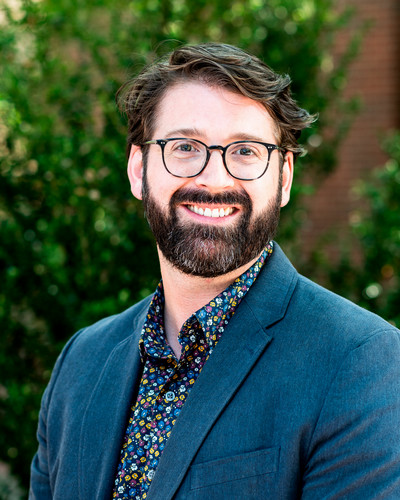
Assistant Professor of Chemistry Michael Henderson was honored with an NIH INBRE award for his research project, “Unveiling the BAR ‘Code’ of srGAPs Through Phospholid Gating, Curvature Preferences and Actin Regulation in the Control of Cellular Protrusions.” Henderson first received INBRE funding for the project in 2024, and this renewal secures another two years of support.
“Research support from the Maine INBRE program has been foundational to establishing my research program and the cutting-edge membrane biophysics research my students and I are undertaking,” said Henderson. “It has made it possible for us to create custom and, to my knowledge, unique instrumentation in the state of Maine that integrates fluorescence confocal microscopy with micropipette aspiration and optical tweezers to manipulate biomimetic cells we call giant vesicles.” With continued INBRE support, Henderson said he and his team are working to reconstitute out of the cell how neurologically important proteins assemble on membrane surfaces in lipid-specific ways and how these proteins collectively induce forces that generate curvatures necessary for growth cone and synapse formation and function.
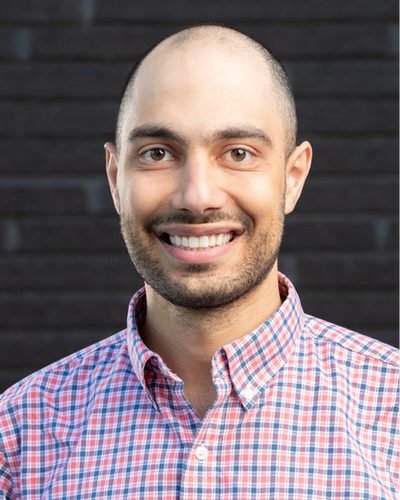
Assistant Professor of Computer Science Bobak Kiani has been made an EPSCOR Research Fellow by the NSF, in support of his project “Quantum Advantage in Random Quantum Hamiltonians” (NSF award number 2624545). Kiani, whose research lies at the intersection of quantum computing, machine learning, and mathematics, said he’s excited to receive the grant.
“This project will study random quantum Hamiltonians, models of highly interacting quantum systems that are a focus of research in quantum physics, mathematics, and computer science. The project will be conducted in collaboration with MIT and the Boston area research community. With this grant, I hope to expand Bowdoin’s presence in quantum information science and help provide pathways for students into graduate study and research careers.” According to the NSF, the fellowship will expand research in quantum information science in Maine and train undergraduate researchers at Bowdoin to prepare them for a future in STEM.
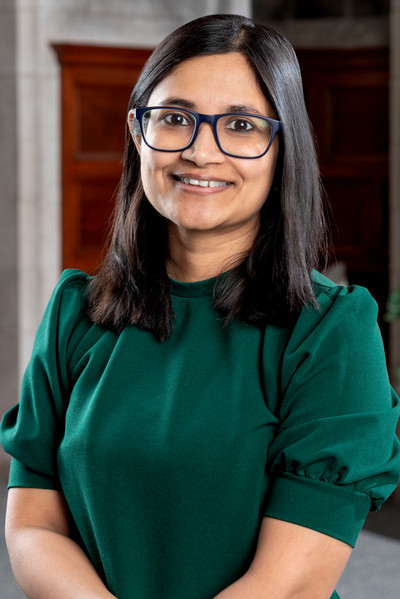
Assistant Professor of Psychology Abhilasha Kumar is also the beneficiary of a Maine INBRE award from NIH for her continuing work in the field of cognitive science, particularly human memory. Her latest initiative is a pilot project called “Integrating computational and neural methods to identify explore-exploit tradeoffs in memory search,” and it looks at temporal dynamics of memory search using brain waves.
“It’s really exciting to have the opportunity to engage with the MDIBL* community and work at the intersection of neuroscience and computational modeling. I’m excited to involve students in this work and use brain wave data to better understand how people search through memory."
In previous memory research, Kumar has worked with Bowdoin’s IT department to devise a series of online mind games and quizzes designed to collect data about the workings of our mental dictionary.
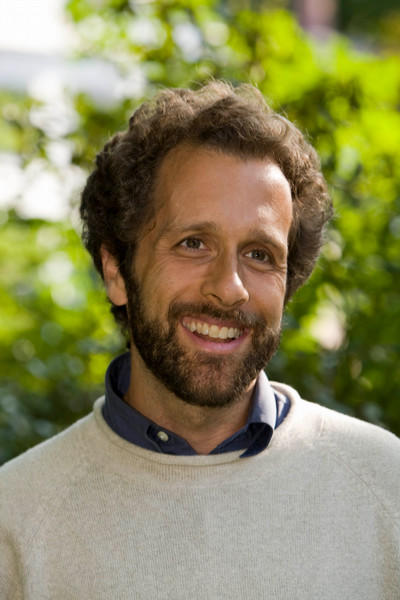
George Lincoln Skolfield Jr. Professor of Religion and Middle Eastern and North African Studies Robert Morrison has been awarded a fellowship from the School of Historical Studies of the Institute for Advanced Study for his project titled A Scientific Polemic. Morrison, who is on academic leave this year, will spend next spring semester at the IAS campus in Princeton, New Jersey, working on the project.
Last year Morrison published the critically acclaimed book Merchants of Knowledge , a groundbreaking study of the crossflow of ideas that developed across the Eastern Mediterranean between 1450 and 1550 and the people who made this possible. With that project behind him, Morrison said he was excited to be tackling this new work. “A Scientific Polemic begins with a study of a text from early fourteenth-century Iran titled You Did It, So Don’t Blame Me. The author criticizes another scholar for plagiarizing and for getting the facts wrong in the process. I hope to learn a lot about how the historical actors thought about creativity and intellectual property.”
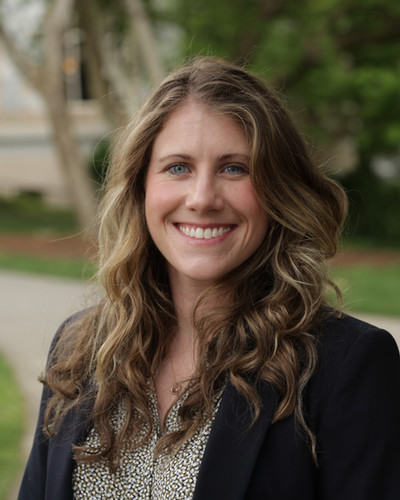
Assistant Professor of Biochemistry and Biology Maria Sterrett has picked up a Maine INBRE grant for her pilot project: “Characterizing Human-Disease Mutations in the Essential RNA Exosome with Budding Yeast.” Sterrett’s research focuses on the RNA exosome, which she describes as a “highly conserved molecular machine that ‘chews up’ nearly every type of RNA.” If RNA molecules are like working copies of our genetic blueprint, she explained, the RNA exosome is a shredder, regulating the amount of RNA within every cell of our body.
“Newly discovered mutations in the RNA exosome have been linked to distinct tissue-specific defects in patients. In my lab, we’re asking how changes in this singular molecular machine that is necessary in every cell can result in differing disease conditions. To answer this, we model disease mutations in yeast cells and investigate the molecular impacts of these changes on the function of the RNA exosome to regulate and ‘shred’ RNA. I'm excited to be bringing this research to Bowdoin, as it provides students with exposure to biomedical research while investigating the underlying biology of this essential molecular machine.”
Related Stories
-
-
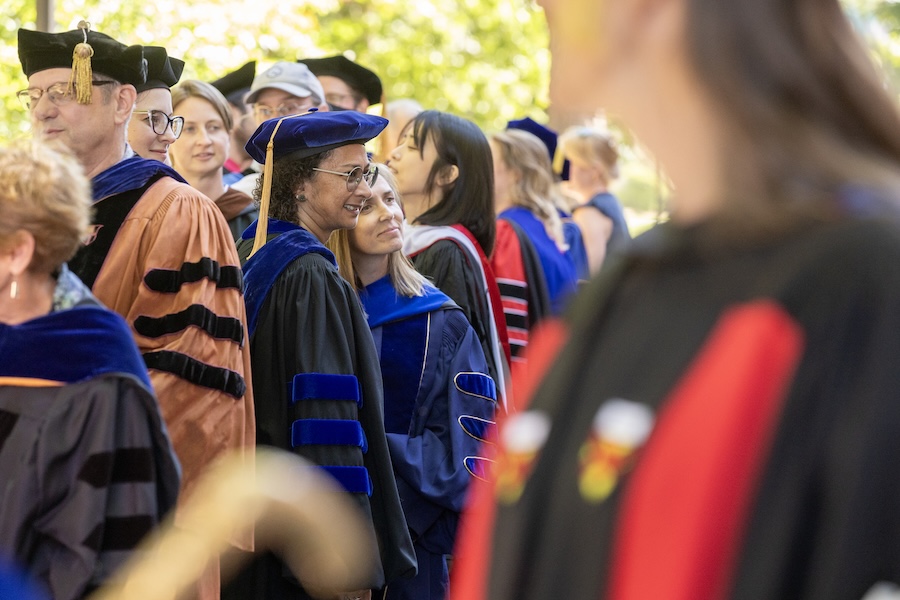 August 31, 2026Professor of Art Jackie Brown addressed the audience of new students at this year’s Convocation by drawing parallels between the creative process and a liberal arts education.
 -