At the start of her class, Psychology of Nostalgia, Armstrong warns students, especially seniors, that they should be prepared to open up to their emotions, and maybe even shed a few tears.
“Graduating seniors are a particularly nostalgic bunch because they’re getting ready to leave behind a powerful time,” she said. “They’re already anticipating leaving it behind.”
But this is no trigger warning. Because, as students learn over the semester, nostalgia is fortifying, not traumatic. Psychologists define it as a bittersweet longing for a meaningful but irrevocable moment in one's past.
“It’s bittersweet, it’s a longing. There’s a sadness associated with it, but it also evokes a feeling of joy and gratitude for having had this experience,” Armstrong said.
Nostalgia is a relatively new subject of research in psychology, going back about thirty years. It has especially grown in the past decade, driven in part by social media, Armstrong suggested, pointing to YouTube compilations like “Everything 1970s” or “1980s Memories Unlocked,” (pre-cellphone). “It seems to increasingly be used in ads and commercials, as well,” she said.
Researchers have found that the mixed-up nature of nostalgia—sad yet happy, pinching but also comforting—is doing much more than conjuring a fuzzy feeling for a moment. It also confers several psychological benefits that help us live more contentedly.
“It boosts mood, and it bolsters our sense of belonging, because we tend to focus on meaningful relationships of the past, and this increases our sense of meaning,” Armstrong said. We also tend to lean into nostalgia when we are lonely or facing an existential threat.
Armstrong has designed her course to offer a broad examination into the nuances of nostalgia. Students not only study the psychological science of nostalgia, they also read philosophical arguments to explain its existence and debate its possible evolutionary benefits.
Working in pairs, students lead class lessons on topics ranging from nostalgia's influence on romantic relationships to its possible applications in therapy and how it shapes our thoughts about mortality.
The class also explores nostalgia's role in consumerism, climate change, and politics. “We talk about how politicians encourage others to look back at this romanticized past, even if people haven’t personally experienced that past,” Armstrong said.
Climate change nostalgia even has its own term: solastalgia, or the emotional distress caused by environmental change. (Solastalgia can also be induced by war, mining, and deforestation.)
For Armstrong, teaching about nostalgia is an effective way to achieve one of her broader objectives. “I look for the ways psychological research connects to human lives, starting with students’ own lives,” she said. “One of my goals for them is to think about science as not just existing in the lab, but as having all these connections to the real world.”
Grace Chang ’27, a student in the class who's also done research with Armstrong, was drawn to the subject because of the way nostalgia manifests in her life. “Although I don't consider myself an extremely sentimental person, I do find myself reminiscing on the ‘good old days,’ back when things seemed simpler, and this does get me into a more sentimental mood,” she said.
Growing up in the United States in a South Korean family has also added cultural dimensions to her experience of nostalgia. She said studying the emotion has helped her understand why she feels both sadness and hopefulness when she thinks about the past.

Research with Students
For some students, their curiosity about nostalgia leads to independent projects investigating questions like how the emotion affects people across cultures or shapes their perception of time.
Each year, Armstrong selects one or two students to work with her, either contributing to her research into cross-cultural applications of nostalgia or pursuing a separate topic on nostalgia or another emotion.
Both Chang and Chayma Charifi ’25 have undertaken independent research with Armstrong looking at nostalgia across cultures. Charifi said this work is helping fill a knowledge gap in the field, since many studies on nostalgia have only been conducted on Western populations.
They surveyed participants in nine countries—India, Brazil, Turkey, Venezuela, Nigeria, Ireland, Australia, France, and Israel—to find out whether consistent topics emerged in people's nostalgic memories. “Common themes that came up were food, familial relationships or romantic relationships, and school memories,” Charifi said.
They were also interested in finding out whether nostalgia affects people differently in cultures that emphasize group bonds versus individual achievement. So far, Armstrong said they've found little evidence that it does.
“Given all the social benefits that nostalgia confers in terms of belonging, I expected to see some difference between cultures, but there don’t appear to be,” she said.
But Charifi was struck by how much people from different parts of the world have in common when they look back on their lives. “It’s really special to see how present this phenomenon is regardless of where you’re from, regardless of how different cultures are,” she said.
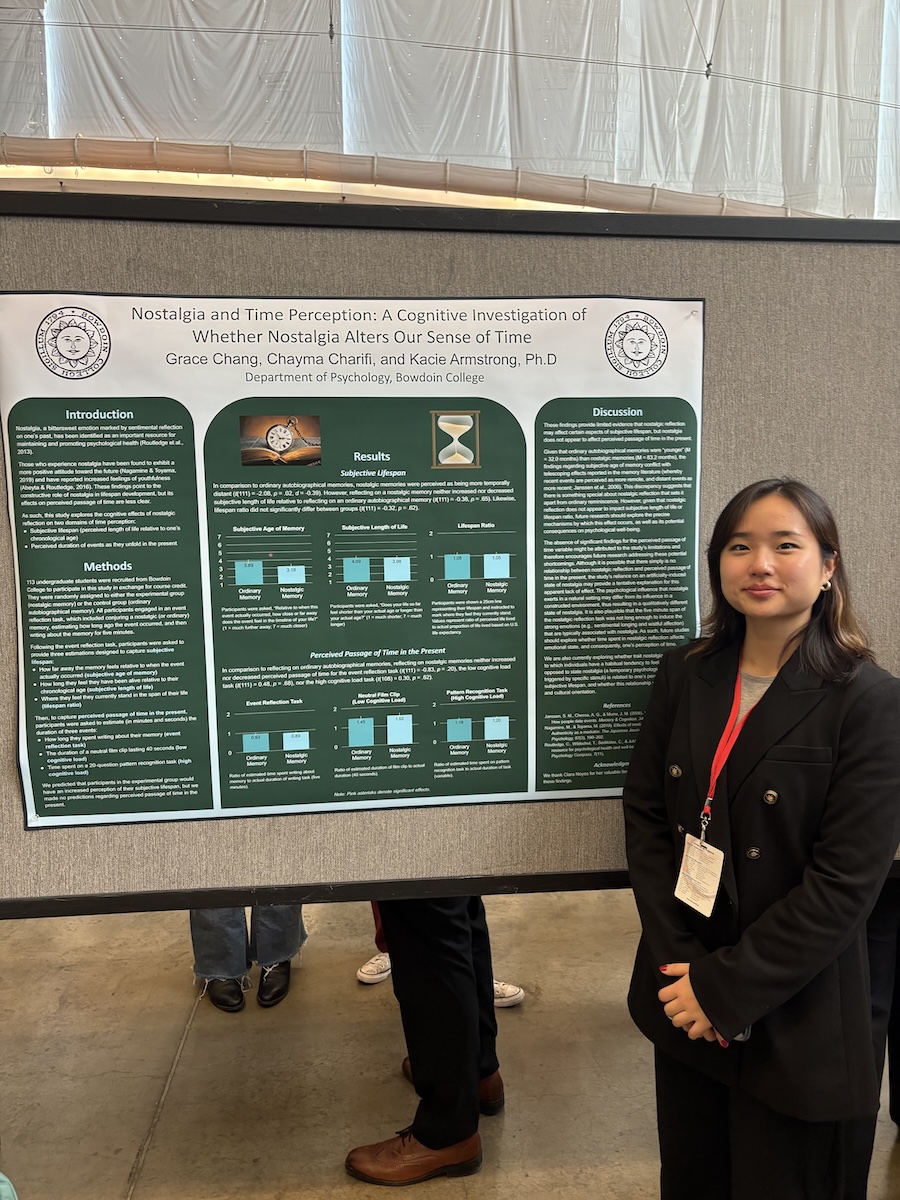
Chang and Charifi also looked into whether nostalgia affects people's perception of time, including whether nostalgic memories feel closer or more distant, or made people feel older or younger.
They found “limited evidence that nostalgic memories were perceived as being more temporally distant but do not appear to affect perceived passage of time in the present,” Chang said.
Chang is now interested in looking into how nostalgia impacts dementia patients and how it could be applied clinically. “Nostalgia seems to provide psychological landmarks for our memories, and I am interested to learn more about how these landmarks change as we age,” she said.
Both students are considering careers that touch on the psychological work they've done at Bowdoin. Chang is planning to pursue a legal career, “specifically in how psychology intersects with law and how it affects policymaking.” Charifi is considering graduate school in either creative writing or psychology.