At Bootcamp 2026, Sophomores Jump Start Their Careers
By Rebecca Goldfine, Tom Porter, Adam Bovie


A roadmap to the future
Bowdoin students tend to view their sophomore year as a make-or-break time, according to CXD Executive Director Kristin Brennan. It's when they must declare a major, decide whether—and then where—to study abroad, and, many believe, line up an impressive internship for the summer ahead.
"One thing we hear from students is that sophomore year can be stressful, and there's no time in this packed calendar to pause and figure it out," she said.
That's where Bootcamp comes in. "This is that space, that break."
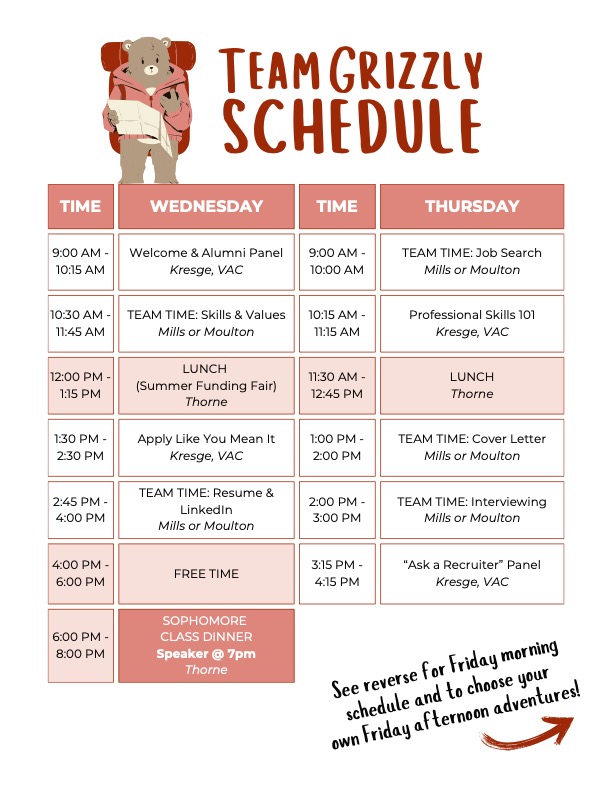
In her welcome to students on the first morning of the workshop, Brennan promised that every student would walk away from Bootcamp with a professional toolbox: a resume, cover letter, and LinkedIn profile, as well as networking and interviewing practice and time to reflect on what they want from a career.
Perhaps most importantly, they will have begun sketching out a roadmap to their future. "You will have more confidence about what you want to do and how to do it," Brennan said. “That's our hope.”
A packed three days
All sophomores travel through Bootcamp in small teams led by a trained upperclass student. For more than half the time, the teams work together in focused workshops to develop skills like interviewing and resume writing.
Between these sessions, they attend larger talks and panels with alumni and CXD staff that examine themes such as defining and achieving success, managing personal budgets, navigating mid-career shifts, accepting failure and setbacks, and balancing financial needs with making a positive impact in the world.
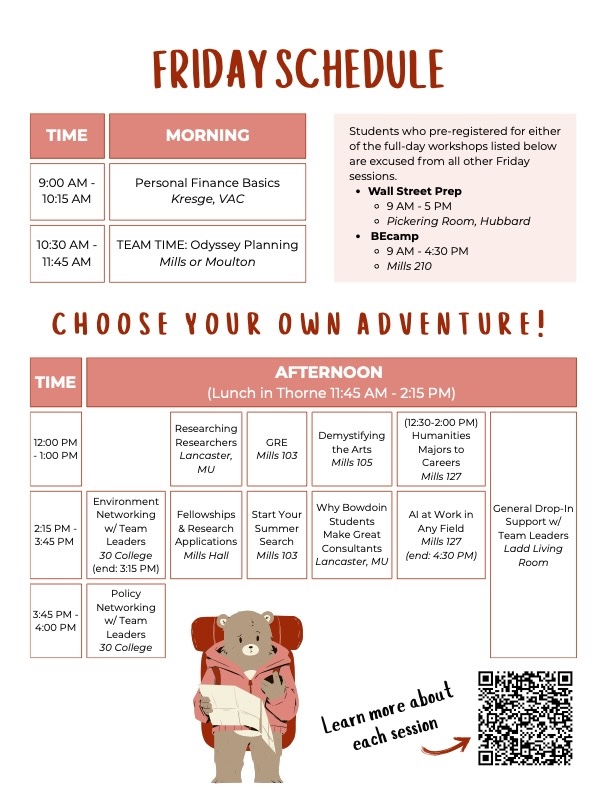
Bootcamp concludes on Friday with an afternoon of more tailored programming, which CXD calls "Choose Your Own Adventure." This block of time includes voluntary sessions aimed at humanities and science majors, and for those interested in areas such as the arts, the environment, policy, or consulting. Students are also invited to drop into Ladd House for more one-on-one advice from upperclass leaders.
Students teaching students
Sophomore Bootcamp wouldn't be possible without the army of upperclass students who assist CXD staff.
This year, Assistant Director of Programming Leah Hodder-Romano, who runs Bootcamp, oversaw a student staff of forty-five. Six served as "pod leaders," who not only helped CXD shape this year's programming but also helped to train team leaders. (Pod leaders are also team leaders during Bootcamp.)
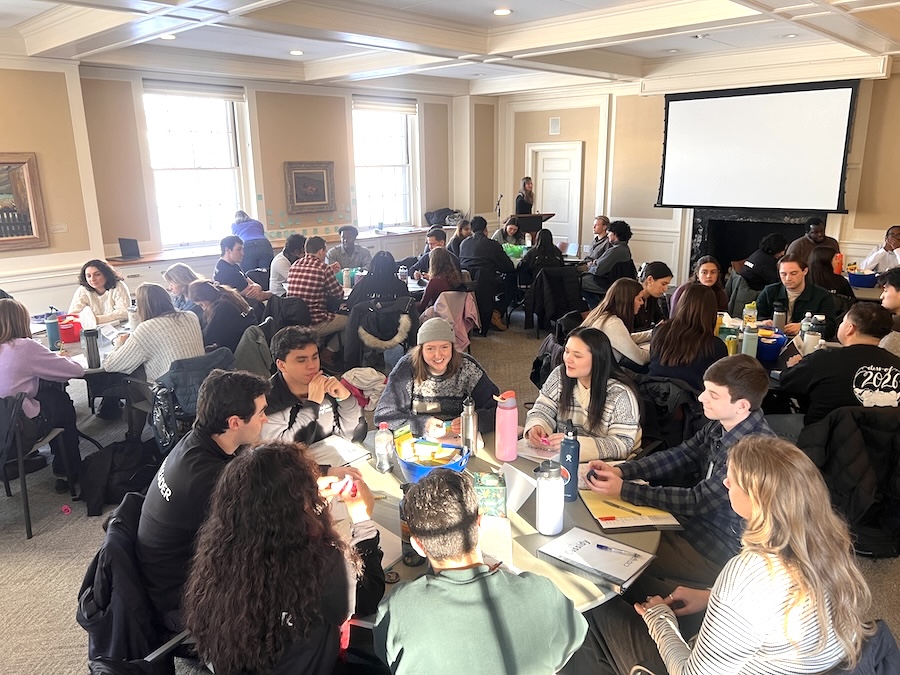
Hodder-Romano described the Bootcamp flowchart like this: "We teach six pod leaders to teach forty team leaders to teach five hundred students."
Team and pod leaders bring their own wisdom and experience, having gone through Bootcamp themselves as sophomores. Team leader Sara Coughlin '26 said her Bootcamp experience had been invaluable. "It was my first introduction to the career world."
She added that she wanted to return this year to serve as a resource for sophomores interested in journalism—a perspective she would have valued two years ago when she was considering this professional path.
Being a team leader also offers a chance for juniors and seniors to revisit skills that never go out of style. Neiman Mocombe '26, a pod leader, said working for Bootcamp “is a really useful refresher on applying for, interviewing, and eventually working in any career.”
As part of their training, Bootcamp team leaders pore over all the details involved in getting a job. They also participate in a leadership development workshop, led by Director of Leadership Development Sarah Binkhorst, and an inclusivity workshop on socioeconomic differences, taught by Katy Stern, director of institutional inclusion and diversity programs.
How to get a return offer!
Solomon Aborbie ’22 led a new Bootcamp session this year called Professional Skills 101. Currently a corporate customer engineer at Google, Aborbie gave students tips about how to flourish at their internship.
CXD invited Aborbie to Bootcamp because he job-searched so thoughtfully when he was a student, Hodder-Romano said. “He worked so hard with our office and ended up with so many great options.”
Plus, students love to hear from alumni, she added, and Aborbie gets real with them about how important it is to be helpful, thoughtful, curious, hardworking, and responsible at the workplace. “He talks about how to network, how to be good at an internship to get a return offer—how to be a nice person. It's all such good advice.”


What do you want to ask a recruiter?
Four executives from the world of recruitment, including a Bowdoin alumna and a parent, offered insights into how best to navigate the hiring process and to make an application stand out from the rest.


Business crash course
Business educator Mike McQuillan ’15 ran an all-day workshop on the final day of Bootcamp. McQuillan, who majored in economics, is the founder of BEcamp, an outfit providing Business Education for Non-Business Majors. The goal of the Bowdoin workshop, said McQuillan was “to help students learn the basic principles of business, so they can be well-prepared for interviews and be successful once they're on the job.”


AI at work in any field
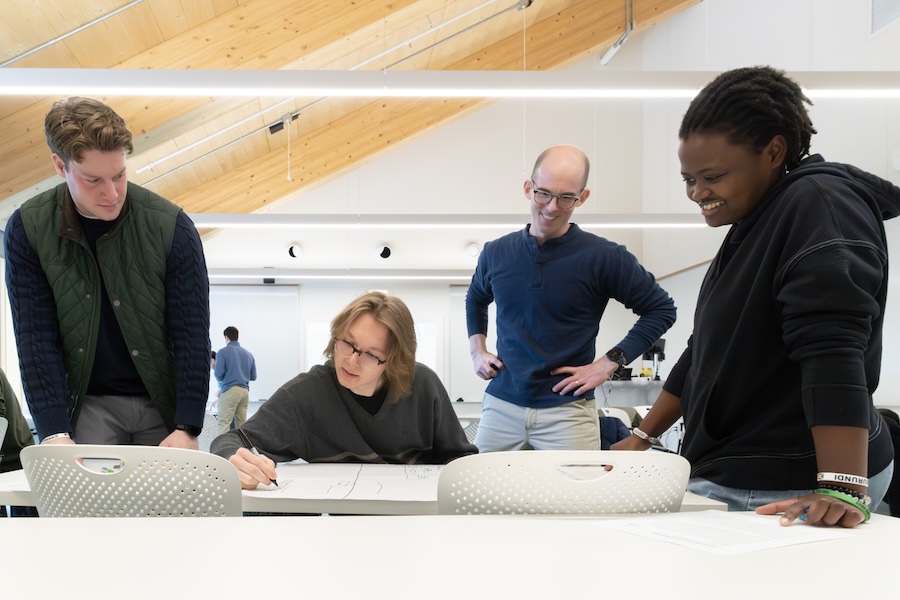
“I spend way too much time on Reddit,” David Byrd admitted. But, said the Marvin H. Green, Jr. Assistant Professor of Computer Science, this has made him acutely aware of the dangers of being overly reliant on artificial intelligence (AI).
“I can't tell you the number of posts I’ve seen that sound like this: ‘Help! I'm a junior and I want to start applying for internships, but I've gotten through my entire degree program so far by just having AI do everything and now I don't know anything.’ Avoid using AI to get into a dead end like that.”
Byrd, a former software developer, was among the faculty and staff on hand the final afternoon of Bootcamp to offer attendees advice regarding some of the issues surrounding AI and its likely impact on the job market.
Whatever career Bowdoin graduates end up choosing, one important takeaway was that AI tools should be used to augment human capabilities, not replace them.
Postdoctoral associate Collin Lucken, whose position was created by Bowdoin’s Hastings initiative for AI and Humanity, has an academic background in philosophy. “AI programs can read philosophy perfectly well, summarize it, and produce logically valid arguments,” he said. But what they struggle to do is to know what real humans are thinking and what they care about.”
Kristin Brennan said that the CXD office advises students to become adept at using various AI platforms for different purposes. “We think it's important that all students have some opportunities to use AI in ways that are similar to how it might be used on the job, so they can have an informed point of view about when it could be an asset and when it's not helpful,” she said.
But, she stressed, a liberal arts education is more important than ever in this dawning era of super computer intelligence. “The elements of a liberal arts education make students more capable than anyone to meet this moment,” she said. “They are the people we need, and this is the education that enhances the critical thinking and human judgment we need.”
Photos by Andrew Estey.