Object(s) of the Month: Celadon-Glazed Bowls, Goryeo Dynasty (918–1392)
By Bowdoin College Museum of Art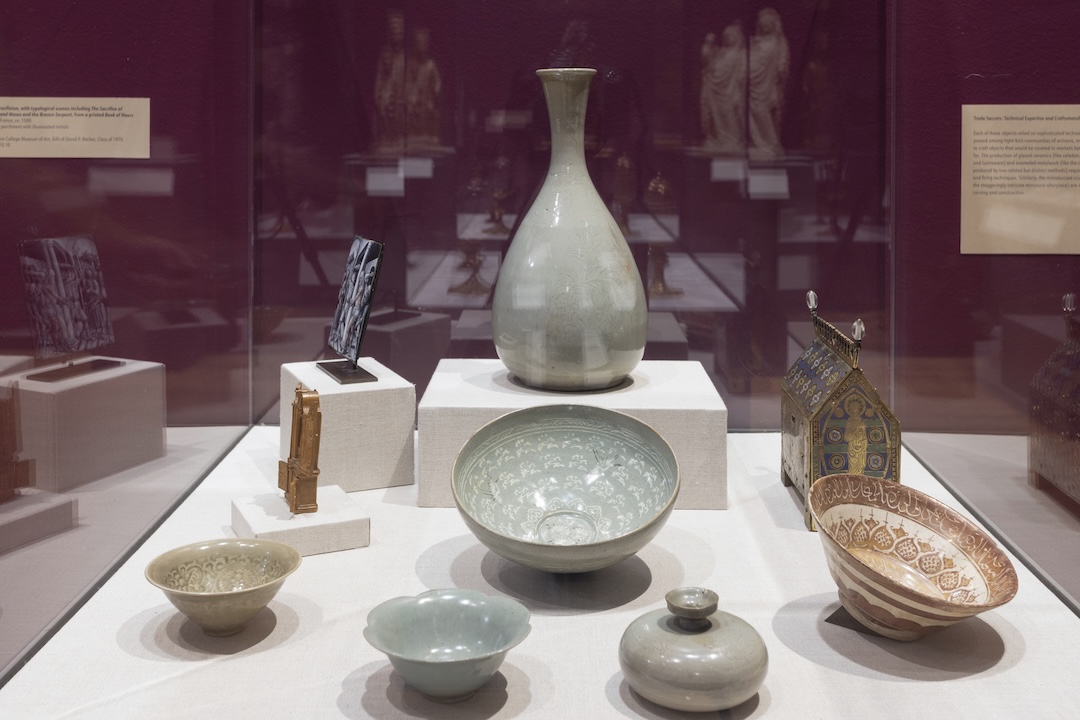
Pictured: Bowl (1968.90), Vase (1940.404), Bowl (1940.406), Bowl (1940.408), and Oil bottle (1990.3.18). Full citations below.
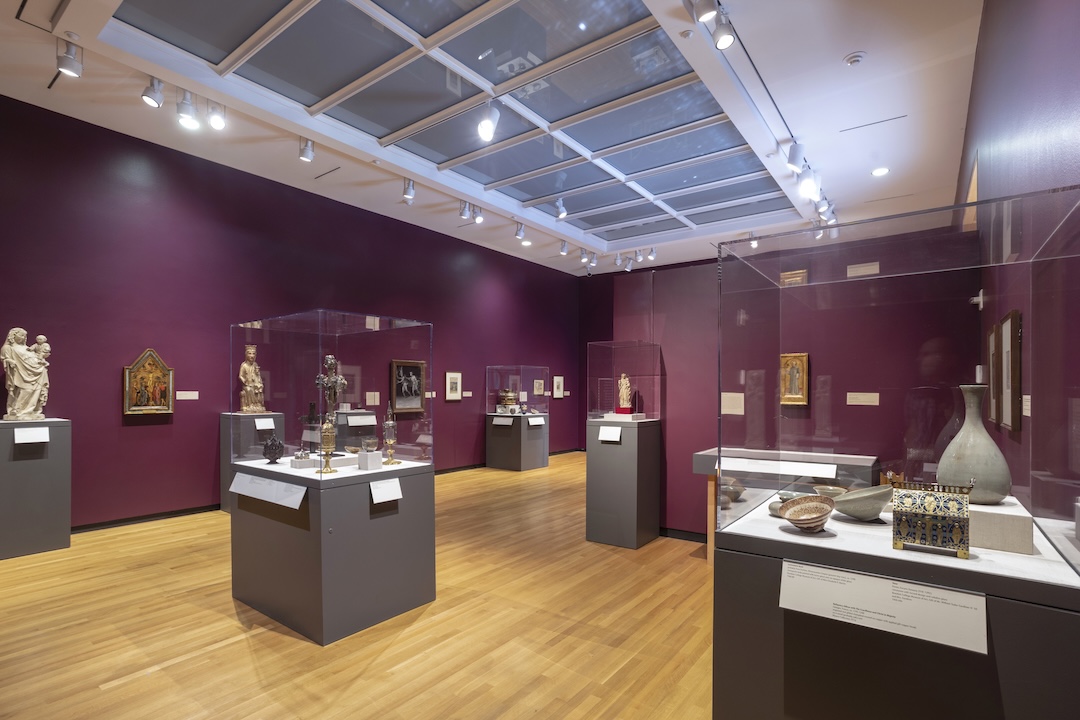
Featured in the Shaw Ruddock Gallery as part of the exhibition Medieval Art from the Wyvern Collection: Global Networks and Creative Connections, five celadon ceramics reside together in a display case accompanying the section “Trade Secrets: Technical Expertise and Craftsmanship.” While the greater exhibition highlights many extraordinary pieces of art from the Middle Ages, these items caught my eye from the start of the summer. Curious to learn more, I researched them briefly for my student tour, and it became clear there was much more to discover. The items were acquired in 1940 and 1990 at the donation of Mr. William Tudor Gardiner and Mrs. Gardiner, and Mrs. Herbert S. Ingraham, respectively. The creation of the bowls is dated to the Goryeo dynasty (918–1392). However, the technique of celadon glazed bowls is much older, first used in the Song dynasty of China. Potters of the Goryeodynasty adapted and mastered techniques of the Song dynasty. Pottery made in the Goryeo dynasty was truly remarkable and exceeded what had been seen before.
Celadon ceramics earn their name from the specific green hue that is created in the firing process. The celadon color is produced in the kiln through a process known as reduction firing, meaning the amount of oxygen in the kiln is at a diminished level. Because oxygen quantity is low, the flame pulls oxygen from the iron oxide glaze, chemically altering the glaze and thus produces the celadon green. The complexity of this technique required mastery of craftsmanship, warranting an increased value of celadon glazed ceramics. Depending on the amount of oxygen in the kiln when fired, the colors of celadon ceramics can range from a soft yellow to a blue; in the case of the bowls in the Museum's collection, it is a jade-like green hue. Sharing a similar color to the culturally significant rock, jade, celadon ceramics became a sought-after commodity.
The five examples in the display case in the Wyvern exhibition show the different applications of the celadon technique. For example, a bottle in the case assumedly used for perfumed oil would have only been used by elite women, who had access to fragrances. Even more rare than the fragrance oils themselves would be the celadon glazed bottle. Also included in the case are three bowls and a large vase. The item that most caught my eye was a beautifully decorated bowl that particularly exemplifies the sophistication of the ceramic technique. Catalogued simply as "bowl", its specific maker is unknown. It is 3 1/2 inches in height, 7 3/4 inches in diameter, and intricate details cover the exterior and interior of the bowl. These details were created using an inlay technique developed in Korea called sanggam, which is the incision of designs, in this case cranes, into semi-dry clay before filling the incisions with liquid clay. This technique was developed in the 12th century—around the time this bowl was created. The cranes are also symbolically significant. In Korean culture, cranes represent longevity, harmony, and suggest proximity to heaven. This motif is present in this bowl, as the cranes are depicted with their wings stretched wide, flying in the sky amongst repeated white painted shapes emblematic of clouds. The introduction of celadon wares as a commodity demonstrated the expansion of celadon as more than a purely functional object. The beauty and intricacy of these ceramics was desirable for many elite members of Goryeo society to communicate status as well as cultural values.
We are lucky to have these artistically significant works of celadon in our collection. Stop by the Bowdoin Museum of Art to check out these objects for yourself!
Claire Stone ’28Communications Intern
Works:
Bowl, China, Song Dynasty (960–1279), stoneware with incised design and celadon glaze. Bowdoin College Museum of Art, Brunswick, Maine. Gift of Miss Elizabeth P. Martin, 1968.90
Vase, Korea, Goryeo Dynasty (918–1392), stoneware with incised design and celadon glaze. Bowdoin College Museum of Art, Brunswick, Maine. Gift of Mr. William Tudor Gardiner H ’45 and Mrs. Gardiner, 1940.404
Bowl, Korea, Goryeo Dynasty (918–1392), stoneware with inlaid slip and celadon glaze. Bowdoin College Museum of Art, Brunswick, Maine. Gift of Mr. William Tudor Gardiner H ’45 and Mrs. Gardiner, 1940.406
Bowl, Korea, Goryeo Dynasty (918–1392), stoneware with incised design and celadon glaze. Bowdoin College Museum of Art, Brunswick, Maine. Gift of Mr. William Tudor Gardiner H ’45 and Mrs. Gardiner, 1940.408
Oil bottle, Korea, late Goryeo Dynasty (918–1392), 12th century, stoneware with celadon glaze. Bowdoin College Museum of Art, Brunswick, Maine. Bequest of Mrs. Herbert S. Ingraham, 1990.3.18