Object of the Month: "Portrait of Cléo de Mérode" by Eugène Pirou
By Bowdoin College Museum of Art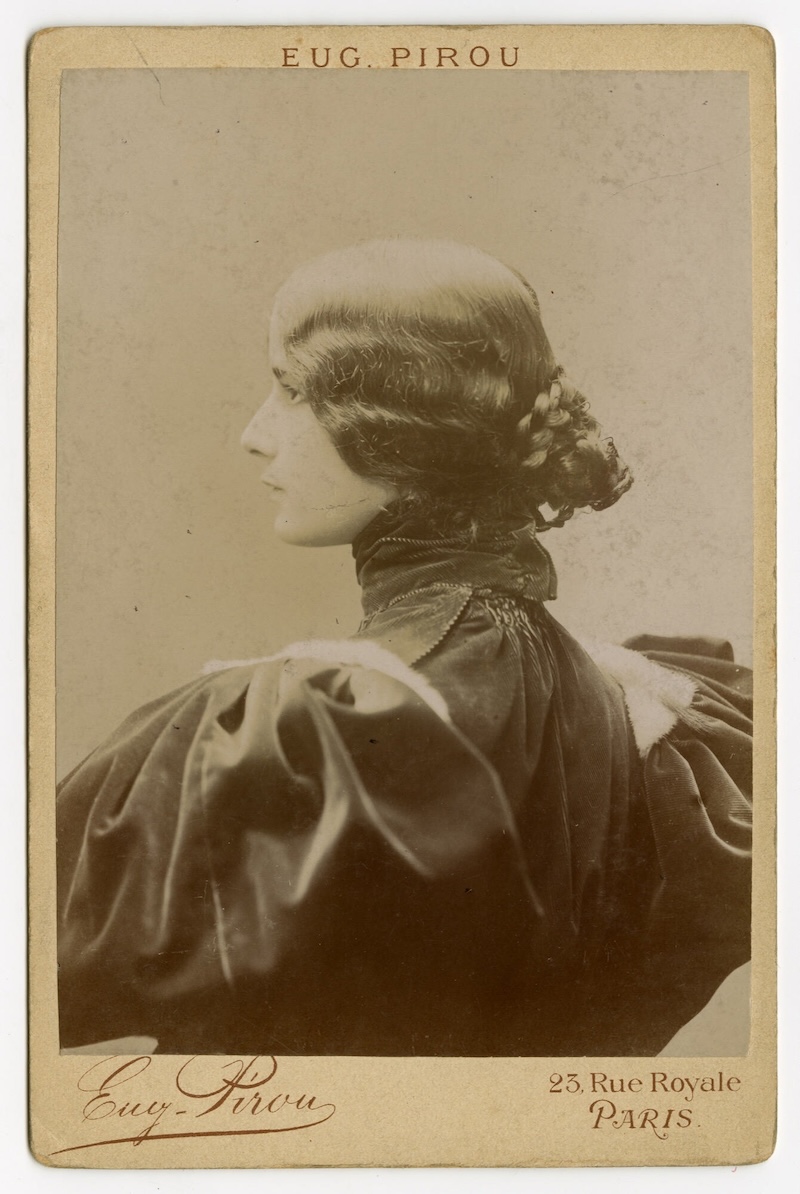
I first discovered Portrait of Cléo de Mérode on the BCMA’s web kiosk as a curatorial assistant in the summer of 2024. At that time, the cabinet card was named Profile Portrait of a Woman after its unidentified sitter. However, I recognized and re-identified the woman as French dancer Cléo de Mérode based on my familiarity with turn-of-the-century theater postcards. When I began to work on my Becker Gallery exhibition, From Guild to Genius: Inventing “The Artist” in Western Culture, a year later, I could not help but return to Portrait of Cleo de Mérode for the questions it surfaces about photographic authorship and copyright law at the turn of the twentieth century.
Cléo de Mérode was born Cléopâtre-Diane de Mérode (1875-1966) in Paris, as the illegitimate child of an expatriate Belgian noblewoman. Entering the ballet of the Paris Opera at age seven, she became one of the most famous dancers of the Belle Époque, the term used to describe France’s exuberant cultural and social landscape in the decade leading up to World War I. She was renowned for her mesmerizing beauty that was captured by the period’s most famous photographers, including , Leopold Reutlinger, and Cecil Beaton for Vogue when she was 90. She toured Europe and even had a limited stage run on Broadway in 1897. Mérode’s stardom coincided with the beginnings of cinema in France, which has led to her reevaluation as one of the first modern “celebrities.”
However, Mérode’s meteoric rise to fame did not come without its challenges, as she frequently experienced the impacts of the public’s negative opinion of her occupation. The ballet’s predatory environment—in which young female dancers were forced to entertain wealthy men behind the curtain—led to its reputation as the “national harem.” The sensational French press further swayed the public’s understanding of the occupation, often portraying famous dancers as courtesans, a contemporary term used to describe sex workers who had wealthy or aristocratic clients. Early in her career, Mérode had personally grappled with the damaging ramifications of the scandalous—and unsubstantiated—rumor that she and King Leopold II of Belgium were having an affair.
Nonetheless, Mérode used photography to shape her public image as a courtesan into France’s national treasure. For example, she was rarely photographed as a ballerina after her original stardom. She also adopted a signature “look” that made her pictures iconic; she did not subscribe to the “naughty” suggestion that many female entertainers cultivated in their image through leading winks or suggestive hand gestures. Instead, she often looked away from the camera, reversing the conception of the promiscuous dancer by making herself unattainable. Moreover, Mérode was always photographed in a low bun that covered her ears, and the press soon drew comparisons between her and Botticelli and Leonardo’s Renaissance beauties. Professor Michael Garval, Mérode’s biographer, explains that Mérode was one of the first to manipulate her image via photography in a similar manner to celebrities today, transforming herself from a sexual object into an “objet d’art” collected by thousands. Mérode soon captivated the public: they voted her the most beautiful woman on the Paris stage a year after her scandal in 1896.
New research into Portrait of Cléo de Mérode illuminates that, while Mérode had the power to stage the original images in the studios of famous photographers, they often had a life of their own. The artist's stamp on the BCMA’s photograph reads “Eug. Pirou,” corresponding to the French photographer Eugène Pirou. However, it is also stamped with the address “23 Rue Royale,” which is incorrect if the object was printed by Pirou, as he was only known to have worked in studios located at No. 3 and No. 5 Rue Saint Germain, Paris.
A document from the office of notary Felix Edouard Lefebvre in the French National Archives reveals that, in October 1889, Pirou legally ceded the right to use his name for a new photography establishment at 23 Rue Royale to a man named Arthur Herbert. Although this arrangement may seem counterintuitive to contemporary viewers, who might assume that an artist would want to protect their work from plagiarism, it was more common for photographers in the nineteenth century. These arrangements would both bolster an established photographer’s popularity, while attaching a reputable name to a fledgling photography business. For Pirou, it was also profitable, as the notary document outlines that Herbert paid 100,000 Francs over three, three-month installments to purchase the rights. In return, Herbert received access to Pirou’s “materials.” The document is unclear in its definition of what constitutes “materials,” but it can be inferred that it most likely ranged from Pirou’s name itself to photography supplies or his own negatives, including this portrait.
These arrangements could happen more freely for photography, since the medium was still unevenly protected by copyright law in France during this period. Critics saw photography’s mechanical reliance as preventing the medium from representing the “mind or genius” of an artist, which was needed to receive a copyright. To reverse this assumption, photographers used dancers and stage actresses like Mérode to argue that their “imprint of personality” was made visible through their creation of highly stylized, theatrical photographs. Pirou’s act of increasing his name’s circulation through his arrangement with Herbert may speak to a desire to center himself, a photographer, as a notable creator. In giving Herbert the right to use his name, Pirou even recreated the historical tradition of an artist and his workshop in a modern context; Herbert as the Apprentice, who carried out the monotonous artistic labor of developing and printing, and Pirou as the Master, who became the credited conceptual author of their joint efforts.
However, Pirou’s arrangement soon unraveled. By 1898, Arthur Herbert sold his business and rights at 23 Rue Royale to Oscar and Georges Mascré. The brothers began to expand their presence and exploit Pirou’s name, going as far as having one of their older employees impersonate the artist. This extravagant advertising led the real Eugène Pirou to sue the brothers in 1907 on grounds that he gave only Arthur Herbert legal use of his name. Pirou lost the case because the original notarized document stated that Herbert or his successors were permitted to use it. However, as photography’s status as an art rose in the years following 1889, the court also ordered the brothers to include the words “the house founded by Eugène Pirou” on their future work. This complicated history reveals that, while Pirou was probably the original photographer behind Portrait of Cléo de Mérode, it was most likely Arthur Herbert, the Mascré brothers, or their associates who printed it for sale. In doing so, the imposters—both legal and illegal—have blurred the line between forgery and original.
Mérode’s quest to legitimize her art in the face of male critics and the portrait’s contested production history complicate the question of authorship in Portrait of Cléo de Mérode. Within a male dominated canon, photography provided female creatives like Mérode agency over the construction of her image, which had long been controlled by male artists. The multiple artistic hands responsible for its creation also challenge the Renaissance-derived ideal of artistic authorship as exceptional. The portrait instead resists a singular attribution: Is its artist Pirou, who made the original photograph? Herbert or the Mascré brothers, who printed it? Or Mérode herself, whose intention shaped its creation? Ultimately, the portrait’s production history demonstrates the precarious nature of naming a singular artist and asks us to consider what is lost when we do so.
Portrait of Cleo de Mérode is currently on view From Guild to Genius: Inventing “The Artist” in Western Culture.
Marianna Zingone '26Curator of From Guild to Genius: Inventing “The Artist” in Western Culture