Object of the Month: "Ella Watson, American Gothic, Washington, D.C." by Gordon Parks
By Bowdoin College Museum of Art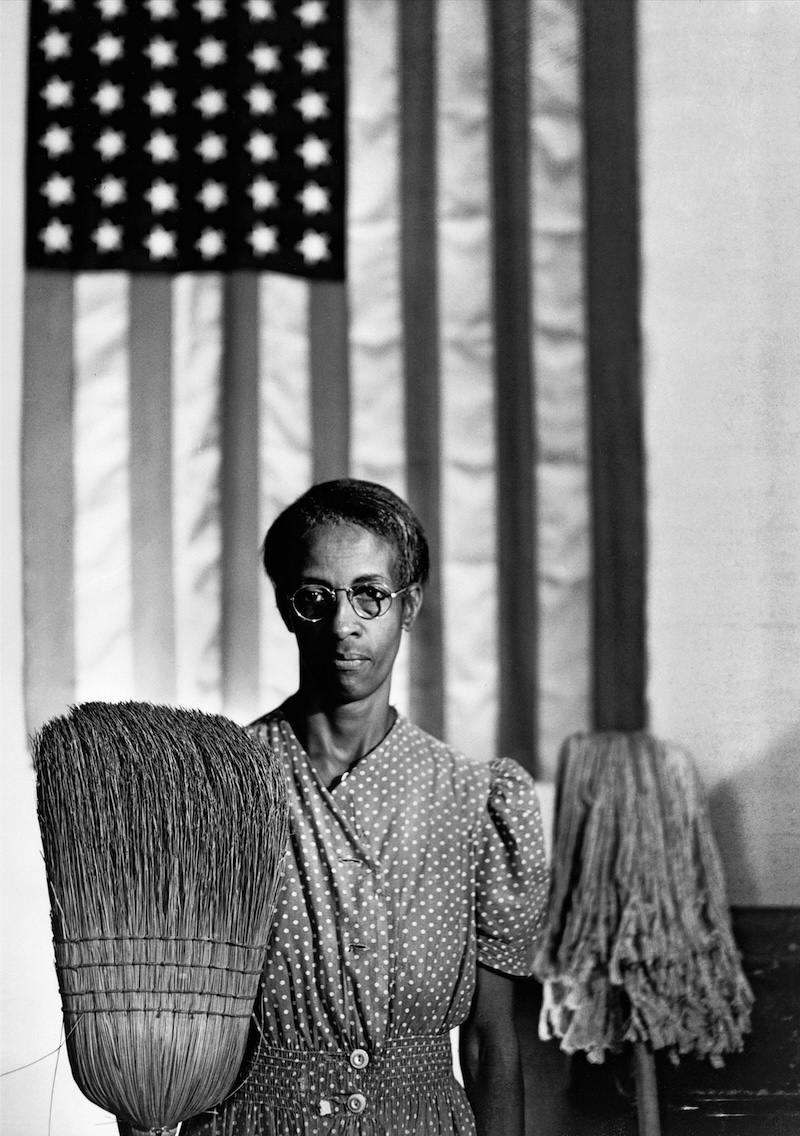
Gordon Parks, Ella Watson, American Gothic, Washington, D.C., 1942, gelatin silver print on paper. Bowdoin College Museum of Art, Brunswick, Maine. Museum Purchase, Lloyd O. and Marjorie Strong Coulter Fund. Courtesy and copyright The Gordon Parks Foundation.
In his famous photograph Ella Watson, American Gothic, Washington, D.C. (1942), Gordon Parks (1912 –2006) positioned Ella Watson, who worked as a janitor in government offices, in front of an American flag with a broom and mop in her hands. In her pose and title, she echoes Grant Wood’s 1930 painting American Gothic, an iconic image of rural American resilience, while also providing a critique of the country’s inequities.
Parks created this image while on a year-long fellowship with the Farm Security Administration (FSA) in Washington, D.C, a New Deal program originally designed to help farmers recover from Depression-era agricultural disasters. In the 1930s, the FSA began hiring photographers to record the conditions of those who lived in rural or small-town environments and illustrate the necessity of federal assistance. In addition to Parks, famous photographers like Ben Shahn, Dorothea Lange, Walker Evans, and Arthur Rothstein worked for the FSA (and their works can be found in the BCMA’s collection).
Having spent his youth in progressive Northern cities like Minneapolis and Chicago, Parks was unprepared for the challenges he faced upon his arrival in the then-racially segregated city of Washington, D.C. Parks recalled that in a single day he was “refused service at restaurants, barred from a theater, and dismissed by a department store clerk.” He later said, “I had experienced a kind of bigotry and discrimination here that I never expected to experience.”
In response, Parks decided to focus on documenting Black life in the capitol, and turned his attention to Ella Watson, who worked as a charwoman, or cleaning woman, in the FSA building. After learning about her family and her struggles, Parks decided to make Watson the subject of his first extended picture story, and for four months Watson gave the photographer access to her home and community. The resulting photographs—which show Watson not only her work as a custodian, but also at home with her family, and serving as a deaconess at her church—were a breakthrough in Parks’ career. Through Watson, Parks gained an intimate, humanist perspective on Black American life beyond the historical gleam of white Washington, D.C., one that captured both struggles and moments of joy.
Parks saw in Watson a potent critique of the country’s inequalities as well as an illustration of American fortitude. In creating the photograph, the artist said: “I felt that I must photograph this woman in a way that would make me feel or make the public feel about what Washington, D.C., was in 1942. So I put her before the American flag with a broom in one hand and a mop in another. And I said, ‘American Gothic’—that’s how I felt at the moment.” The photograph reveals Parks’ experience of coming to terms with the segregated city he once embraced as “the seat of democracy,” with all its promises and perils.
Notably, When Parks showed American Gothic to Roy Stryker, the head of the Historical Division of the FSA and Parks’ boss, he was warned that its publication could cost them their jobs. As the FSA was a government agency, the provocative image was considered too controversial. Despite being taken in 1942, the photo remained unpublished until 1948, when Parks became the first Black staff photographer at LIFE magazine.
Today, Gordon Parks’ Ella Watson, American Gothic, Washington, D.C. is one of the most iconic photographs in the history of American art and documentary photography writ large. It is currently on view in USA @ 250 at the Bowdoin College Museum of Art.
Anne Strachan CrossAndrew W. Mellon Postdoctoral Curatorial Fellow