Object of the Month: "Tlaloc" (1944) by Josef Albers
By Bowdoin College Museum of Art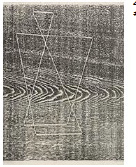
“Art is revelation instead of information, expression instead of description, creation instead of imitation or repetition. Art is concerned with the HOW, not the WHAT; not with literal content, but with the performance of the factual content. The performance—how it is done—that is the content of art.” – Josef Albers
I first encountered Tlaloc (1944) by Josef Albers in researching several works that arrived at the Bowdoin College Museum of Art in a generous gift from Howard M. Haimes ’76. Initially, I wasn’t sure what to make of the print. It seemed simple yet somewhat difficult to read. It wasn’t until I learned more about the work and artist that I found that Tlaloc beautifully embodies many key sentiments of Alber’s practice.
Born in Bottrop, Germany to a master craftsman and the daughter of a blacksmith, Josef Albers was an artist and educator best recognized for his exploration of color perception and spatial relationships in art. Albers worked with various mediums including photography, graphic design, painting, printmaking, and furniture design. His innovations in abstraction and color theory with works such as his series Homage to the Square are often considered precursors to color field painting and optic art. Before his career as an artist, Albers worked as an elementary school teacher for twelve years. He began his art studies in 1913, attending the Royal Art School in Berlin, the Kunstgewerbeschule in Essen, and the Art Academy in Munich before he enrolled at the Bauhaus in 1920.
The Bauhaus was an innovative German art school that aimed to reimagine the material world through the integration of art, craft, and technology. The school helped shape modern art and challenged traditional aesthetics with its emphasis of principles such as material and form, simplicity, functionality, and mass production. Its influence is still prevalent in the art, design, and architecture of today. During his time at the Bauhaus, Albers began his experimentation with abstract art and was exposed to ideas such as incorporating a material’s inherent qualities into his works. Albers began teaching at the school in 1923 and did so until 1933 when the school was forced to close by the Nazi Regime. Following the school’s closing, Albers emigrated to the United States bringing with him the avant-garde ideas of Bauhaus.
Tlaloc is a woodcut on paper. The print is named after the Aztec god of rain, inspired by the various trips to Mexico that Albers took with his wife between 1935 and 1967. The work is often reproduced in the portfolio Formulation: Articulation, a collection considered as a capstone of the artist’s career. Tlaloc’s composition is simple consisting of a rippling water effect with a series of thin, straight lines carved on top. While the work only contains a few elements, each one is done with great intention as Albers leaves little mystery to the how of the print. Perhaps the most noticeable aspect of the work is the background imagery of water. In the portfolio, regarding the woodcut, he comments “to show wood merely as wood is a factual report. To make wood acting as water is an actual engagement.” Rather than hiding the material, he embraces it using the grain of the woodblock to effectively depict the movement of water. Additionally, Albers also manipulates the properties of the ink, leaning into its tonal capabilities. Throughout the print there are subtle shifts in the tone of the ink that create vertical streaks, giving the appearance of rain. The final and possibly the most abstract visual element is the series of lines. While it doesn’t seem that they depict anything specific, their arrangement functions like a circuit. The lines are placed in a manner that they connect, making a continuous path of flow that alludes to the way water cycles through the atmosphere. These visual elements individually demonstrate the method of the artwork, but they collectively work together to create a scene that is familiar. This familiarity is married with the unfamiliarity that Albers presents in the use of the title Tlaloc. It is from this marriage that the viewer is introduced to a new perspective of something they know, experiencing a revelation and re-presenting of nature.
Tlaloc will be on view in the upcoming exhibition Creating the Modern: Works on Paper from a Recent Gift by Howard M. Haimes ’76, on view March 26, 2026 - May 31, 2026.
Taylor Dunn
BCMA Summer Curatorial Intern, who is currently a graduate student in the Chadwick A. Boseman School of Fine Arts at Howard University
[i] Josef Albers, quoted in Danilowitz, Brenda, The Prints of Josef Albers: A Catalogue Raisonné, 1915–1976. New York: Hudson Hills Press, 2001.