Building Community and Joy Through Art
By Bowdoin College Museum of Art
Edwin Kim ’27 is the student curator behind the upcoming exhibition hyperVISIBLE: Building Community in Diaspora through Contemporary Art, opening at the Bowdoin College Museum of Art (BCMA) on November 19, 2026. Amanda Skinner, Assistant Director of Museum Communications, spoke with Edwin and supervising curator Cassandra Mesick Braun to learn how hyperVISIBLE came together. The transcript has been condensed and edited for clarity.
Amanda Skinner (AS): It’s been great to see you back in the BCMA, Edwin, as you’ve been working on hyperVISIBLE. How did this project begin for you?
Edwin Kim (EK): I saw the call for student exhibition proposals in the Campus Digest while I was abroad—a friend sent me a screenshot and said, “Dude, you have to check this out.” It was a very last-second application, but the timing felt right. I'd worked at the BCMA as a student intern with you in the communications department, and that really shifted my thinking professionally toward museum work.
I had seen the exhibition Without Apology: Asian American Selves, Memories, Futures when it was up. That show was centered on the Asian diaspora, and I'm Korean American. It spoke to me in ways I didn't fully realize in the moment, but thinking back, it was a big deal. And it made me notice a gap in the representation of other diasporas. That became my starting point.
Hypervisibility as a concept came later. My original application was broadly about diaspora, but we needed to narrow it down. Around that time, works by Tommy Kha were being acquired by the BCMA—I got this big sheet of his photographs, maybe twenty pages. My first thought was that they felt kind of silly. Not unserious, exactly, but very playful. And then there's this eerier undercurrent once you understand why he's making them: his family's journey to America, his experience as a queer Asian American in Memphis. The word “hypervisible” clicked for me while looking at his work, and I started finding ways to connect it to other works in the collection.
AS: How exactly did this term “hypervisible” click for you as the entry point for the exhibition title?
Cassandra Mesick Braun (CMB): Part of it was working through the exhibition description at the same time Edwin was brainstorming titles. When I read his draft, I pushed him to be more specific about what “hypervisible” actually meant—is this a term with an academic grounding in diasporic studies? What are visitors going to take from it? He came back with language that captured both sides: communities wanting to be seen and being overlooked, but also the way hypervisibility can simultaneously other or ostracize. The complexity was part of the point.
EK: I also just thought the word sounded great. (laughs) But honestly, at Bowdoin, the word “dialogue” gets tossed around a lot. We talk about what it means to be a person of color here, or to be part of an underrepresented group, but sometimes the conversation just ends there. That's where “building community” came in. Hypervisibility captures both sides of being seen so visibly for something you can't control, while still lacking the visibility you actually want.
I knew I didn't want to make a show that was doom and gloom. The artworks in the exhibition show many sides of the diasporic experience. The community aspect was always the point—I didn't want “hypervisible” to read like another lecture on what it’s like. Students who identify that way already know. They're looking for ways to build something through that experience.
CMB: The artists Edwin chose are actively foregrounding joy, humor, and playfulness without denying those histories. That became an important lens for me curatorially too.
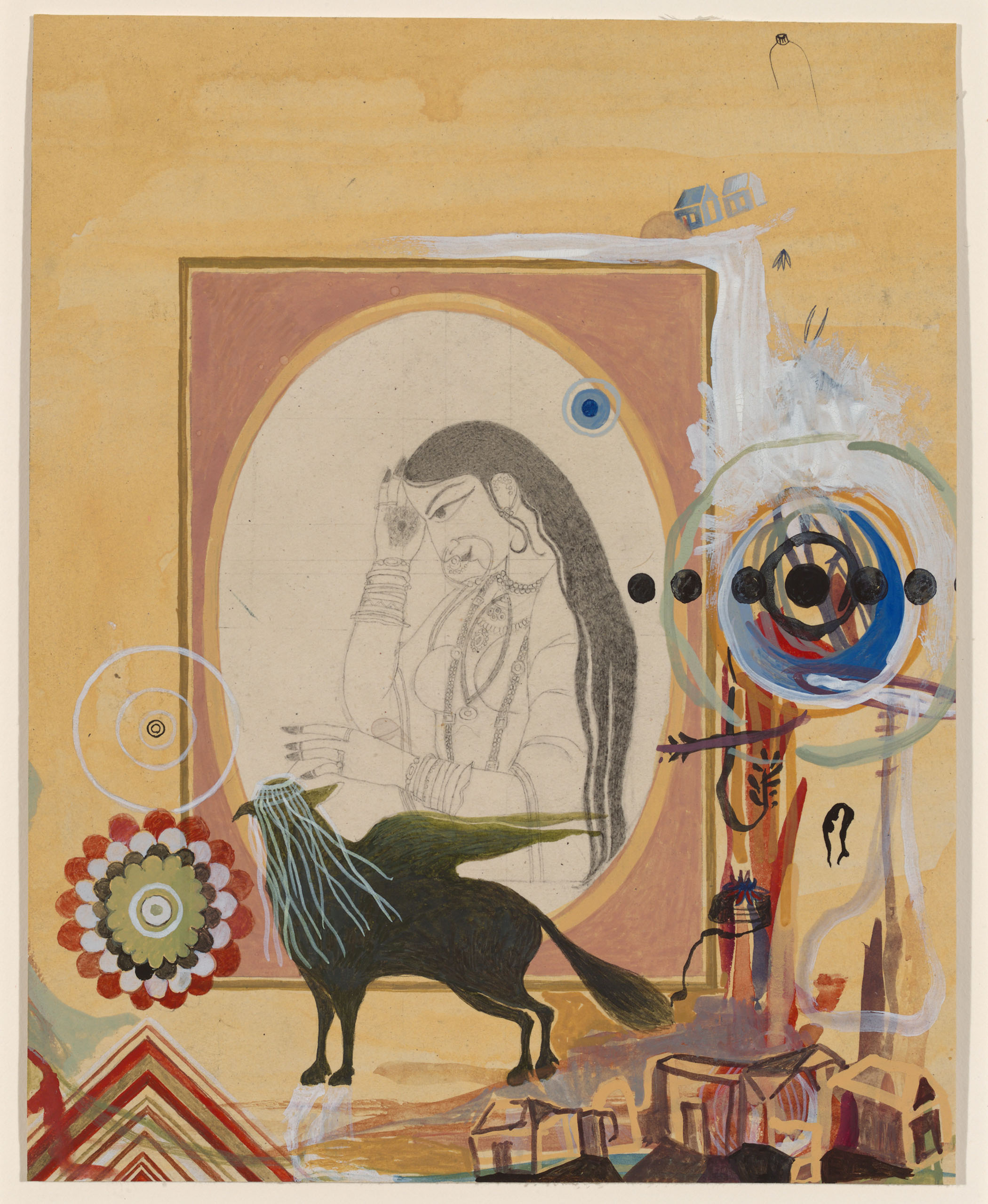
Shahzia Sikander, Ready to Leave, Series II, 1997, vegetable color and watercolor on wasli paper, 7 3/4 x 6 1/4 in. (19.69 x 15.88 cm). Bowdoin College Museum of Art, Brunswick, Maine. Museum Purchase, Laura T. and John H. Halford, Jr. Art Acquisition Fund, 2021.70. © Shahzia Sikander
AS: So Casey, what does curatorial mentorship actually look like on a project like this?
CMB: For me, it’s about meeting the student curator where they are. Edwin came with an idea that was exciting and relevant and beautiful but really big. A lot of the mentorship was helping him think critically about what he wanted to say and how he could say it through the works of art we have at the BCMA. It was about preserving his voice and vision while giving real training in how to make focused arguments and engage in visual analysis.
I'll also say that the mentorship genuinely went both ways. At a certain point, Edwin was onto something more interesting than what I'd even been thinking. He'd looked at a range of works and came back and said, “the themes I keep seeing are about building community, joy, playfulness—that's what I want to run with.” That direction came from him.
One concrete example: as the acquisition of photographs by artist Tommy Kha was moving forward, we shared a list of available works with Edwin and asked which ones resonated with him and why. He identified specific photographs and articulated exactly why he felt they were so resonant—I was able to take that back to the Collectors’ Collaborative group overseeing the acquisition. So, one of the works ultimately chosen for acquisition was a direct result of Edwin’s input, and it will be a focal point of the exhibition.
EK: I honestly didn't expect that. I'd given it some thought and said, “I really like this photograph, this speaks to me.” And now it's in the show and in the collections. That was really cool.
AS: Along those lines, Edwin, what surprised you most about moving from an idea to a physical exhibition?
EK: Even after interning at the Queens Museum and the BCMA, I'd never actually been the one to make curatorial decisions like picking a wall color, choosing a graphic design scheme, or generating ideas that end up on the website. Those were always things I'd observed, not made. Actually being responsible for them was harder than I expected but the support system made the difference.
AS: As the curator of this exhibition, Edwin, what do you hope visitors take away from it?
EK: I picture my friends walking through with each other and just... relating. To what's on the walls, and to each other. On an academic campus, there's pressure to leave with a thesis or a strong argument. That's not what this show is going for. I want people to feel closer—to whoever they came with, or to this campus—just from knowing that somebody thought these works were worth putting in a museum.
Amanda SkinnerAssistant Director of Museum Communications