Exploring "Josefina Auslender: Drawing Myself Free"
By Bowdoin College Museum of Art
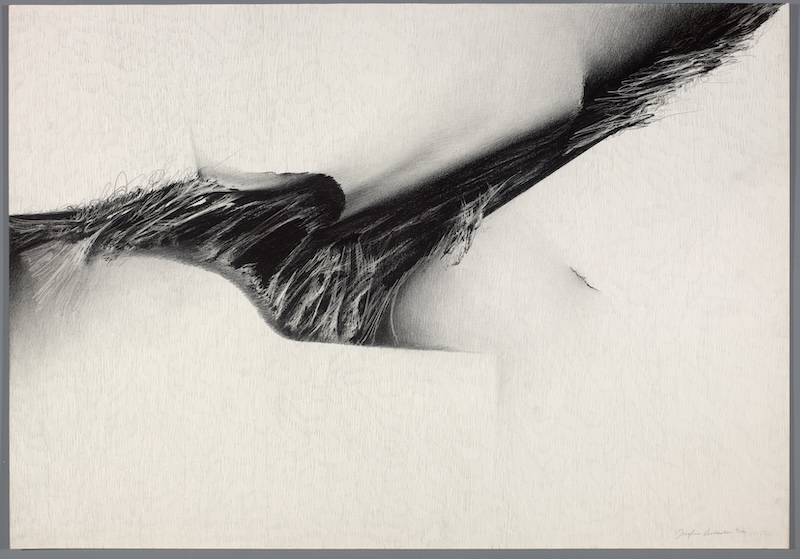
In December, the Bowdoin College Museum of Art opened Josefina Auslender: Drawing Myself Free, an exhibition featuring more than eighty drawings by the Maine-based artist Josefina Auslender. Auslender was born in Argentina in 1934, and by the 1960s she was a rising star in the dynamic art scene of midcentury Buenos Aires. As she honed her technical skills as a draftsperson, she became celebrated for work in graphite that reflected her interest in Surrealism and abstraction. She emigrated to the United States in the late 1980s following the political instability and violence of Argentina’s Dirty War (1976–1983), and settled in Cape Elizabeth in 1991. Auslender has continued to expand her practice since then, creating drawings that invite visitors to explore immersive worlds built from her capacious imagination.
Despite her prolific artistic output, Auslender has received relatively little attention from institutions and scholars. Drawing Myself Free is the first career retrospective of her work, and the project has been incredibly rewarding; the joy of providing a long-underappreciated artist a platform to share their talent, curiosity, and passion cannot be underestimated. Yet curating such an exhibition also comes with challenges—a lack of existing scholarship with which to situate her oeuvre; the reconstruction of the social, intellectual, and artistic networks that weaved through her life; the winnowing down of hundreds of drawings to a sample that simultaneously represents the arc of her career and anticipates more to come. Fortunately, we had near-unfettered access to the most invaluable source of insight for the project: the artist herself, who, even in her early 90s, was able to reflect on her artistic practice with clarity, incisiveness, and humor.
On Thursday, January 29, at 5:00pm, audiences will have an opportunity to hear directly from Josefina Auslender about her remarkable life and career. During this public conversation with curator Cassandra Mesick Braun, Auslender will share more about the development of her practice, including how both global events and personal experiences have impacted her professional trajectory. Following this program, which will take place in Beam Classroom at the Visual Arts Center, audiences will be invited to enjoy a reception and view the exhibition with fresh eyes next door at the Museum. This event will provide not only an opportunity to engage firsthand with the artist but also offer a preview of content that will be published in a forthcoming eponymous monograph focused on Auslender, including an extensive oral history.
One of the essayists for this catalogue, Daniel R. Quiles, Associate Professor of Art History, Theory, and Criticism at the School of the Art Institute of Chicago, will visit campus to give a public lecture in conjunction with the exhibition on March 24th. He will present his research into the ways that complex ways that figuration, Surrealism, abstraction, and conceptualism played out in postwar Argentine art, offering new frameworks with which to understand Auslender’s drawing practice in the 1970s and 1980s. Indeed, it was during these pivotal decades that she established her signature style, developed her skills in graphite, and gained critical success in Buenos Aires. Yet it also corresponds to the Dirty War (1976–1983), a period of state-sponsored terrorism during which Argentina was ruled by a military dictatorship. Quiles’ overview of Auslender’s work and that of her contemporaries will suggest ways she can be written back into the art historical canon of Latin American modernism, situating her part of an important boom in drawing that occurred in Argentina between 1962 and 1981.
The BCMA will also offer in-gallery programs so that audiences can engage directly with the exhibition and artworks on display. Curator Cassandra Mesick Braun and student curatorial intern Camilo Rodriguez ’27 will each offer tours that reflect their own interests with respect to Auslender’s work. Dates for these programs will be forthcoming, so please check the Museum’s Events page to learn more.
Collectively, these programs will enrich this exhibition through programs that demonstrate ways to connect the practice of drawing personally and intellectually, as well as in ways that privilege the experiences and insights of an artist. We look forward to seeing you throughout the spring to celebrate Auslender’s work and explore the exhibition.