Reattributing a Portrait Bust by Edmonia Lewis
By Jeffrey Richmond-Moll, Ph.D., The George Putnam Curator of American Art, Peabody Essex Museum, Salem, Massachusetts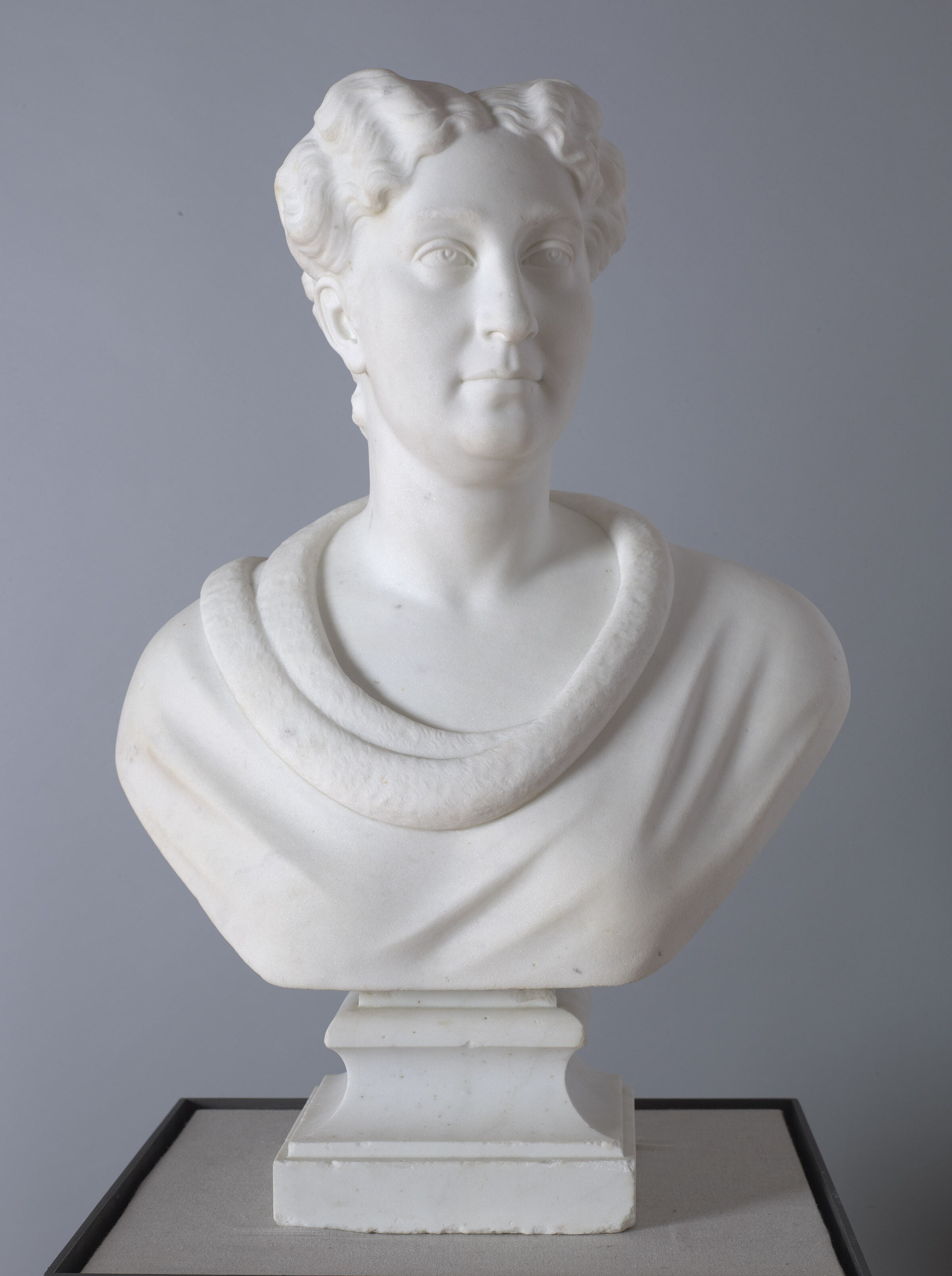
This winter one of the great 19th-century American sculptures at the Bowdoin College Museum of Art will begin a two-year national tour as part of Edmonia Lewis: Said in Stone, opening February 14, 2026 at the Peabody Essex Museum (PEM). The show is curated by Jeffrey Richmond-Moll, Ph.D., PEM’s George Putnam Curator of American Art, and Shawnya L. Harris, Ph.D., the Georgia Museum of Art’s Larry D. and Brenda A. Thompson Curator of African American and African Diasporic Art. Said in Stone is the first major museum exhibition on this pathbreaking sculptor. Through 30 sculptures by Lewis from public and private collections across the United States and abroad, displayed alongside works by her contemporaries and the generations of artists she influenced, visitors will discover Lewis’ mastery of marble and her remarkable, storied life.
Born in upstate New York in 1844, Lewis became the first sculptor of Black and Indigenous descent to achieve widespread international acclaim. Her mother was a member of the Mississaugas of the Credit First Nation, an Anishinaabe nation in present-day Ontario, and was known for her creativity in weaving and embroidery; her father was a free Black man who may have worked as a gentleman’s servant. Orphaned as a child, Lewis was raised by maternal aunts who profoundly inspired her as an artist. Her half-brother Samuel also supported her early education and artistic career. After several years at Oberlin College, Lewis settled in Boston in 1863, where a community of white abolitionist leaders and free Black activists supported her work as a sculptor. Some of her earliest successes were small portraits of famous abolitionists, US politicians, and social activists, artworks that were especially popular during the final years of the US Civil War. In the later 1860s, she shifted to portraying figures engaged in broader causes, including education reform and women’s rights.
The sitter in the BCMA’s bust has recently been identified as Ednah Dow Littlehale Cheney (1824-1904). A prominent social reformer, Cheney shared with Lewis a belief in the power of art to forge new forms of solidarity and selfhood. Cheney not only championed Black freedoms, religious tolerance, and women’s rights in her writings, but also authored several texts on the history of art.
In addition to their shared commitment to art and activism, a portrait of Cheney would make sense for Lewis given their shared commitment to emancipation and racial uplift. Cheney and her colleague Hannah Stevenson (1807-1887) ran the New England Freedmen's Aid Society in Boston, established in 1859 to recruit and send teachers from the Northern states to set up and teach in schools for free Blacks in the American South. Their offices were in the Tremont Street Studio Building, just off the Boston Common, when Lewis occupied a studio there in 1864-65. Lewis herself traveled to Richmond, Virginia, in the summer of 1865 with her Adeline T. Howard (1844-1922)--the daughter of Lewis’s landlords Edwin and Joanna Turpin Howard--to teach at a Freedmen's School in the city.
Several months later, Lewis departed for Italy, but Cheney remained a friend and ally, as one of several women who were key to advancing Lewis’s international artistic career. In March 1866, Lewis sent a photograph from Rome of her newest work, The Freedwoman on First Hearing of Her Liberty (modeled 1866; unfinished and no longer extant), which depicts a protective mother with her young son clinging to her waist at the moment of their liberation. It was the artist’s first sculpture on the theme of emancipation, though she later abandoned putting the clay model into marble in favor of her sculpture, Forever Free (1866-67, Howard University Gallery of Art). Lewis declared her intentions to dedicate the work in honor of Cheney and Stevenson, demonstrating their shared belief in the power of women in the project of Black liberation and Lewis's bond with the two women even after she had departed for Italy
As a likeness of Cheney, the sitter's nose, eyes, chin, jawline, and neck in Lewis’s previously unidentified portrait are strikingly similar to Cheney’s features seen in a photograph of her taken around 1868-1875 (Schlesinger Library, Harvard University). Of course, Lewis seems to have taken liberties with Cheney’s hair, as she so often did with other female sitters, carving them with the most popular hair styles of the day. Further, based on a thorough review of archival photographs of the other major women reformers in Lewis’s Boston networks, no other major figure in Lewis’s biography bears a likeness to Bowdoin's bust.
This newly attributed portrait of Cheney will be on view at the Peabody Museum of Salem until June 13, 2026, and then travel to the Georgia Museum of Art (August 8, 2026 - January 3, 2027) and the North Carolina Museum of Art (April 3, 2027- July 11, 2027).
Jeffrey Richmond-Moll, Ph.D.The George Putnam Curator of American Art, Peabody Essex Museum, Salem, Massachusetts