Object of the Month: "Ellis Sanders" (2025) by Adebunmi Gbadebo
By Bowdoin College Museum of Art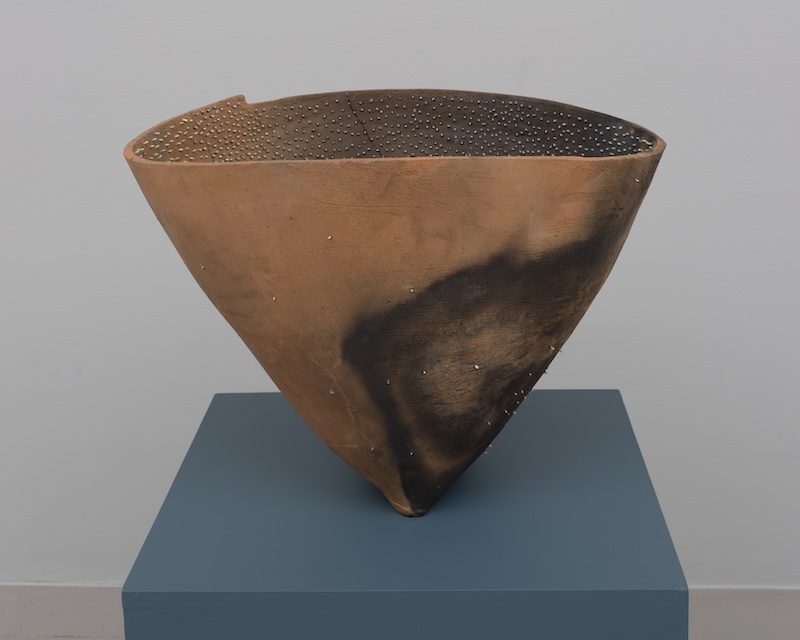
To create her sculptural works, the artist Adebunmi Gbadebo (b. 1992) begins by traveling to the True Blue Plantation in Fort Motte, South Carolina—the site of her maternal ancestors’ enslavement—and hand-digging hundreds of pounds of iron-rich red soil. At her studio in Philadelphia, the artist then combines this soil with other clays to create workable material for her ceramic vessels. The works’ unique sizes and anthropomorphic shapes develop instinctually as the artist hand-builds each of them using a Nigerian and Cameroonian coiling technique. In using this technique, Gbadebo must move around the clay, as opposed to standing or sitting still and having the clay spin around her on a wheel. The artist’s own body and her family’s essence are thus imbued into every piece, which are a material manifestation of Gbadebo’s own journey through loss, family history, and reclamation.
The work Ellis Sanders (2025) is a striking example of Gbadebo’s rich conceptual practice. A cone-like vessel, the work has a narrow, flattened base that opens into a wide mouth at the top. The work’s rich rust-like color—a result of the iron-rich soil—is irregularly punctuated by sweeps of Black created through the addition of combustibles like sugar, salt, and hair. The exterior of the work is irregular, with some visible repairs that evoke the artist’s own hand, alongside subtle additions of Carolina Gold Rice, a product of enslaved labor. Peering inside, the viewer is then treated to a cosmos of individual grains of rice; to create this effect, the artist scored individual holes into the clay before firing the sculpture and then inserted the rice afterward. The work’s interior also features a stunning blueish-gray patina that flows across the surface, created by the artist throwing Epsom salts into the work during the pit-firing process.
Each of Gbadebo’s sculptures is named for an ancestor, which the artist learned from researching the will of True Blue’s enslaver. Works such as Ellis Sanders assert themselves not only as art objects, but also bodies occupying space, announcing their claim on both past and present.
In speaking of her work, Gbadebo often underscores the good fortune she feels to be working with the very soil that once held her enslaved forebears, and which enslaved artisans were forced to cultivate: “This land that I now have in my hands and me being a descendent from this soil, the fact that I could shape it and form it and do whatever I want, it is like the ultimate privilege.”[1] Gbadebo’s art, then, does not merely memorialize loss; it asserts the ancestors’ enduring presence in her practice, transforming burial into a site of emergence, or rebirth.
Recently acquired by the BCMA, Ellis Sanders (2025) complements other examples of ceramic art in the museum’s collection, including a historic stoneware jar from the Edgefield district of South Carolina (2020.40). The earlier work was crafted by enslaved artisans in South Carolina using the same soil as Gbadebo; together, the works initiate an important dialogue between the past and present, and reflect the Museum’s commitment to highlighting unrepresented narratives in the history of art.
Anne Strachan Cross
Andrew W. Mellon Postdoctoral Curatorial Fellow
[1] Press Release, Nicola Vassell Gallery, www.nicolavassell.com/artists/75-adebunmi-gbadebo/