“Imagine the most private thing you ever told somebody in your life,” remarked the student. “Now, I want you to think about saying that to an app like Instagram and all platforms that are linked to it.”
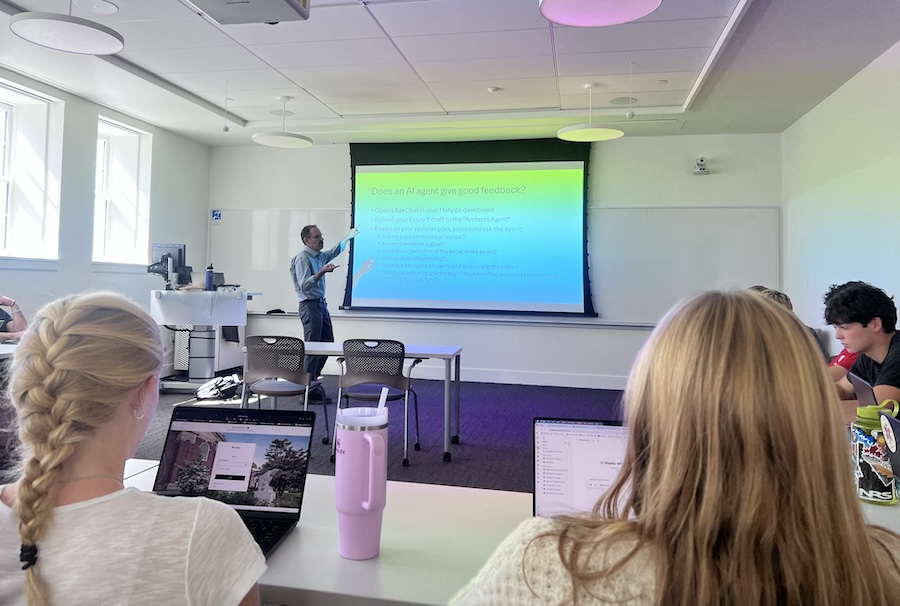
He was taking part in a discussion in a class called Ethics in the Age of Artificial Intelligence (DCS 2475). Taught by Associate Professor of Digital and Computational Studies Fernando Nascimento, the course invites students to consider the ethical issues that arise from a world transformed by AI.

This particular debate was discussing the pros and cons of using a generative AI tool as a romantic partner. When you share your personal thoughts with an AI that’s taking the place of a romantic partner, all privacy is most likely lost, the same student pointed out, referring to a number of studies on the subject. This information simply becomes a piece of data to be shared with other companies and used commercially—to figure out what product you might want to buy next, for example.
Others in the class were tasked with defending the role of AI as a romantic partner. “AI has played a role reducing violence in romantic relationships and helped lonely people cope with whatever they’re dealing with,” observed one student, who referred to a Harvard study suggesting that talking to an AI reduced loneliness, albeit not as much as talking to a real human. “People are having their voices heard, and they're getting feedback from an entity.” A study at Stanford University, meanwhile, showed 3 percent of participants reporting that an AI partner helped stop them from attempting suicide, the student added.

Nascimento's scholarship lies at the intersection of ethics and digital technologies. In 2023 he coauthored
Meaningful Technologies: How Digital Metaphors Change the Way We Think and Live with Bowdoin colleague Eric Chown.
After several students from each side of the argument had made their brief presentations, all citing research papers from a number of sources, the discussion widened to the rest of the class.
For nearly an hour they tackled a number of thorny questions—Can AI help cure loneliness or cause it? Can virtual interactions truly replace human connection, or are they going to increase isolation in the long term? Can we really trust machines run by for-profit companies to act in our best interests? If we become emotionally dependent on a piece of tech, can this also lead to a financial dependence that could be exploited? Most students ended up agreeing that the pitfalls outweigh the benefits when it comes to using AI for romantic partnerships.
“Sometimes we might worry about companies like Amazon knowing what we buy, and passing that information along,” said Nascimento. “These companies, the ones behind romantic partners, could know what we feel. So, imagine the potential they have to understand what you want.”
Add to this the development of virtual reality and it’s not hard to see a world where human-to-human interaction, including romantic involvement, is increasingly replaced by technology. “You'll not only be able to chat with an AI,” said Nascimento, “but you're going to be able to see the entity in a three-dimensional space.” There is now also the possibility of physical interaction with AI-based robots—a development Nascimento said has profound ethical and societal implications that need to be discussed in a course like this.
A Learning Process
Organizing a debate like this often engages students in a way that a straightforward lecture would not, said Nascimento.
“One of the great things about this sort of exercise is that you see the students really start to ‘own’ the argument. They have to prepare for these debates and be able to defend their position, which means exploring the issue from different angles.”
The course also studies other areas where ethics and artificial intelligence overlap, such as AI in the workplace, as more jobs are replaced by automation, and the concept of digital immortality, where AI tools are used to create connections with people who have died.
A class like this, stressed Nascimento, provides valuable training for a variety of careers, not just those in the tech field.
“With AI now so ubiquitous, it is no longer just tech companies using it. It’s in every sector. Think about a hospital, or a college, for example; they are now being exposed to AI, so they need people who know how to use AI ethically within those environments. For example, one of our students recently had an internship in Massachusetts General Hospital, working on a new initiative to create ethical guidelines.”
Fernando Nascimento recommends:
Christian, Brian. The Alignment Problem: Machine Learning and Human Values. New York: W. W. Norton, 2020.
Floridi, Luciano. The Ethics of Artificial Intelligence: Principles, Challenges, and Opportunities. Oxford: Oxford University Press, 2023.
Kearns, Michael, and Aaron Roth. The Ethical Algorithm: The Science of Socially Aware Algorithm Design. New York: Oxford University Press, 2019.
Buolamwini, Joy. Unmasking AI: My Mission to Protect What Is Human in a World of Machines. New York: Random House, 2023.
Coeckelbergh, Mark. AI Ethics. MIT Press Essential Knowledge Series. Cambridge, MA: MIT Press, 2020.
Russell, Stuart. Human Compatible: Artificial Intelligence and the Problem of Control. New York: Viking, 2019.
Elise Siciliano ’27 said she opted to take Nascimento’s class because she wanted to understand more about how the world is making the transition to incorporating AI models in new areas, specifically when the decisions a model makes can have serious implications for a person’s life. “Although AI is just a technology, it is increasingly being used in situations with more moral and ethical weight, making its impacts both social and technical,” observed the neuroscience and government major.
Alma Dudas ’27, a math and economics major, took the class last year because she wanted to develop a more holistic understanding of AI, including its ethical implications, potential benefits, and broader societal consequences. “I loved how we approached the topic from so many angles, from examining bias in AI training to discussing applications in health care, education, and the military,” Dudas explained.
“I think this kind of education is especially important in a liberal arts setting because AI raises questions that go far beyond the technology itself: Whose perspectives are reflected in these systems? Who bears the consequences when they fail? And how should we think about their role in decisions that affect people's lives?”