When the great Italian scholar and polymath Galileo Galilei (1564–1642) was seventy years old and nearly blind, he received a copy of a book about science. He was not happy with what he read, observed Professor of Digital and Computational Studies Crystal Hall.
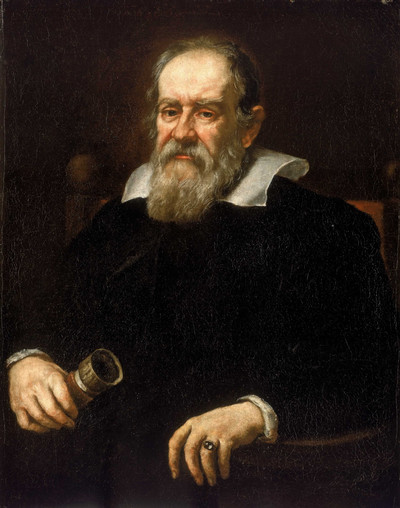
What angered Galileo was that the publication in question repeated scientific claims that he had spent much of his life disproving. The method he chose to voice his discontent, said Hall, was perhaps not one you would expect from the person often described as the “father of modern science”—he drew a pair of testicles in the margin of the text!
Galileo’s feelings were also expressed elsewhere in the book, she added, as he drew a little hand with a pointing index finger (known as a “manicule”) to insert his own hand-written comments.
“It's one of the best demonstrations we have of his reading habits,” she added, “how he was preparing a rebuttal. I just think it's amazing.”
Hall was speaking at a recent campus book launch for her latest work, Galileo's Library: Data, Methods, and the Humanities (Oxford University Press, September 2026), which tells the story of the more than 800 items Galileo amassed in his personal library during his long life.
Not all the items are books as we understand them today: They include personal letters and manuscripts, as well as works by other writers annotated by Galileo and examples of dramatic fiction, some composed by him. Many of these documents were dispersed upon his death, ending up in different collections and archives. Hall reunites them, including some that were previously unknown, applying innovative methods for data analysis and prioritizing historical context and linguistic features. Galileo's Library includes twenty-four data visualizations of patterns related to the collection of books and manuscripts, including interactive bookshelves, and sheds new light on Galileo's role in book circulation.
It also sheds new light on the man himself. Galileo is known by most people for his astronomical innovations: the stargazer whose observations supported the heliocentrism of Nicolas Copernicus, positing that the sun and not Earth was the center of the universe. Consequently, Galileo was tried for heresy by the Roman Catholic Church and in later life was forced to recant his views. Hall’s book does not focus on this story however, commented Assistant Professor of Romance Languages and Literatures Alejandro Cuadrado, who moderated the book launch.


“What's incredible about this book,” said the Dante scholar, “is that it’s about Galileo but doesn't even for a minute give us the Galileo that we all grew up learning about”—namely the lone hero who takes on the church and forges the path for modernity and science. “While not playing into that narrative, this book manages to show us how it is possible that such a narrative came about.”
“Galileo is such a hard personality to work with,” asserted Hall, who has spent almost two decades studying the relationships between Galileo and the literature of his time. “He's very aggressive in his letters. He's very cranky on his annotations. He was on a mission. That mission was about truth and observation. It wasn't about defying the Church; that isn't what he set out to do.” While he was an exceptional person, Galileo was also a normal human who was curious about what others thought of him, said Hall—something that comes across in his many hand-written notes.
“What's incredible about this book is that it’s about Galileo but doesn't even for a minute give us the Galileo that we all grew up learning about.” Assistant Professor of Romance Languages and Literatures Alejandro Cuadrado.
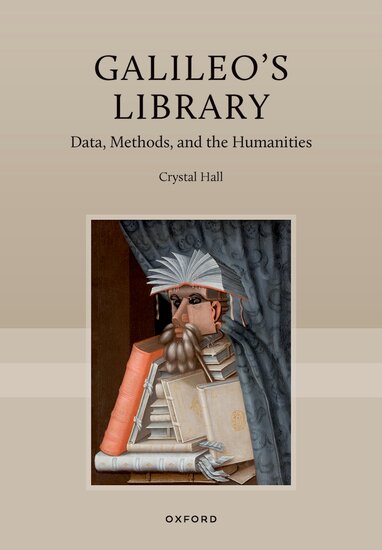
Galileo Galilei (1564-1642) amassed an impressive personal library over his lifetime. Reuniting 800 such items, Crystal Hall tells a story of fame and infamy, breakthroughs and frustrations, forgery and authenticity.
Further insights into the man are offered in one of the book’s earlier chapters, we are told, describing how Galileo wrote letters to people asking for help in acquiring books, essentially analyzing the network he was in touch with.
Hall said it felt strangely modern and relatable to see this legendary scholar writing to someone about a book and wanting to know what it said about him.
“There's a stereotype of scholars who receive a book and start at the back, looking first at the index for mention of themselves, then at the acknowledgments, and then maybe they look at the table of contents. Galileo is doing that too!”
Another revelation in the book is the extent of Galileo’s work as a playwright and lover of drama. Hall has found evidence of at least thirty-seven comedies in the Galileo household. It’s not known how many of these Galileo wrote, she explained, but the drafts of two that he did write have survived, including one bedroom farce where a man dresses up as his love interest’s housekeeper so that he can live in the same house as her.
“To take this person, whom I've always thought of as a major figure in the history of science, and to reread him as a playwright, was just extraordinary—someone who writes plays and shares them with family members, with friends, and is building up his own library with these other genres that aren't scientific.”
“Professor Hall is making a major contribution to what digital humanities can achieve with literary texts,” noted Cuadrado, “especially when looking at the premodern past.”