Students Encouraged to Embrace Academic Challenges on Sarah and James Bowdoin Day
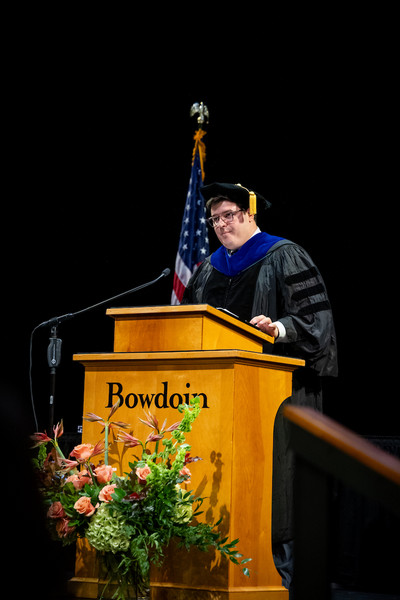
By Tom PorterAs students consider what classes to take next semester, they should challenge themselves by taking a difficult course in an unfamiliar field, urged Professor Alejandro Cuadrado.
They should do this, he said, “not to fulfill a requirement, or because you think having the course on your transcript might impress a future employer, but for curiosity alone.”
The assistant professor of Romance languages and literatures, a leading scholar on medieval Italian literature, delivered the Karofsky Encore Lecture at the annual Sarah and James Bowdoin Day Exercises, held on Friday, October 30, 2026, in Pickard Theater.
The ceremony, which is part of Bowdoin’s Family Weekend, recognizes the College's highest-ranking students—those with grade point averages in the top 20 percent of their class as determined by the previous year's record. The total number of Sarah and James Bowdoin Day Scholars among the students this year was 455.
Each scholar who earns a grade point average (GPA) of 4.0—the highest score awarded—also receives a Book Award, which bears a replica of the early college bookplate found on books in Hawthorne-Longfellow Library’s James Bowdoin Collection. A total of 130 scholars earned this award.
Additionally, the College honored twenty-one Phi Beta Kappa students, two of whom—Adam O’Connor Marianna Sofia Zingone—are from the Class of 2026. The rest are from the Class of 2027, among whom a further two students— Dorian Maillot and Isabella Grace Mele—also received the Almon Goodwin Prize, which is awarded to exemplary members of the academic society.
As he continued his keynote speech, Cuadrado invoked the 1802 inaugural address of Bowdoin’s first president, Joseph McKeen, who urged students to immerse themselves in a subject for its own sake rather than for economic motives—“not for the private advantage,” was a phrase used by McKeen, Cuadrado reminded the students. This, he added, takes us to the core of what the liberal arts are all about: “expending great effort toward the cultivation of the life of the mind, separate from the demands of the market.”
A liberal arts education, he continued, does a very good job of teaching the transferable skills of reading, writing, and critical thinking. “But,” he stressed, “skills development cannot be the reason we teach and study the humanities. If so, our objects of study would be entirely fungible. Instead, I think we who dedicate our lives to those works of art and literature that are the finest expression of human ingenuity ought to be a little bolder in defending them on those merits.”
Cuadrado, who teaches courses on Italian literature and culture ranging from Dante’s Divine Comedy to the critical study of modern tourism, said his words apply as much to students studying the sciences as they do to those studying the arts and humanities.
“No matter what subjects you choose to specialize in, you are being educated in them, rather than trained. Any skills you learn are secondary to the pursuit of knowledge that motivates your study. Rather than bending the liberal arts to the rationale that justifies the mechanical arts, I invite us all to defend the study of these arts as liberal—as free from the concerns of market forces or career preparation, and to restore curiosity and self-knowledge as the center of what we do, not for our own private advantage, but for the common good.”
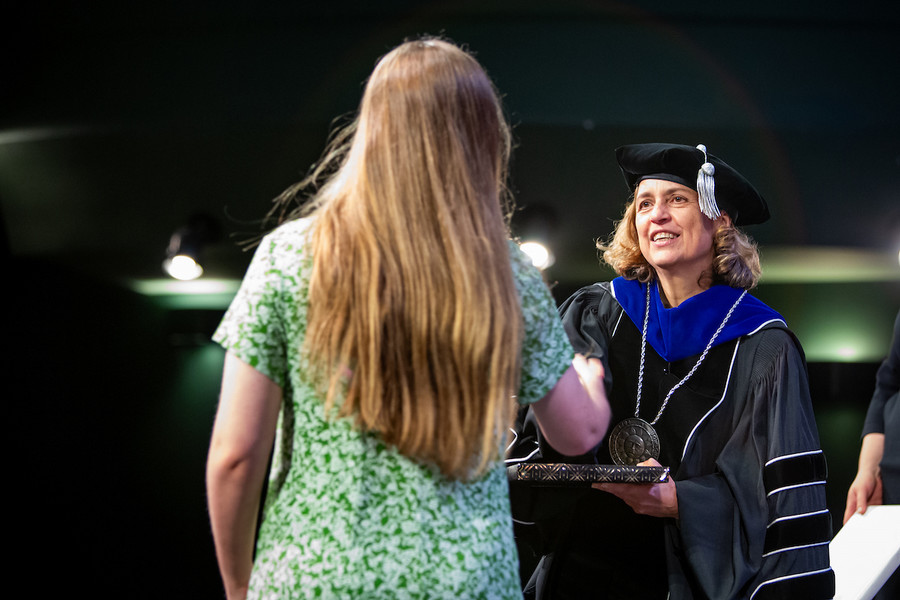
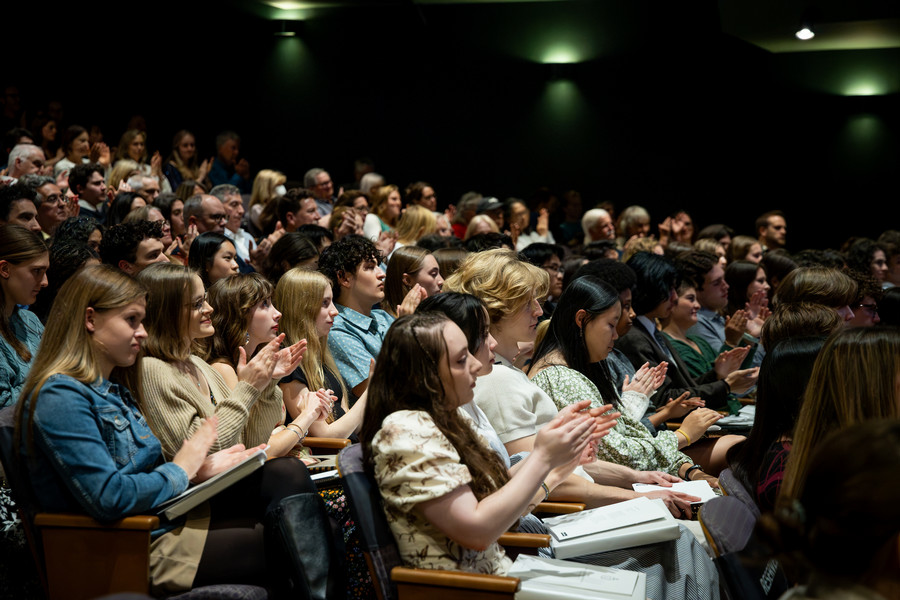
President Safa Zaki got proceedings underway with her opening remarks to the audience, which also comprised students' families and other members of the Bowdoin community, including faculty and staff. She paid tribute to the intellectual curiosity, discipline, patience, and creativity of the students being honoring today. They are asked to aim high, to solve complex problems, and explore difficult questions that resist easy answers, said Zaki.
“This is the hard work that often happens in collaboration with others, but also frequently happens alone,” she commented. "Late at night, in libraries, and labs, and dorm rooms, and over coffee all across campus. The students we honor today do their work with joy and passion and purpose.”
Zaki then introduced this year's student keynote speaker, Aidan Aybar ’28, a philosophy and economics major who has immersed himself in Bowdoin’s community, playing on the varsity baseball team and serving in the Bowdoin Student Government, of which he is now president. In his talk, “The Miraculous Task,” Aybar reflected on the value of focusing less on outcomes and more on the human processes of learning and creation—particularly in an age of rapidly developing artificial intelligence.
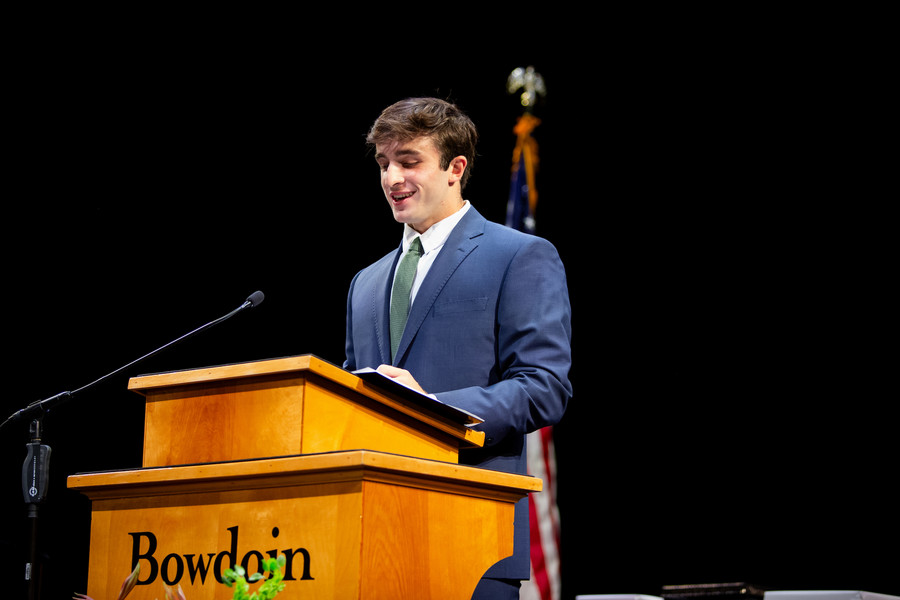
“I think it’s easy at a school like Bowdoin for us to become outcome-oriented—whether about grades, jobs, or just completing tasks. We can get caught up in where we’re trying to go,” observed Aybar. “If we organize our intellectual lives around outcomes, though, we run the risk of optimizing away the very experiences that make courses at Bowdoin so rich,” he added.
Aybar went on to celebrate the virtues of “intellectual wandering,” or “farting around,” as he also called it (quoting from an anecdote he told about the author Kurt Vonnegut). “When you fart around, you opt for uncertainty. It may be less convenient. When we choose to do this in our intellectual pursuits, we open ourselves to a wider and richer array of possibilities. When you prize efficiency,” he explained, “you may not take time to wander. But intellectual wandering without a guaranteed payoff is not only worthwhile — it is important and distinctly human. Wandering helps us to gain the strange collection of experiences from which our ideas are made.”
There is, he stressed, “intrinsic value” in human processes, as well as “something deeply human about sharing our processes with other people. In doing so, we are shown evidence of new things that are within our capacity as humans, even if presently beyond the periphery of our capabilities. When we share what we have learned and how we have learned it, or what we have thought and how we’ve developed those thoughts, it reveals to others what they too could learn if they choose.”
Click here to view the complete Sarah and James Bowdoin Day program for 2026.

Ceremonial music was provided by Beckwith Artist-in-Residence George Lopez on piano. He opened proceedings with Partita No. 4 in D Major by Johann Sebastian Bach (1685–1750). After the singing of the alma mater, “Raise Songs to Bowdoin,” Lopez concluded the ceremony with a performance of Toccata in G Major, also by Johann Sebastian Bach (1685–1750).
Bowdoin began recognizing James Bowdoin scholars in 1941 to honor undergraduates who distinguish themselves by excellence in scholarship and to commemorate the Honorable James Bowdoin III (1752–1811), the College’s first patron. James Bowdoin III—who asked that the institution be named after his father—was an agriculturist, art and book collector, and diplomat who served as Thomas Jefferson’s minister plenipotentiary to Spain.
By faculty vote in 1997, this commemorative day and scholarly distinction were changed to recognize both Sarah and James Bowdoin, who were married from 1780 until James’s death in 1811. Like her husband, Sarah Bowdoin gave many gifts to the College, including most of the Bowdoin family portraits, which were bequeathed to Bowdoin College upon her death.