The Beckman Scholars Award is aimed at talented undergraduates engaged in lab-based research in biology, chemistry, biochemistry, and the medical sciences. Each scholar receives a stipend of more than $20,000 to pursue their work over two summers and the academic year between them.
Bowdoin has received funding to support six students over three years. Cooper and Lex Renkert ’27 are the first two scholars in that cycle.
“A Great New Future for Antibiotics”
Maren Cooper began working in Danielle Dube’s lab the spring of her sophomore year, drawn to its investigation of Helicobacter pylori, a common bacteria that lives in the human stomach and can cause ulcers and gastric cancer.
The lab is engaged in what Cooper calls “ground-level” research, pursuing knowledge for the sake of greater understanding. But she also appreciates that this basic research can lay the foundation for medical breakthroughs in the future, both for H. pylori and for other bacterial illnesses.
With antibiotic resistance on the rise, H. pylori poses a worldwide health threat. Almost half the world’s population is infected with the bacteria, though only a fraction develop a serious illness.
Danielle Dube, Bowdoin’s Norma L. and Roland G. Ware Jr. Professor of Chemistry and Biochemistry, said she supported Cooper for the Beckman Scholars Award because of “the raw talent and potential that she demonstrated, with appreciation for ways it could help her continue to develop scientifically, build her mentor network, and grow as a burgeoning leader in the field.”
She added that the generous, extended stipend for undergraduates not only helps students realize their potential, but also “benefits research labs, leads to advancements in basic science research, fosters peer-mentoring of other young scientists, and provides examples of what’s possible for Bowdoin students in STEM.”
The Dube lab is broadly focused on studying the sugars sprinkled on the surface of H. pylori. “One of the roles of the sugars is they mediate the adhesion of the bacteria to our stomach cells,” which is the first step in infection, Cooper explained.
Bacterial sugars are an exciting area of inquiry for scientists because they tend to be unique to each species. “This means we could target H. pylori but not target beneficial bacteria in our microbiome,” Cooper said. “We could also target different pathogenic bacteria, or whatever bacteria we want, based on their sugars and the proteins they bind to.”
Her specific project in the Dube lab is studying the host cell proteins to which H. pylori’s sugars cling. “If we know more about these binding interactions, we’re opening up a whole new world of drug targets, a great new future for antibiotics.”
Dube said Cooper’s love of the research process—the doing, learning, and discovering—is matched by her tenacity, commitment, and creativity in the face of roadblocks.
Cooper’s experience has inspired her to apply to PhD programs next year, where she hopes to continue researching host-bacteria interactions and immunology. “If I could get a PhD in Danielle’s lab, I would!” she said.
Four Reasons to Love the Lab
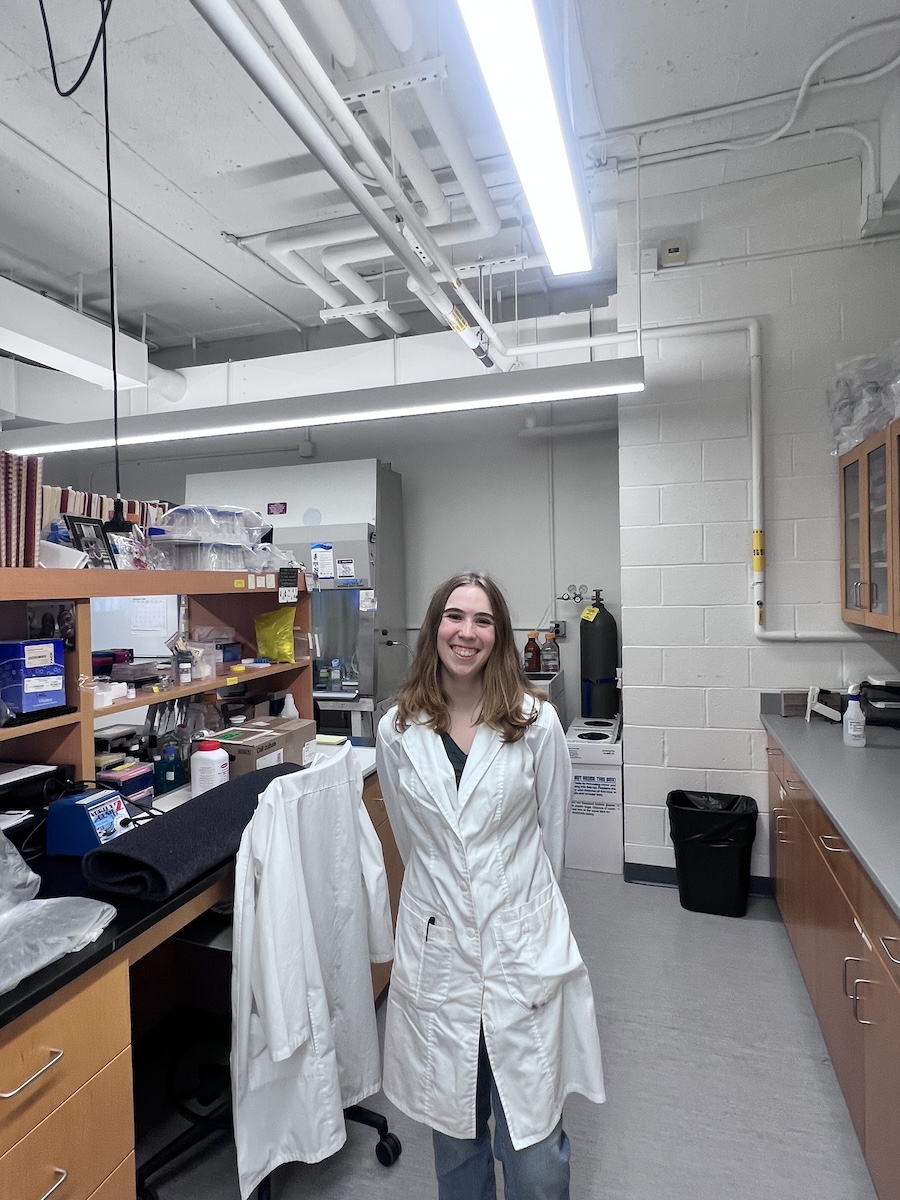
“I love working in the lab for a lot of reasons,” Cooper said, namely for the people, the questions, the techniques, and the discoveries.
People: “I love the environment; it’s very collaborative,” Cooper said. Dube typically has four students working with her and Senior Lab Associate Karen Moulton in the lab. “Even though I have my project and other people have theirs, we’re always bouncing ideas off each other. We teach each other things and work together.”
Inquiries: “I am motivated by the questions we’re exploring into the interactions that bacteria and other pathogens have with our body and how that leads to health or disease. I love that we study that.”
Hands-on work: “I like physically working in the lab. I like the lab techniques; they’re very technical and detail oriented. It’s very precise, so it takes my full attention. I really like that I have to focus everything right in front of me, on my hands.”
New frontiers: “We are learning something new every day, and sometimes that something is an experiment that didn’t work, and we know we can’t do that again. But it’s still new information.”