Biology major Lex Renkert ’27 has received a Beckman Scholars Award to fund fifteen months of independent, faculty-mentored research.
Renkert's research recently received a boost from the Arnold and Mabel Beckman Foundation, which supports promising undergraduate scientists by giving selected institutions three-year awards to fund a total of six students.
As the first two Beckman Scholars in that cycle, Renkert and Maren Cooper ’27 have each received generous research stipends for two summers and the intervening academic year.
At Bowdoin, Renkert's advisor is plant physiologist Barry Logan, the Samuel S. Butcher Professor in the Natural Sciences. The two are collaborating with a team of scientists at Oregon State’s College of Forestry on an ambitious project to measure how much photosynthesis is occurring at different scales—from a single pine needle to an entire forest to a vast landscape.
The team is part of a global effort to calculate how much atmospheric carbon is being absorbed by the planet’s vegetation.
“One of the largest uncertainties in our ability to model the global carbon cycle—which includes the movement of carbon in and out of certain pools, like the atmosphere or the ocean—is how much photosynthesis is happening on earth,” Logan said. “We don’t actually know that yet.”
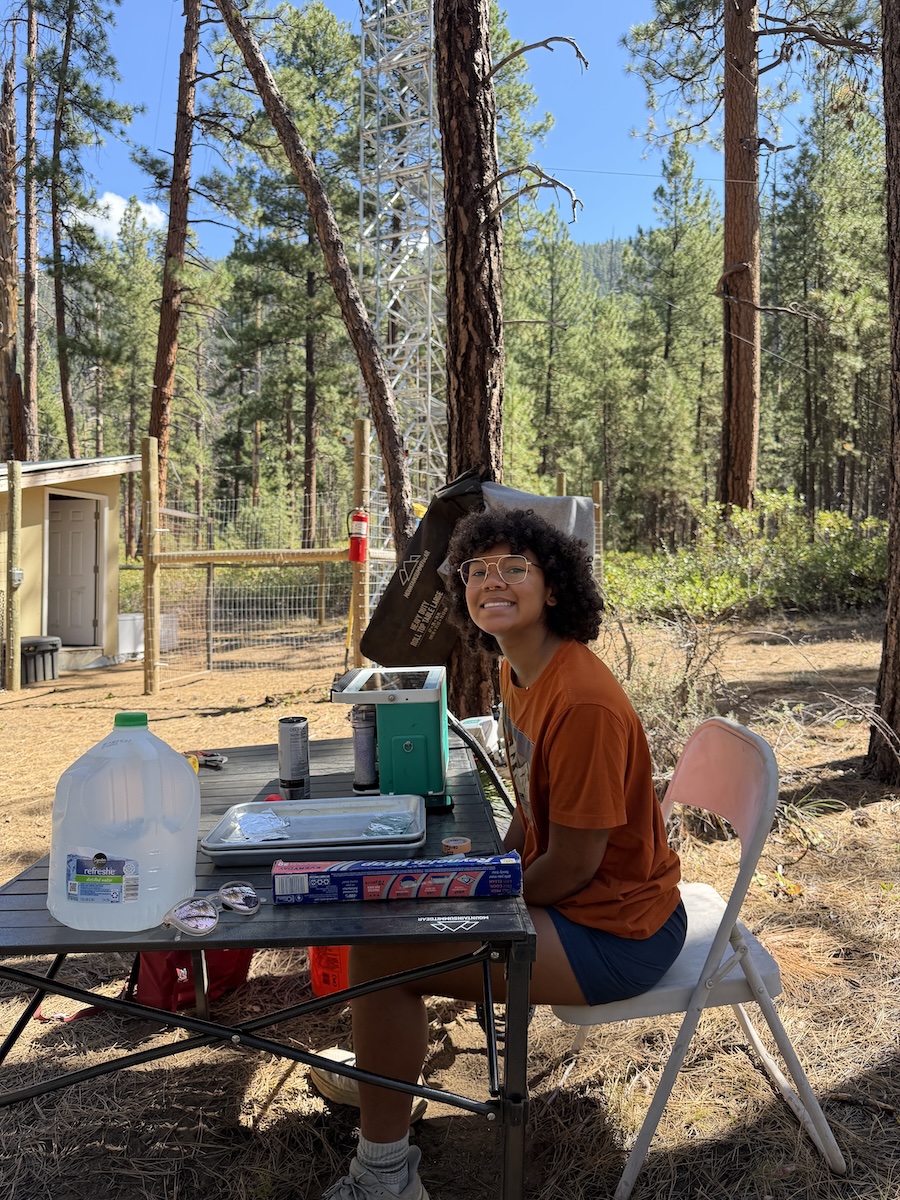
This summer, Renkert traveled to Oregon twice to do fieldwork with researchers from the Leaves to Ecosystems Lab run by Loren Albert. The lab uses satellites and remote-sensing technology to collect data on photosynthetic activity across a forest.
Or, more accurately, the instruments are measuring fluorescence. Photosynthesis occurs when a plant leaf captures sunlight and uses that energy to turn water and carbon dioxide from the atmosphere into sugars, providing energy and building materials for its growth. But plants cannot use all the sunlight they absorb. Some of that energy is released as a faint glow called fluorescence.
Scientists can detect this tiny light with remote-sensing instruments and use it as an indicator of photosynthetic activity.
When plants are under stress, such as during a drought, they reduce their photosynthetic activity. “But the sun’s energy has to go somewhere,” Renkert said. “Theoretically, looking at fluorescence data through remote sensing gives us an idea about how much stress a plant is under and hopefully could be a proxy for photosynthesis.”
“Which brings us back to the needle scale, which is Barry’s niche, so we are bringing that piece of the puzzle to this.”
Logan and Renkert are contributing to the broad-scale research by studying the physiological mechanisms of single needle. They're essentially connecting the signal of an individual needle to what satellites can see across an entire forest.
The collaboration between the scientists interpreting satellite data and those measuring photosynthesis on the ground with biochemical instruments leads to a clearer picture of how plants are responding to a changing climate.
“We are considered the so-called ground truthers,” Logan said.
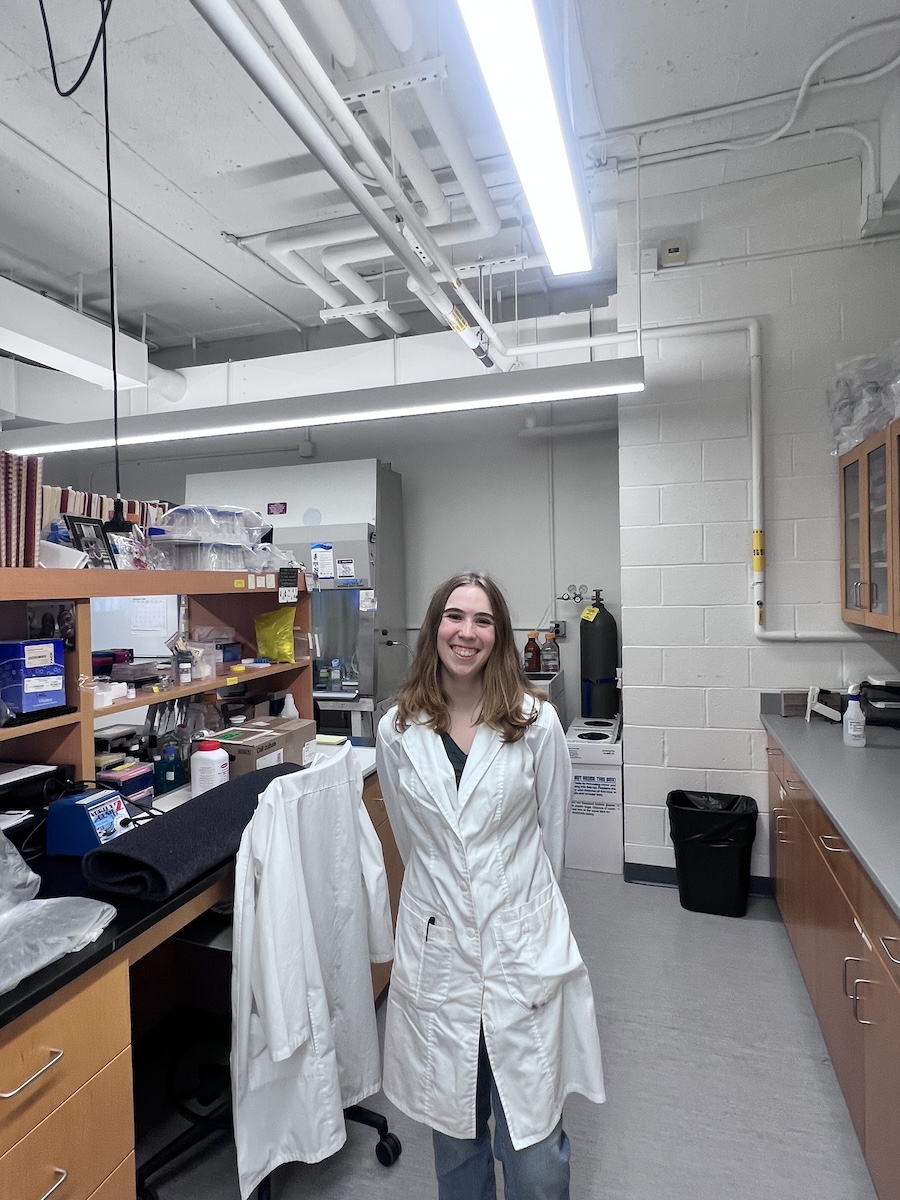
During their two field trips to Oregon, Renkert partnered with graduate student Summer Harper to strap into harnesses and ropes and climb seventy-foot ponderosa pine trees to collect needles. After gathering the samples, Renkert brought them to the forest floor to take measurements on the spot. Some samples are also being sent to Bowdoin, where Renkert will conduct more detailed observations of their photosynthesis, fluorescence, and pigmentation, all of which can reveal how a plant is responding to and using sunlight.
Renkert, who grew up in New Hampshire, said they’ve always considered themselves a science person, even as they’ve also been drawn to the humanities and social sciences. Along with biology, they’re majoring in environmental studies and minoring in gender, sexuality, and women’s studies.
“It’s always been easy for me to be curious about science,” Renkert said. But they didn’t know that plant science was a particular calling until they took Logan’s Ecophysiology class. “I totally fell in love with plants and their physiology, and the beautiful mechanisms we were working with.”
As they consider the future, Renkert said they could envision themselves in a lab, conducting research and teaching. Or—drawing on their enduring interest in studying people and societies, as well as nature—they’re also considering a career in law.
“I love the environment, and I would love to live in a world where science is used appropriately to guide its protection,” Renkert said.
Whatever career they choose, science will remain at its core. “I hope to be doing science in some regard for the rest of my life.”