“Students often assume that if you’re active in the humanities, you may be doing what you love but you never do original research until your senior year, when you might tackle an honors thesis,” said Professor Birgit Tautz.
“We want to show this doesn’t have to be the case,” explained the George Taylor Files Professor of Modern Languages. There are many ways you can do original research in humanities as an undergraduate, she stressed.
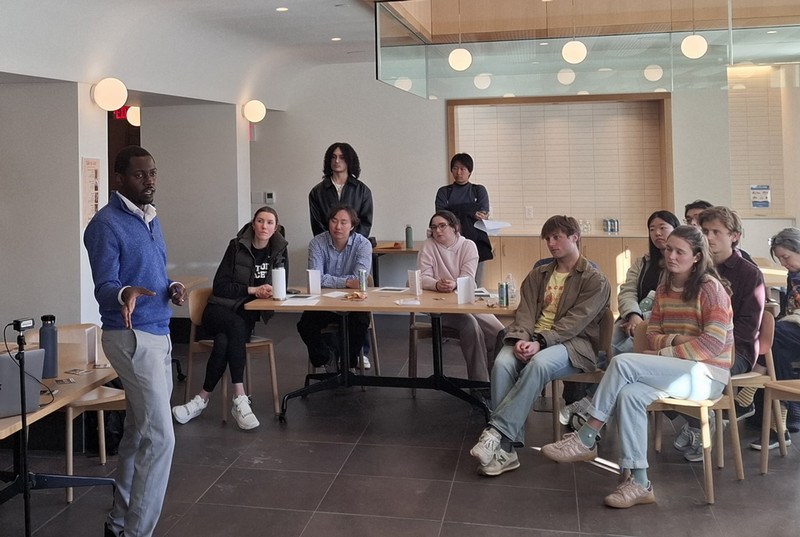
For this reason, the German department held its first “Forschungsfest,” or exhibition of research opportunities in the German department, on March 27. Informal conversations over food were followed by a program of four fifteen-minute slots, enabling seniors and faculty to showcase opportunities for independent research and collaboration with professors that can take place before senior year.
Each slot consisted of “flash talks” of around three minutes, with the format also allowing for interviews and posters, followed by ample opportunity to ask questions, explained Tautz, who organized the event. The aim is to show that research is being done across the college and, in German in particular, that opportunities exist for students to be involved, thrive, and excel independently and in collaboration.
Furthermore, just because you’re studying a traditional subject doesn’t mean you are wedded only to traditional research methods, said Tautz, a specialist in eighteenth-century German cultural studies, among other things, who often embraces a digital approach to her research.
Here’s a look at some of the projects the presenting seniors talked about:
“Working as a research assistant in German has been one of the most meaningful experiences I have had at Bowdoin,” reflected John Schubert ’26. For the past three years, he has assisted Tautz on a number of projects. Much of his work involves developing research questions and ideas, he said. “For example, I receive draft abstracts or publications from Professor Tautz and am tasked with finding primary or secondary source material that would help develop the work further. This usually takes the form of an annotated bibliography.” Schubert said his research work has enabled him to touch on a variety of projects, mostly concerning literary and cultural history around the year 1800. “Literary history, in particular, has been a gift. It has been incredible to see how literary history acts as a broken mirror for political, cultural, and social histories in the German-speaking world.”
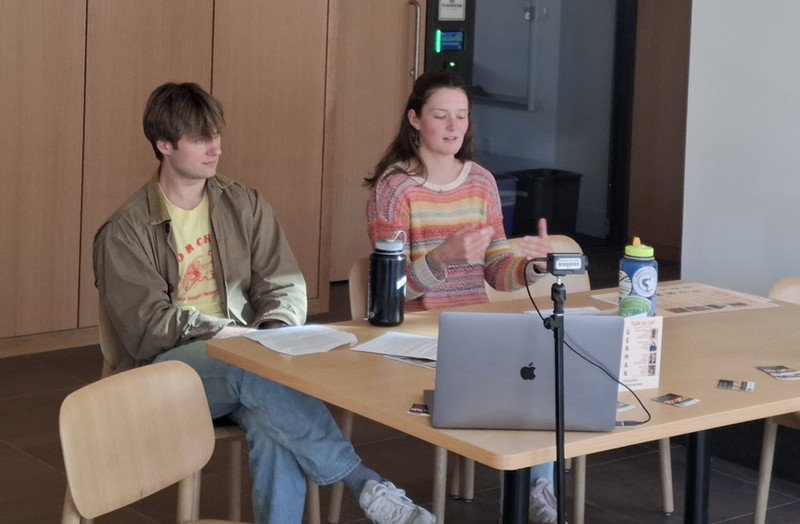
“My research focuses on the fragments of the early German Romantic writer Friedrich Schlegel,” explained Shep Solimine ’26. “The project has been a genuinely formative experience,” he added. Under Tautz’s guidance, Solimine has spent long periods exclusively with the primary texts, without turning to secondary literature. “That discipline forced me to sit with confusion, struggle through the material, and find my own way of thinking about it. It challenged my assumption that research is primarily about engaging with what others have said and taught me that developing my own voice and my own thoughts is just as important.”
Frances Trafton ’26 shared details from her honors project, which, she said, “takes advantage of the interdisciplinary nature of the German department.” It does this, she explained, “by studying the 1521 Reformation pamphlet Passional Christi und Antichristi (by Philipp Melanchthon and Lucas Cranach the Elder) from religious, art historical, historical, political, and linguistic perspectives. “I seek to understand the Passional as a piece of media that both was influenced and had influence on its current historical moment. As an honors project, it has allowed me to dive into a period of German history that I am interested in, while using skills that I have gained throughout college to consider one object from many angles.” Read more about Trafton’s project.
“I’ve worked with Professor Tautz on a research project for the past one and a half to two years,” said Daniel Wang ’26. The work has looked at ways of understanding the contemporary German literature canon: “What books were getting published? Which authors earned a second publication? What books were ending up on prize lists? And, perhaps most importantly—which works of fiction ended up in US libraries?” Understanding this, said Wang, would show which books end up being read by American audiences. “I learned a lot from this experience,” said Wang, “as the project was fairly unprecedented and the questions were shaped throughout the research process… I had to learn ‘on the go’ a lot.”
"My independent study looks at twentieth-century trends in the representation of tourism and nature in Germany and Austria,” said Ben Weintraub ’26. “This has been an enjoyable, self-guided process, and I am very grateful to my advisor, Professor [Rebecca] Jordan, for her support and flexibility,” he added. The semester began with a literature review, explained Weintraub, before going on to look at how to display semantic trends within archival texts in an engaging way. “For example, can a series of word clouds capture how German-speaking writers regarded nature as a tool of touristic diplomacy across the Weimar Republic, Nazi dictatorship, and post-War periods?"
Professor Tautz hopes the event will have persuaded some first-year students to consider opting for German as a major or a minor. “My opening line to them was ‘You are here because we want to show you that you do not have to be a biology major in order to do research.’ ”
According to the department’s latest figures for the semester, Bowdoin has five newly declared German majors (all of them double majors), and nine newly declared minors. One of the double majors is combining German with anthropology and one with music performance, while three are double majoring in German and biology.