The biology major recently made the trip up to Augusta for the Maine Sustainability and Water Conference and came home with first place for her undergraduate research project investigating the effect of salt and fungal parasites on water fleas (Daphnia) in a nearby pond.
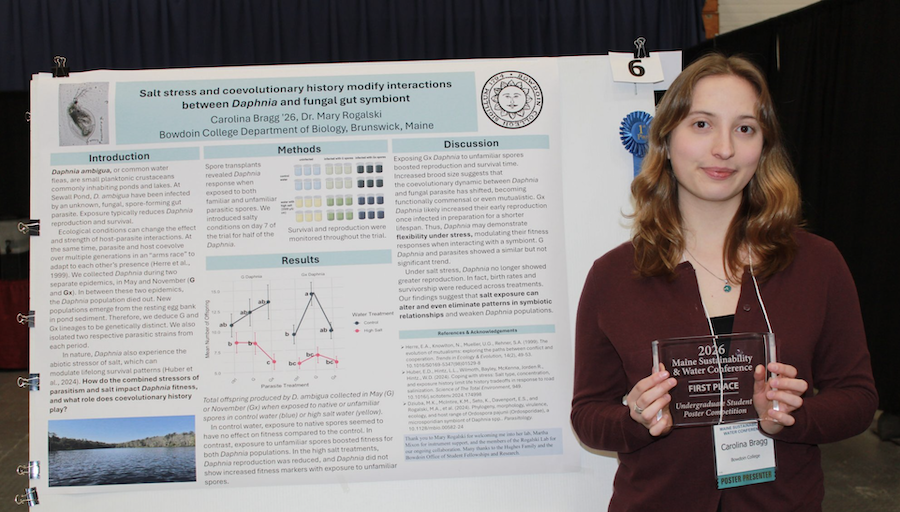
The research is part of Bragg’s honors project with Assistant Professor of Biology and Environmental Studies Mary Rogalski. It's focused on a recently-discovered fungal zooplankton parasite that lives in the gut of the Daphnia—tiny freshwater crustaceans found in fresh water sources like ponds and lakes.
After finding that their survival and reproduction appeared to be boosted by infection, Bragg hypothesized that Daphnia are responding by investing in early reproduction.
Daphnia feed on algae and are a food source for fish, therefore making them integral to the aquatic ecosystem in Arrowsic's Sewell Pond, where Bragg conducts her sampling. Ecosystem disruptions like algal blooms or an influx of salt—such as from road treatments—affects the health of the species, and Bragg is studying how these factors affect the relationship between Daphnia and the parasite.
"Because Daphnia are so tiny, they're not immediately thought of when you think of a pond,” Bragg said. “But once I kind of explain that system, it becomes clear to listeners how it connects to them, and how going to Sewell Pond, they might see algae, see fish, and consider how this relationship affects the pond overall.”
Bragg said she particularly enjoyed talking to people at the conference and answering questions as she encountered individuals from a variety of backgrounds, from experts in hydrology and sustainability to passionate Mainers looking to learn more about their local environment.
“I just love how it showed that in Maine, there are many generations of people invested in sustainability who are willing to come to a conference, to think about solutions, to nerd out together, to ask questions,” Bragg said. “That was a really cool experience.”
Bragg said she was not expecting her first-place award, given that many of the presentations were centered around geochemistry and hydrology and she “was coming to the conference as a visitor from biology.”
Overall, she was happy she was able to communicate and explain her research to so many different people over the course of the conference.
“We talk about [how] our research can get kind of theoretical, and it's great to be able to connect it back to something that's tangible to people,” Bragg said.
After graduating this May, Bragg will continue on to the Bowdoin Teacher Scholars program, taking education classes in the fall and teaching full-time in the spring. She plans to be a life science instructor for middle schoolers.
“I think that that's the age students start to form a sense of academic identity—and even younger,” Bragg said. “Sometimes they come into a middle school science class thinking, ‘Oh, I'm good at this or I'm not good at math, I’m not good at science,’ and it's a great time to encourage them to see themselves in it, and it's a great age to do experiments before you get into more formal high school biology.”
More than fifty Bowdoin students attended this year's Maine Water and Sustainability Conference, which has been hosted every year since 1994 by University of Maine's Center for Sustainability Solutions to share recent findings on resource issues in the state.
This spring, approximately 600 professionals, researchers, consultants, citizens, students, regulators, and planners attended to learn about issues related to water, climate, energy, agriculture, forestry, fisheries, and tourism.
This is the second year that Laboratory Instructor Shana Stewart Deeds has brought all the students in the class Perspectives in Environmental Science, which she is co-teaching with Brandon Tate, visiting assistant professor of chemistry and environmental studies, and Phil Camill, professor of earth and oceanographic science.
The students enjoy learning about research across the state of Maine and ways to get involved, Deeds said. “They also see climate communication in practice, are exposed to environmental science and interdisciplinary practices, and they learn about Maine organizations and researchers,” she added.
The other students attending included ones working with Rogalski, Camill, and Jabari Jones, assistant professor of earth and oceanographic science.