Benner was in Maine to attend a Bowdoin trustee meeting and appear at a book signing at the downtown Brunswick bookstore Gulf of Maine Books.
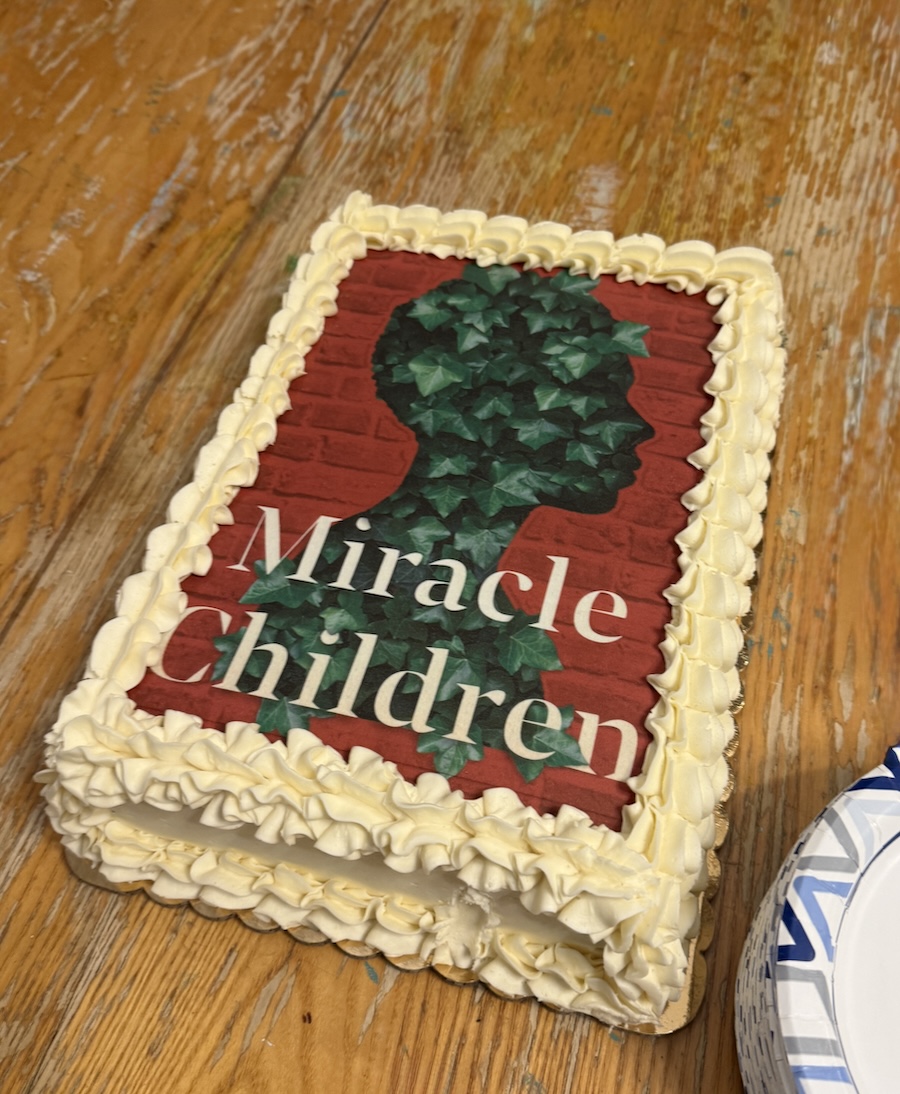
Miracle Children, cowritten with Erica Green, is the full-length account of a story they uncovered in 2018 about a private school in Louisiana that for years had fabricated the transcripts and life histories of its students to give them an edge in college admissions.
The New York Times reported that while their original article exposed the school’s proprietors, their book "makes the case against the punishing inequities and wide-ranging market for Black trauma that enabled the scam.”
But Benner did not speak with students so much about her book as she did about the exhilarating, stressful, confusing, and transformative passage from college to working world.
She candidly described her complicated time at Bowdoin, and her own uncertainty about what her life would look like after she left. After graduating, she lived briefly in Portland before deciding to move to Beijing on a whim, not anticipating she would become a journalist.


Then in 2001, the September 11 attacks happened, rocking the world. Because of the state-run media, Benner did not have reliable access to information about what was taking place back home. She decided to fix that herself.
“The first story I wrote was compiling all these bits of information I was getting from other expats in Asia and Europe, friends of mine and people I knew who were living overseas,” she said. “[I was] trying to find out what they knew, how they were responding to it, and how their communities around them were responding to it.”
“I had a very up-and-down experience. I wasn’t someone who came in and sailed through school, so I was comfortable with the discomfort of rejection or trying something and failing.” ”
—NYT reporter and Bowdoin trustee Katie Benner ’99
Once she had written the story, she called the Portland Press Herald to see if there was any interest in running it. She knew a lot of the reporters from her time in Portland—she had worked around the corner from their office in a deli.
“I made all their lunches so they knew me, and they were really surprised to hear from me. I think it was a little out of context, but they were excited by the idea of the story, so I was able to send it to them,” she said. “That’s actually how I got into reporting.” Benner admitted she didn’t see herself ending up in this line of work; she had not found college easy, and was also frank about her uneasy transition into adulthood. She eventually discovered that these challenges helped her in her reporting and writing.
“I had a very up-and-down experience. I wasn’t someone who came in and sailed through school, so I was comfortable with the discomfort of rejection or trying something and failing,” she said.
At Bowdoin, Benner took on an interdisciplinary course load, but in the end became an English major. She spoke about her favorite English professors, as well as a physics class that stuck out to her.
“I don’t remember anything particular about that class, I just remember him,” she said, describing Stephen Naculich, Bowdoin's LaCasce Family Professor of Natural Sciences. “I just remember his enthusiasm, how much he made us feel like we wanted to learn something, and his great sense of humor.”
Benner additionally recalled why she chose to be an English major, saying that she mostly based her decision on the professors in the department.
“I just really got along well with the professors in that department,” she said. “The learning aspect was more important to me than a career-oriented major, but I will say that history, English, film, sociology classes—if you can learn to write in those environments, you have an enormous edge over basically every single person you’ll encounter in every profession.”
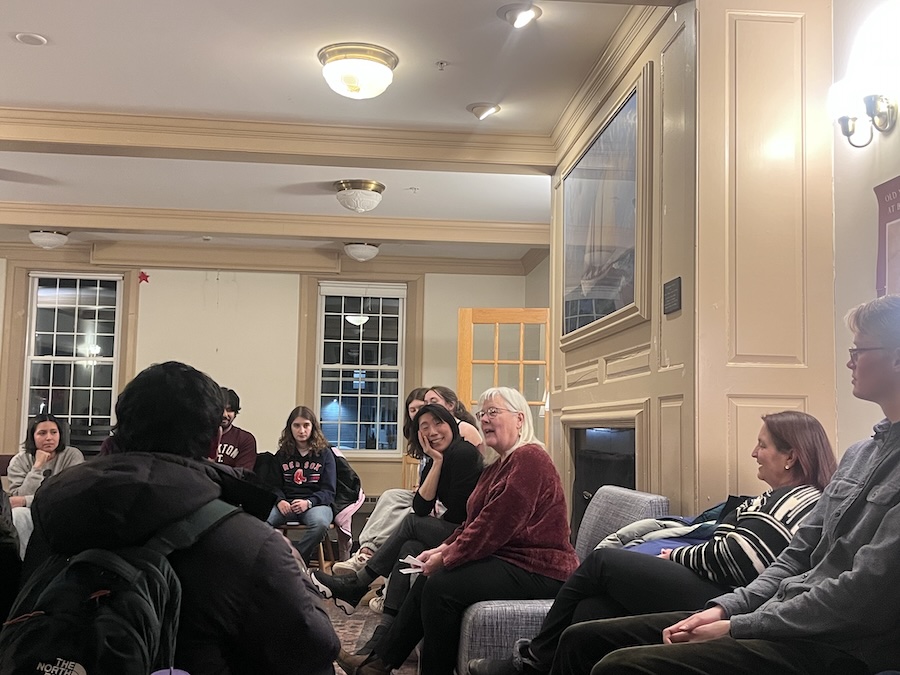
During the Q&A portion of the event, students asked questions ranging from her opinion on broader journalistic ethics to funny personal anecdotes from her time at Bowdoin. Benner spoke on the importance of local news and building trust with readers, as well as the importance of neutrality.
“Neutrality is not saying that something’s not right,” she said. “Neutrality is simply saying what’s happening.”
All were invited to enjoy a slice of cake and continue chatting with Benner. Among audience members were Benner’s friends from college, a couple of whom were her roommates. They keep in touch and reunite every summer.
“I think that coming back and spending time here has been amazing,” she said. “I feel like when you go to college, you don’t know what your life will be like. Being in a place like Brunswick is so wonderful, because you might not ever get to live in a place like this again.”