“Disagree without being disagreeable. It’s a cliche, but an important one,” said Dan Stone, associate professor of economics at Bowdoin, in a recent talk on campus. “People find disagreement uncomfortable, but it's necessary for pursuing the common good.”
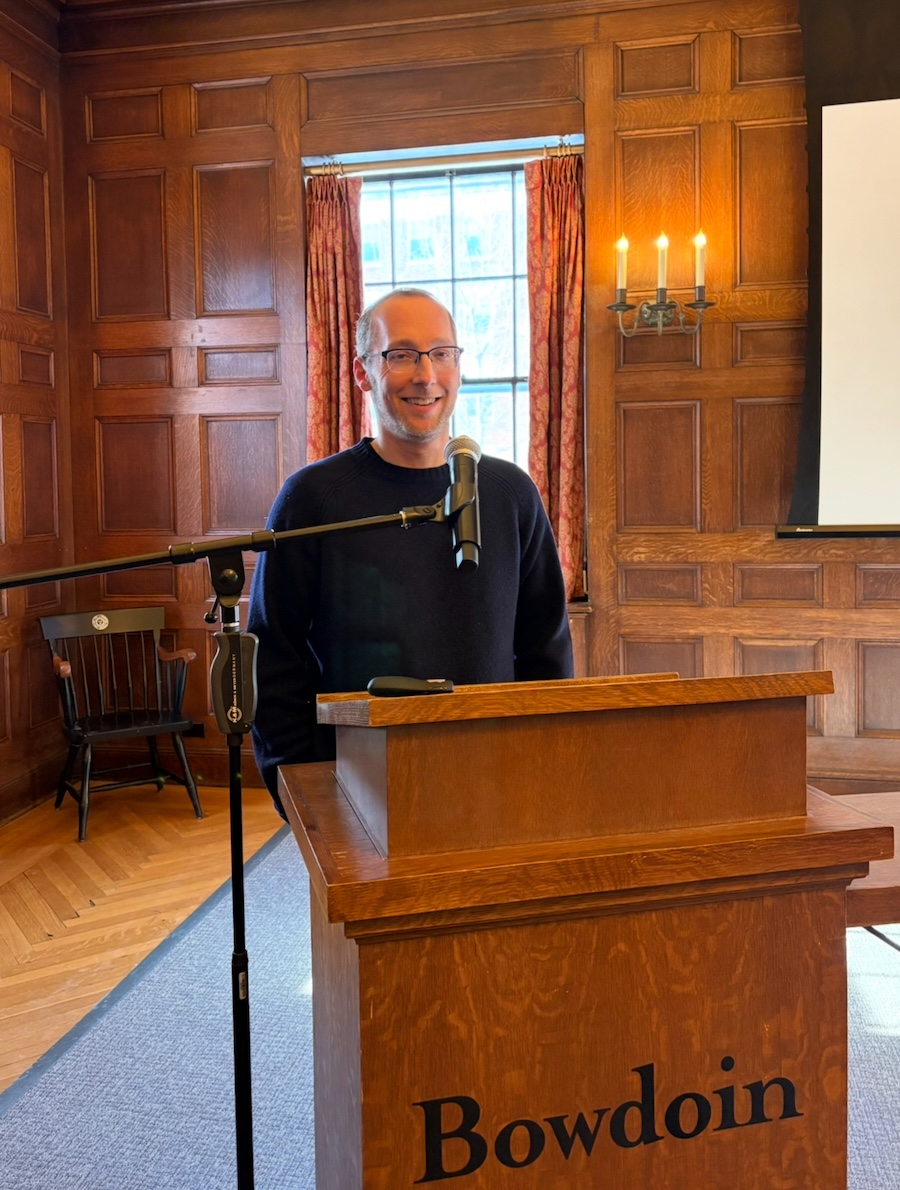
In a presentation aimed at Bowdoin faculty and staff, Stone discussed his use of the new AI tool Sway, and urged other faculty to try it in their own classes.
With the motto “talk more, fight less,” Sway is an AI-powered messaging platform designed to facilitate dialogue across differences, particularly among students. It was developed by researchers at Carnegie Mellon University and is free to use.
Stone has long promoted dialogue around political differences. Throughout his career at Bowdoin, he has developed initiatives that encourage engagement across ideological lines, including Bowdoin’s Polar Bear Purple Media Plunge, the Strengthening Democracy Challenge, and the creation of the online platform Media Trades. In 2023, Stone published Undue Hate, a behavioral economic analysis of polarization in US politics. Undue Hate is available as a hard-copy book and through an open access link.
This year, Stone used Sway in his Economics of Information, Uncertainty, and Communication class, a 22-student course with first years through seniors. “When I explained the premise, their eyes widened,” Stone said with a laugh. “But it ended up going very well.”
In the program, the professor selects several statements that invite competing viewpoints. Students place themselves on a spectrum from “strongly disagree” to “strongly agree,” and then are virtually paired with a classmate who holds an opposing view. The pairs discuss the question in a private online chat facilitated by an AI guide. Conversations can take place either synchronously or asynchronously, with the students’ real names optional but encouraged. Afterward, the software generates a multiple-choice quiz based on the discussion to encourage attentiveness. Student responses remain anonymous to the professor, with the exception of quiz scores.
Bowdoin students responded favorably to the program, according to survey data shared by Stone. Of participating students, 60 percent rated the Sway tool as “good” or “awesome,” and and less than 10 percent rated it unfavorably. Ninety-one percent said they felt comfortable voicing their genuine views. Over 80 percent reported "it was valuable to chat with a student who did not share my perspective" and 77 percent said "it would be good if more students and classes used Sway." One hundred percent reported not feeling offended by their conversation.
“This is a great tool to foster healthy disagreement,” one student shared in the survey.” “The College should require every student to do something like this,” said another.
After the initial trial, Stone used Sway in his Behavioral Economics course as well. The second time was even more successful, he shared, with 90 percent of students rating their chat as "good" or "awesome." Stone noted that it may be even more useful in non-quantitative classes that involve more discussion and debate. “The point of the program is not to change people’s minds,” Stone said. “It's to cultivate respect and understanding between students of different perspectives.”
Students reported that the AI moderator treated both sides of the conversation equally. According to Sway’s creators, the “guide” is designed to deescalate tense moments and help ensure participants do not talk past or over one another. The guide also aims to strengthen students’ reasoning by posing tough questions, encouraging them to reflect on their assumptions and potential biases, and providing relevant factual information.
Political polarization continues to shape national discourse, and Bowdoin has responded by emphasizing the importance of respectful engagement. Sway is one of several initiatives at Bowdoin aimed at fostering constructive disagreement. Other campus programs include Bowdoin Conversation Fellowship, the Viewpoint Exchange Series, and the McKeen Center’s Building Bridges at Bowdoin Dialogue Program.
In her Commencement address last May, President Safa Zaki described Bowdoin as a noisy place where “different ideas, different perspectives, different ways of knowing, different disciplinary lenses, and different life experiences all come together.”
She continued, “Everyone in this room has an important role to play in contributing to making that sound—the sound of the bright clatter of ideas—as layered, multifaceted, and complex as possible. Everyone in this room also has a role to play in listening to and trying to understand that sound, both in the moments when the sound is harmonious and consonant as well as in the moments when it is dissonant and discordant.”