What have you been up to since graduating from Bowdoin?
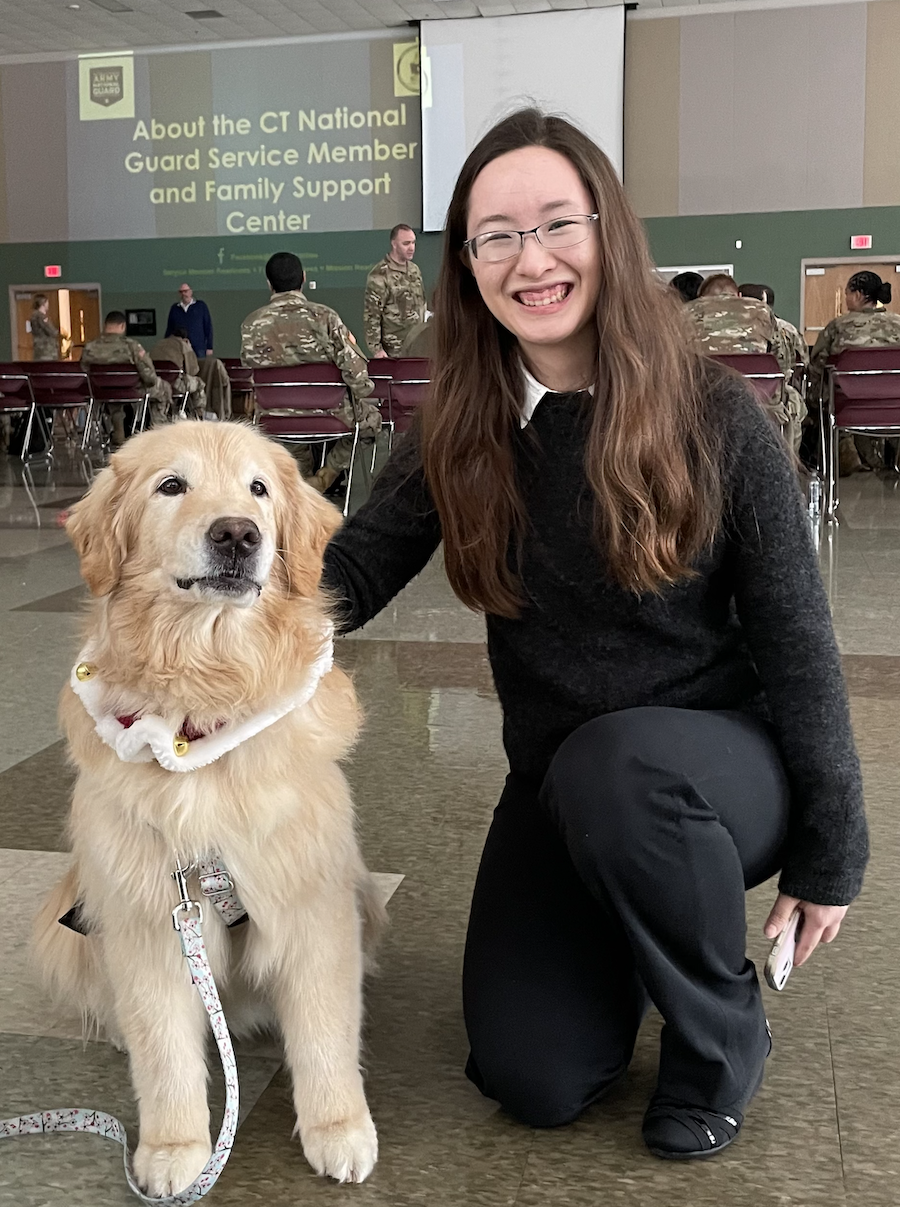
I am currently a post-baccalaureate research assistant for a military suicide prevention research team at the University of Pennsylvania. Our current study examines what types of support are most helpful to soldiers serving in suicide prevention roles in the Connecticut Army National Guard. As a research assistant, I help with data collection and management, participant recruitment, and drafting manuscripts and poster presentations, as well as supporting other tasks for the study team and our collaborators at the Natinal Guard as needed. (My photo was taken at work with an army clinician’s therapy dog!)
Why Chinese studies?
I grew up in Hong Kong and had been taking Mandarin classes at school since third grade. Although I studied Mandarin for many years before college, the local spoken dialect in Hong Kong is Cantonese, so I did not have many opportunities to practice Mandarin outside of the classroom. Attending Chinese classes and discussion groups at Bowdoin helped me take my language skills and cultural knowledge to the next level. I also participated in 中文桌子 (Chinese Table), which gave me a unique type of language immersion that I had never experienced before college and helped me make new friends.
Are there any classes, professors, or experiences that had a lasting impact on you?
I had the opportunity to complete two independent studies in the Chinese department. In my sophomore year, I worked with Professor Jia on a project about perspectives on psychology and mental health in Chinese-speaking countries. In my senior year, I worked with Professor Qin on a project about Chinese pop music. Some of my favorite self-created “assignments” across these projects included interviewing students about their perspectives on mental health, writing informational essays and personal reflections, and recording covers of my favorite pop songs, all in Chinese.
What advice would you give to current students or recent graduates interested in your field?
Take advantage of the many excellent resources Bowdoin offers for language learning. This applies to both current students and recent graduates. Taking classes is a great way to learn, but you can also get involved with language tables, discussion groups, and independent studies. In addition, there are several strong study-abroad programs in China and Taiwan, and opportunities to study abroad do not end after graduation. Bowdoin has a fantastic track record of helping students and alumni enter programs such as the Critical Language Scholarship, Fulbright, Princeton in Asia, and others. If you talk with professors and advisors in the Chinese department, Off-Campus Study, and Student Research and Fellowships, they can help you identify opportunities that align with your goals. Finally, do not hesitate to reach out to alumni. They enjoy hearing from fellow Polar Bears and are generally happy to share their insights.