Reflections on Teaching in the Art Museum: Academic Year Recap
By Bowdoin College Museum of Art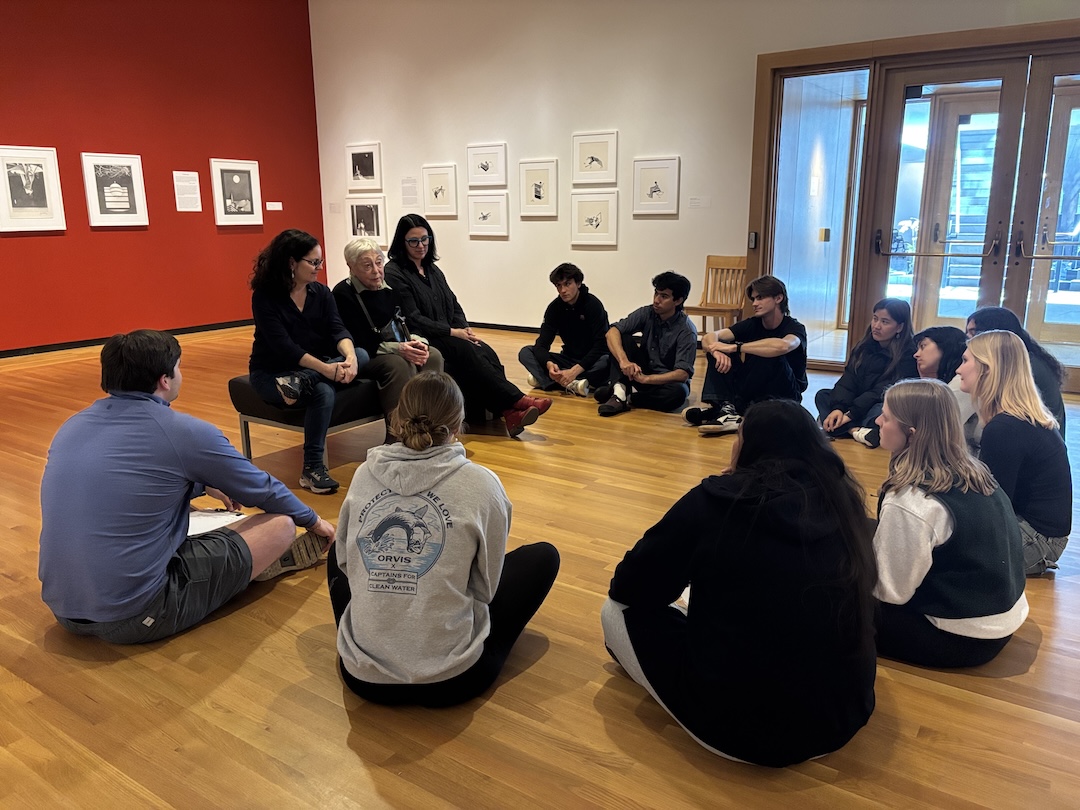
In August 2025, I joined the Bowdoin College Museum of Art (BCMA) team as the new Andrew W. Mellon Postdoctoral Curatorial Fellow, following the successful tenure of my predecessor, Sean Kramer. Reflecting on my first year of teaching, I feel fortunate to have followed in Sean’s footsteps, as he left the museum curriculum in great shape. For the first semester, I was able to re-run many of Sean’s lesson plans as I worked to familiarize myself with the BCMA’s collection and build relationships with faculty across campus.
This past academic year, the BCMA welcomed over 1,600 students during 117 class visits to the Museum. These visits represented a breadth of departments across campus, from Art History, History and Visual Art, to Government, Chemistry, and Earth and Oceanographic Science. Most of these visits required close coordination with faculty members to design lesson plans, for which I would develop a tour or object study session that would speak to the content of the course.
Some highlights of the school year included designing a scavenger hunt for Professor Crystal Hall’s Fall 2025 Digital and Computational Studies (DCS) capstone seminar, which prompted students to reflect on how research is represented in the design and experience of an art museum. We also had the opportunity to use the Zuckert Seminar Room to examine works of art not on view and consider how they would amplify or change the narratives on display.
Another highlight was working with Laura Sprague, the BCMA’s Senior Consulting Curator, to design a lesson for Professor Caylin Carbonnell’s Spring 2025 course The History of Hard Work: Labor in Early America (HIST 2730). Laura is deeply familiar with the Museum’s collection of early American artifacts, and it was a great opportunity for me to get to know the collection and learn from Laura’s expertise. I look forward to teaching the material to future classes.
In addition to welcoming courses in the humanities, the BCMA is working to strengthen our co-curricular connections to the sciences. This past academic year, I also collaborated with Brandon Tate, visiting assistant professor of chemistry and environmental studies, and Claire Harrigan, visiting assistant professor of earth and oceanographic science, to design object-based lessons that positioned artworks as primary instructional tools, leveraging the museum’s collections to teach the essential skills and core content of their scientific courses. For Tate’s course in Environmental Chemistry (CHEM 2050), this meant asking students to identify the three T’s of environmental chemistry – transfer, transport, transformation – in works of art. For Harrigan’s course in Mineral Science (EOS 2105) the students proposed studies of Wyvern Collection objects to demonstrate their knowledge of the tools that would be used to study minerals.
Of the many rich experiences, guiding students in tours of the special exhibition Josefina Auslender: Drawing Myself Free was especially rewarding. It was moving to see how Auslender’s work could speak to so many different courses – from classes in English, Drawing, Anthropology, and Government. In one memorable instance, Josefina herself came to the museum and spoke to students in Spanish Non-Fiction Writing Workshop (HISP 2306), taught by Carolyn Wolfenzon Niego, professor of romance languages and literatures. Speaking in Spanish, Josefina shared stories about her upbringing and art education in Argentina, as well as the evolution of her practice over time. Following the visit, students then had an opportunity to write about their experience in the art museum for a class assignment.
What has struck me most about my first year of Bowdoin is not only the students’ academic rigor, but also the commitment to the liberal arts and object-based learning across disciplines. I look forward to seeing what new connections can be made next academic year!
Anne Strachan Cross
Andrew W. Mellon Postdoctoral Curatorial Fellow


