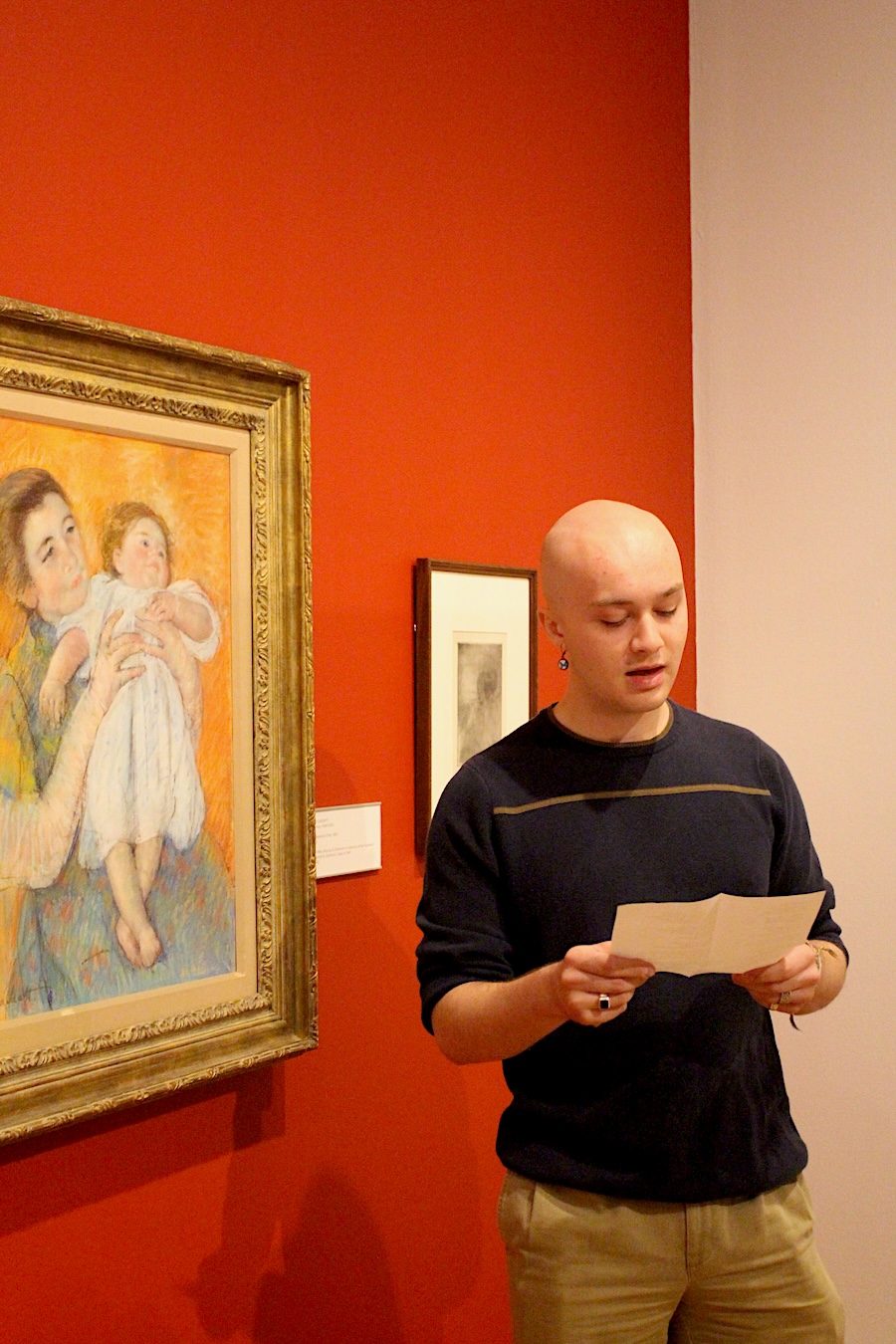
Dylan Beckett, in front of Mary Cassatt's 1897 painting, A Barefoot Child.read their poem “A Numbers Game” about Americans' obsession for ever-growing wealth.
In senior Dylan Beckett’s poem A Numbers Game (read the full poem below), numbers keep multiplying exponentially. Two and three become thousands, millions, and billions before transforming into invented figures: “frackousand degradillion petrolium pumps” and “superultramosterillion lifted power trucks.”
As the poem goes on, the underlying assumption becomes increasingly clear: more must mean better.
Beckett was among the student poets who read their work at "Poetry in the Galleries" in October. Presented alongside the exhibition USA@250, the program featured students reading a mix of original poetry and other works inspired by the exhibit, which itself was inspired by the United States’ 250th anniversary.
The show explores the nation’s history through a series of artworks created since 1776, all from the Museum’s own collection. The intention of the exhibition is to both celebrate the artistic accomplishments of the past 250 years and to make visible the diversity of American life throughout the nation’s history.
Pairing student poetry with the show opened conversations about American values, identity, and belonging.
For Beckett, the event presented an opportunity to question what they call “the number-go-up culture,” in which increasing wealth is understood as inherently good.
“I find that to be extremely morally dubious and at the root of a lot of problems today,” Beckett said. “So, I wanted to write something satirizing by including these further and further ridiculous numbers.”
“A Numbers Game” juxtaposes its ever-growing numbers with images of industrial expansion and environmental destruction. As trees become stumps and railroads cross the continent, the speaker accumulates increasingly extravagant possessions. Yet, satisfaction remains beyond reach: “Just a little better now, / Just a little bigger now, / And I’ll finally have won.”
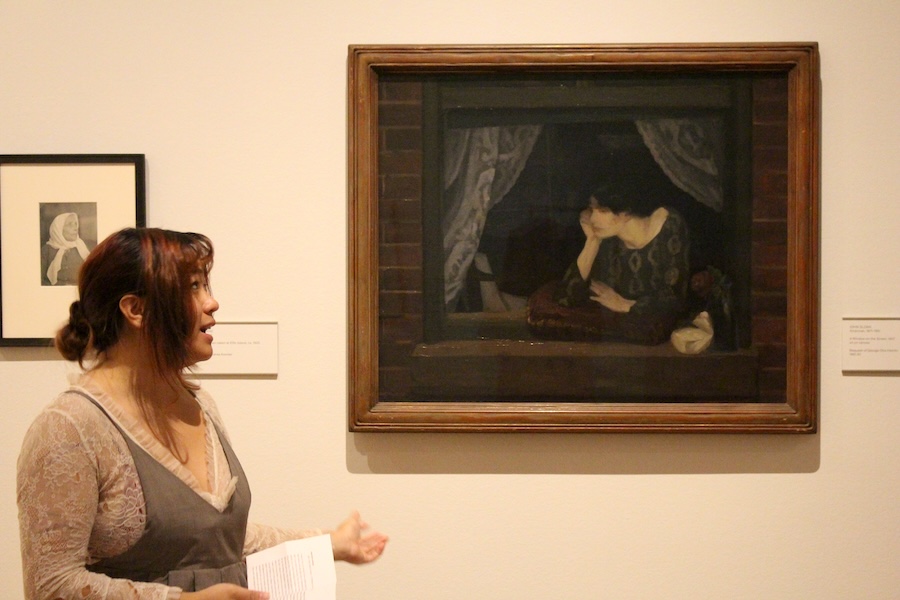
Rin Pastor ’27 approached the exhibition through a different American landscape: New York City. Her chosen painting, John Sloan's A Window on the Street, connected both her interest in the New York School of poets and a class she took with Associate Professor of English Samia Rahimtoola called Poetry and the City.
“There is a long tradition of poets trying to write in the same language as different types of art, and I was so happy to try my own hand at it,” Pastor said.
In Rahimtoola’s course, Pastor explored the window as a symbol of an “ephemeral in-between space.” The painting offered a way to revisit that idea through the contradictions of urban life. Pastor described the American city as a place both of possibility and exclusion, where economic prosperity and social opportunities coexist with redlining and exploitative labor.
“Like a window, the American city, especially New York City, is a place that holds all of these contradictions in such tension, and poetry is the most interesting medium for exploring tension,” she said.
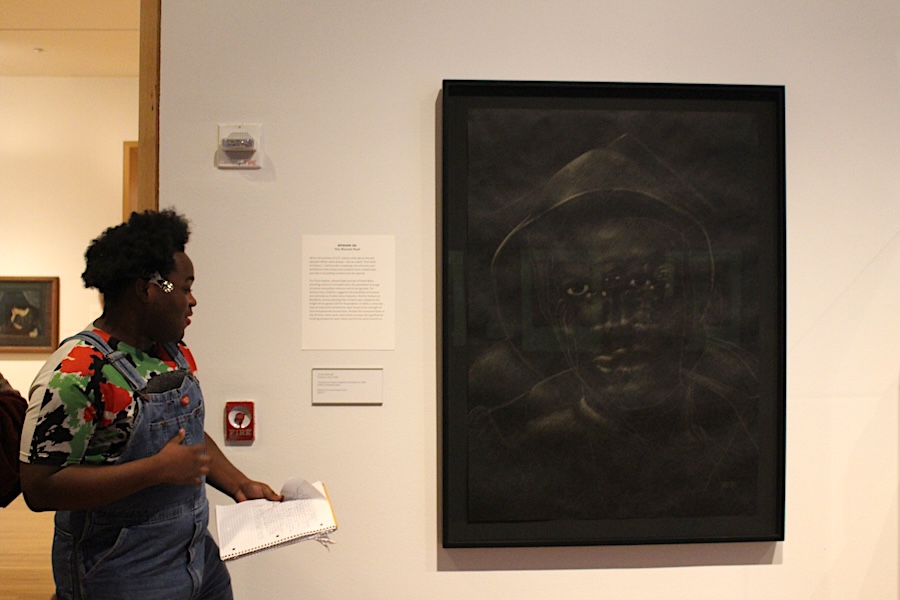
Jaeleen Baffour ’28 next to Titus Kaphar's 2015 The Jerome Project (Asphalt and Chalk) XI.
Jaeleen Baffour ’28 responded to the exhibition by drawing on their personal experience in this country. “A lot of my poetry, I would say, has a lot of political and social commentary, as it’s about me moving in the world as a Black queer person in America,” Baffour said. “I loved the exhibit and have a lot of really strong feelings about America.”
Baffour described the pairing of images and poems as a compelling way to encounter the exhibition. “I honestly wish I had experienced the exhibit like this for the first time,” they said.
The opportunity to experience visual art through another art form—or, to “surround yourself in visual and verbal imagery”—helped motivate organizers Anne Cross, an Andrew W. Mellon Postdoctoral Curatorial Fellow, and Jonathan Pessant, a security officer at the Museum and a poet himself.
Pessant and Museum Shop Manager Rachel Rodrigues have hosted “Poetry in the Pavillion” during National Poetry Month for years. After attending that program last year, Cross was struck by the students’ creativity, so this year, she partnered with Pessant to organize poetry readings in response to a specific exhibition.
“I hope attendees take away an appreciation for poetry, but also an awareness that the BCMA can be a space for all arts, not just the visual arts,” Cross said.
The collaboration reflects museum staff members’ growing interest in interdisciplinary arts programming, Cross said, pointing to Beckwith Artist-in-Residence George Lopez's popular gallery concerts.
For Pastor, the BCMA’s welcome has been a defining part of her relationship with the Museum, which has hosted The Quill, Bowdoin's literary magazine, on many occasions. “They’ve made my time at Bowdoin so special,” Pastor said of the Museum staff.
Following the first program’s success, Cross and Pessant plan to organize another Poetry in the Galleries event in the spring. Asked about her favorite part of the event, Cross pointed to the students whose voices brought the exhibition into new focus. Other presenters included Jack Twining ’27, Cameron McDonald ’29, and Cole Hickey ’30.
“I was blown away by the incredible talent of the students who contributed, and appreciate their generosity in sharing their work with BCMA audiences,” she said.
A Numbers Game
Come and see! Two, three
trees logged and spread
sheets, quilts for shanty beds.
Five acres and a dream off west.
Sixteen years, time I spent
Dimes bent down the road
Seventeen, I growed taught:
all numbers–
Eight teens caught the river.
Under, getting hot gold,
the world in my pot.
Now nineteen hundred whirls fast
Into view, and past you.
‘Cause me, I’ve got it figured out.
It’s all figures now and you gun’ bow
When I’ve got twenty thou
In the bank from my fathers.
Then thirty thousand caddies jog
Through the black smog roads,
The racing red fog roads,
Tugging forty thousand clubs for me,
Or some other Bill in a sky suite
showing a fifty thousand dollar suit.
I make thrifty bets on the green.
My steamroller rolls flatter than yours.
My dollars stack fatter than yours.
The road is hot with attack,
and the drivers don’t matter like yours.
I make a million dollars in a beat.
My street is the expanding hours of history,
And it’s looped back east,
fifteen million feet, still walking to the water.
I’ve got my strong arm stretched long,
My palm grips char, steam spreading far
and wide, I hide billion dollar diamonds between
my fingers, like crushed trees to appleseeds,
dusting coal on my continental stroll.
Each train is a trillion trips,
Each diesel rail is my deliverance.
New steel rivers carry the mouthing sea
to me, and I’m buried in the lip
of the delta tip.
I am a king among things.
Now is the era of abstraction.
My action is to slumber,
dreaming of seeming theoretical numbers:
A superultramosterillion lifted power trucks.
Two addictocarcinogillion Blue Razz vapes deluxe.
Three unincorpundred low and level acres of stumps.
Four frackousand degradillion petrolium pumps and deepwater dumps.
Five googol geminillion centers built on top of jobs.
Six Leviathillion civilized peoples satisfying Hobbes.
Seven spectaculousand multiversillion American myths.
Eight disafectillion un-unboxed ballots and three fifths.
Nine immortogeritillion reaching hands you can’t outrun.
Just a little better now,
Just a little bigger now,
And I’ll finally have won.