Arctic anthropologists Susan Kaplan and Genevieve LeMoine remind us that the voices of Inuit who live in Greenland should have priority in any talks of who governs the world’s largest island.
In January 2026, the White House announced the intention of the US to acquire Greenland. In the avalanche of media coverage that followed, information about the Inuit of Greenland, who make up 90 percent of the island’s population, was largely missing.
Bowdoin College has a long history of involvement with the Indigenous communities of Greenland, including our own work over many decades. Bowdoin faculty, staff, student, and alumni involvement in Greenland goes back to Professor Paul Chadbourne’s 1860 expedition to study the natural history of the region. Other Bowdoin-associated expeditions followed, including the well-known work of Robert E. Peary (Class of 1877) and Donald B. MacMillan (Class of 1898), whose combined involvement in the area spanned from 1886 to 1954.
Since its opening in 1967, the Arctic Museum has built on the relationships Peary and MacMillan established with families in Greenland, including organizing a reunion of Greenland and American Peary descendants, inviting Inuit elders to campus, studying the island’s changing environment, and hosting high-level diplomatic delegations from Greenland.
As a result of these interactions we have learned about Greenland’s quest for self-determination and want to help tell that story. We wrote a piece for The Conversation to provide historical context about who Greenland’s Indigenous people are and how they are governed; what appears here is a lightly edited version of that essay, used with permission.
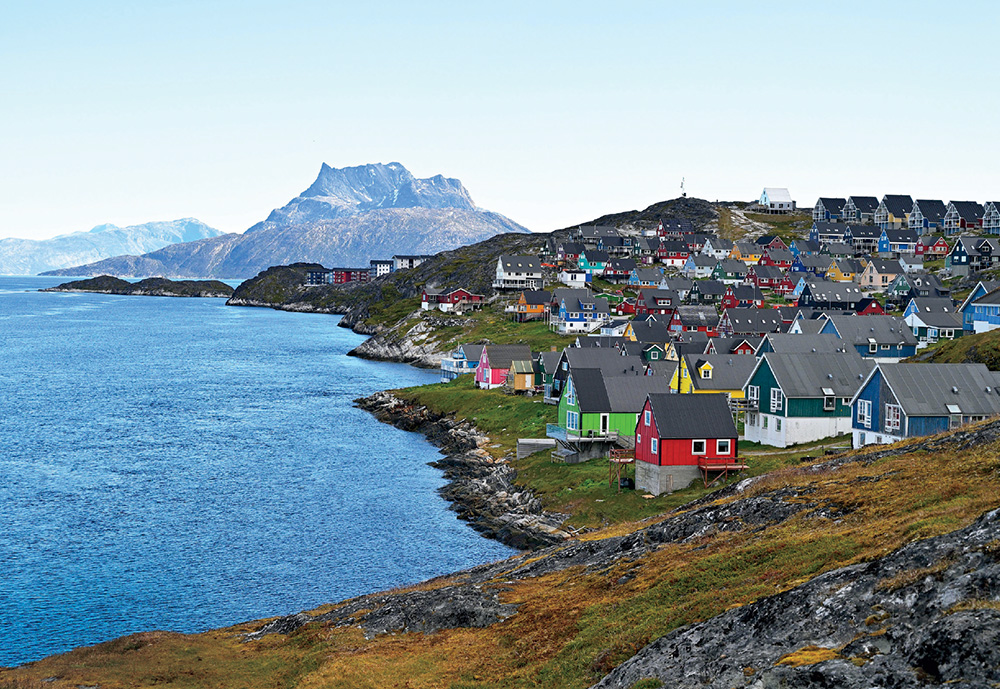
Nuuk, the modern capital of Greenland. Photo by Thompson Graham.
Greenland’s Inuit have spent decades fighting for self-determination. The Kalaallit (Inuit of West Greenland), the Tunumi (Inuit of East Greenland), and the Inughuit (Inuit of North Greenland) together represent nearly 90 percent of the population of Greenland, which totals about 57,000 people across 830,000 square miles (2.1 million square kilometers).
We are Arctic anthropologists working in a museum focused on the Arctic and its people. One of the areas we study is a land whose inhabitants call it Kalaallit Nunaat, or land of the Kalaallit. Known in English as Greenland, it is an Indigenous nation whose relatively few people have been working for decades to reclaim their right to self-determination.
For nearly five thousand years, northwestern Greenland—including the area that is now the US Space Force’s Pituffik Space Base, formerly known as Thule Air Force Base—was the island’s main entry point. A succession of Indigenous groups moved eastward from the Bering Strait region and settled Siberia, Alaska, Canada, and Greenland.
Approximately a thousand years ago, the ancestors of Inuit living in Greenland today arrived in that area with sophisticated technologies that allowed them to thrive in a dynamic Arctic environment where minor mishaps can have serious consequences. They hunted animals using specialized technologies and tools, including kayaks, dog-drawn sleds, complex harpoons, and snow goggles fashioned from wood or bone with slits cut into them. They dressed in highly engineered garments made from animal fur that kept them warm and dry in all conditions.
Their tools and clothing were imbued with symbolic meanings that reflected their world view, in which humans and animals are interdependent. Inughuit families who live in the region today continue to hunt and fish, while navigating a warming climate.
At Qassiarsuk in south Greenland, around the time Inuit arrived in the north, Erik the Red established the first Norse farm, Brattahlíð, in AD 986. He sent word back to Iceland to encourage others to join him. Numerous Norse families followed and established pastoral farms in the region.
As Inuit expanded southward, they encountered these Norse farmers. Inuit and Norse traded, but relations were sometimes tense, and Inuit oral histories and Norse sagas describe some violent interactions. The two groups maintained distinctly different approaches to living on the land that rims Greenland’s massive ice sheet. The Norse were very place-based, while the Inuit moved seasonally, hunting around islands, bays, and fjords.
As the Little Ice Age set in early in the fourteenth century, and as temperatures dropped in the Northern Hemisphere, the Norse were not equipped to adjust to the changing conditions. Their colonies faltered, and by 1500 AD had disappeared. By contrast, the mobile Inuit took a more flexible approach and hunted both land and marine mammals according to their availability. They continued living in the region without much change to their lifestyle.
In Nuuk, the modern capital of Greenland, an imposing and controversial statue of missionary Hans Egede commemorates his arrival in 1721 to establish a mission in a place he called Godthåb. In 1776, as trade became more important, the Danish government established the Royal Greenland Trading Department, a trading monopoly that administered the com-munities on the west coast of Greenland as a closed colony for the next 150 years.
By the nineteenth century, some Kalaallit families who lived in Nuuk/Godthåb had formed an educated, urban class of ministers, educators, and writers, although Danish colonists continued to rule. Meanwhile, Kalaallit families in small coastal communities continued to engage in traditional economic and social activities, based on respect of animals and sharing of resources.
On the more remote east coast and in the far north, colonization took root more slowly, leaving explorers, such as American Robert Peary, and traders, such as Danish-Greenlandic Knud Rasmussen, a free hand to employ and trade with people.
Earlier US administrations had periodically showed an interest in Greenland; however, the US formally recognized Denmark’s claim to the island in 1916, when the Americans purchased the Danish West Indies (now the US Virgin Islands). And in 1921, Denmark declared sovereignty over the whole of Greenland, a claim upheld in 1933 by the permanent Court of International Justice. But Greenlanders were not consulted about these decisions.
World War II brought the outside world to Greenland’s door. With Denmark under Nazi control, the US took responsibility for pro-tecting the strategically important island of Greenland and built military bases on both the east and west coasts. US efforts to keep military personnel and Kalaallit apart were not entirely successful, and some visiting and trading went on. Radios and broadcast news also spread, and Kalaallit began to gain a sense of the world beyond their borders.
The Cold War brought more changes, including the forced relocation of twenty-seven Inughuit families living near the newly constructed US Air Force base at Thule to Qaanaaq, where they lived in tents until small wooden homes were built. In 1953, Denmark revised parts of its constitution, including changing the status of Greenland from a colony to one of the nation’s counties, thereby making all Kalaallit residents in Greenland also full-fledged citizens of Denmark. For the first time, Kalaallit had elected representatives in the Danish parliament.
Denmark also increased assimilation efforts, promoting the Danish language and culture at the expense of Kalaallisut, the Greenlandic language. Among other projects, the Danish authorities sent Greenlandic children to residential schools in Denmark.
In Nuuk in the 1970s, a new generation of young Kalaallit politicians emerged, eager to protect and promote the use of Kalaallisut and gain greater control over Greenland’s affairs. The rock band Sumé, singing protest songs in Kalaallisut, contributed to the political awakening.
In a 1979 Greenland-wide referendum, a substantial majority of Kalaallit voters opted for what was called “home rule” within the Danish Kingdom. That meant a parliament of elected Kalaallit representatives handled internal affairs, such as education and social welfare, while Denmark retained control of foreign affairs and mineral rights.
However, the push for full independence from Denmark continued: In 2009, home rule was replaced by self-government, which outlines a clear path to independence from Denmark, based on negotiations following a potential future referendum vote by Greenlanders. Self-government also allows Greenland to assert and benefit from control over its mineral resources, but not to manage foreign affairs.
Today, Nuuk is a busy, vibrant, modern city. Life is quieter in smaller settlements, where hunting and fishing are still a way of life. While contemporary Greenland encompasses this range of lifestyles, Kalaallit are unified in their desire for self-determination.
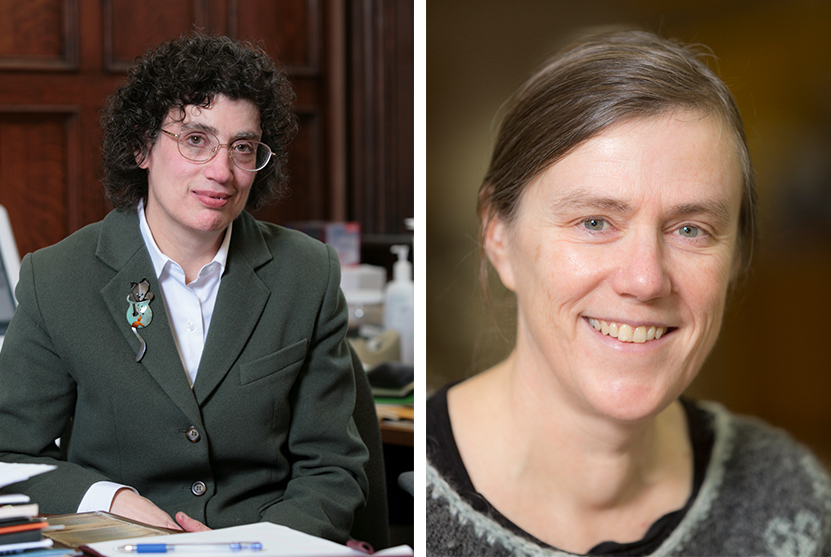
Susan Kaplan is professor of anthropology and director of the Peary-MacMillan Arctic Museum and Arctic Studies Center.
Genevieve LeMoine is curator for the Peary-MacMillan Arctic Museum.

This story first appeared in the Spring/Summer 2026 issue of Bowdoin Magazine. Manage your subscription and see other stories from the magazine on the Bowdoin Magazine website.