Navigating Life
By Somira Sao ’99 for Bowdoin MagazineSomira Sao ’99 was born in a Khmer Rouge work camp during Pol Pot’s occupation of Cambodia and came to Maine as a three-year-old child with her family through a refugee resettlement program. She is now a mom of six who sails around the world, writing and photographing her travels as a professional photographer and freelance journalist.
When they had their first child, she and her husband made a pact to keep traveling. Their first sailing adventure as a family was in 2011 when they left Portland, Maine, and sailed across the Atlantic to Cherbourg, France, with a toddler and a new baby. They have been sailing and living on the water ever since.
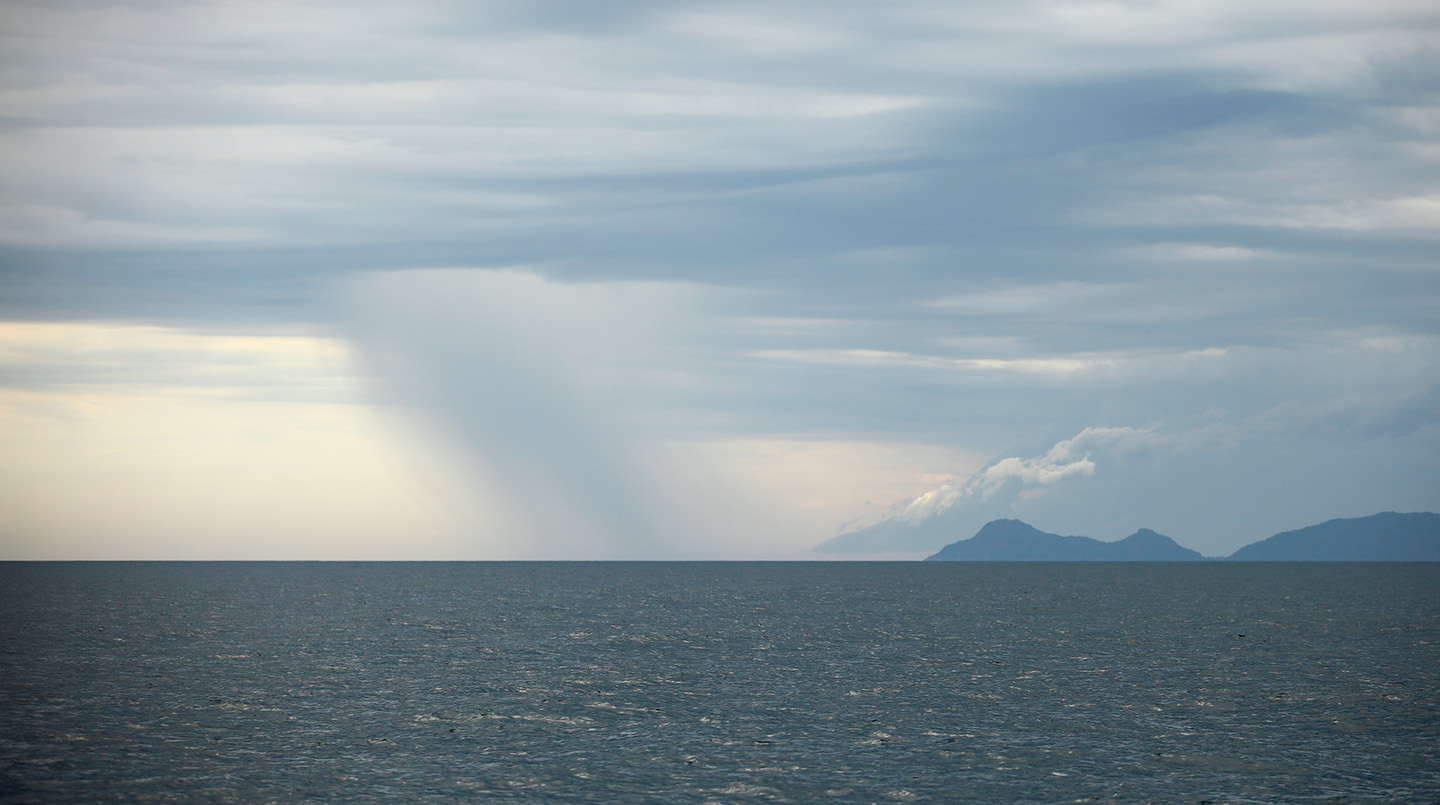
A squall approaches off the coast of Rio de Janeiro, Brazil, on New Year’s Eve in 2020.
In the pitch-black of a moonless night, I stood in the cockpit of our fifty-foot trimaran, Thunderbird. We were surfing fast, moving south at 10–12 knots off the coast of St. Vincent and the Grenadines. Leaning forward, I scanned the horizon for lights, marine traffic, and signs of an approaching squall, simultaneously reading the movement and sounds of the boat. Wind speeds averaged 24 knots, sometimes gusting to 30.
My watchmate was my fifteen-year-old son, Raivo—second-oldest of our six children, fourteen years of life at sea under his belt. He sat in the shelter of the cockpit bubble, observing wind instruments, boat speed, sail shapes, and auto-pilot performance. Few words passed between us, but there was comfort in each other’s presence—a quiet, steady trust that had been building since his early childhood. Night watches were one of the few times, in the floating home we eight shared, where quiet could be found amid the darkness and the white noise of the sea.
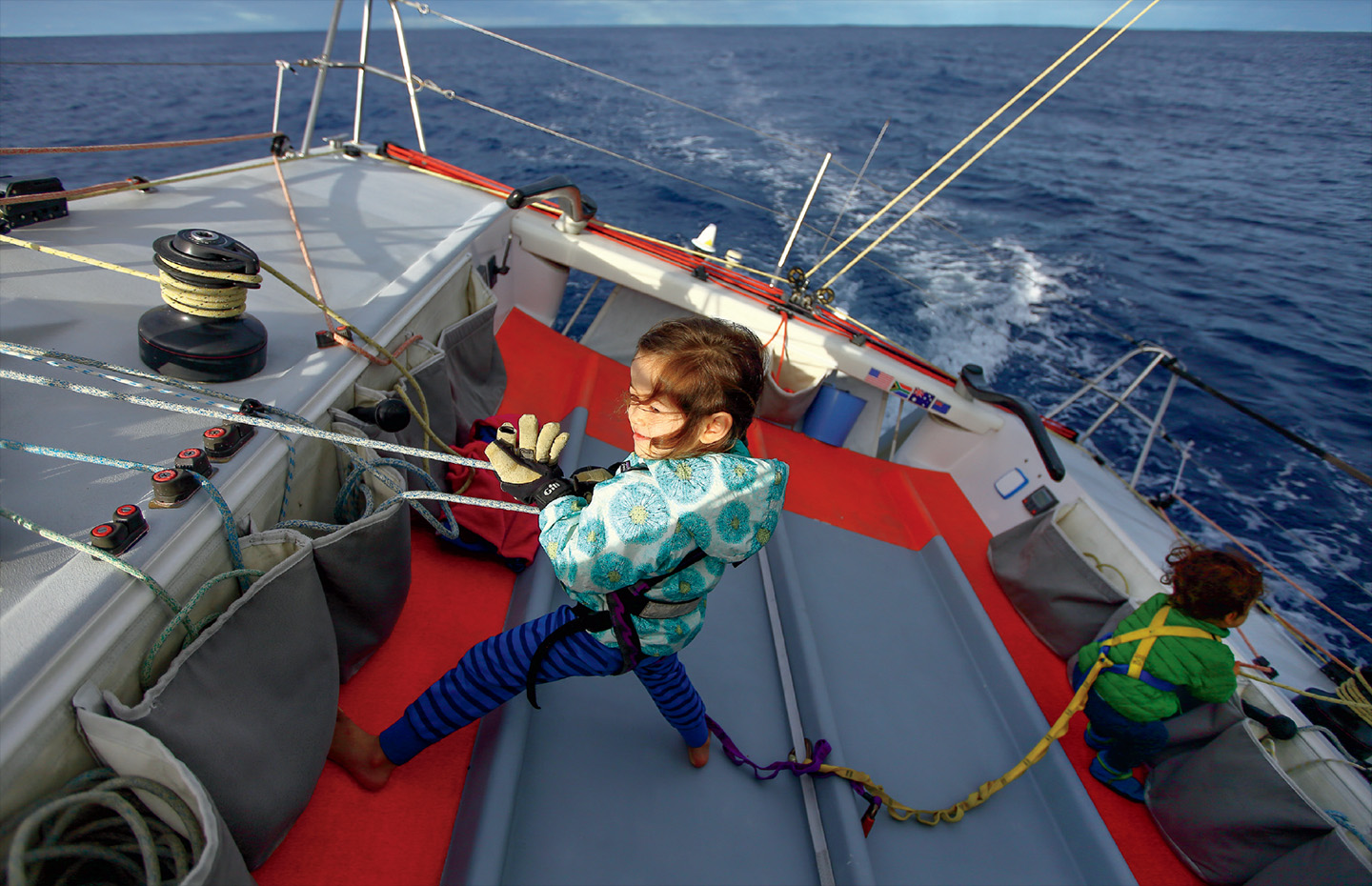
Tormentina, four, and Raivo, one, on day twenty-nine of a 2012 thirty-day nonstop passage between Simons Town, South Africa, and Fremantle, Western Australia.
Extraordinary happiness exists when we are in motion like this. Different from the happiness of arrival—of having gotten somewhere—it is the joy of being underway, of doing the work, of being fully inside the experience. I find it in small, recurring moments: changing light in the first minutes before and after sunrise, encountering marine wildlife, the feeling of working as a team on a sail change, children and adults finding their places, doing their jobs, the boat moving better for it. Watching a squall build on the horizon, seeing the wind before we feel it and plotting a route through it together. These are not transcendent. They are just life, lived at a frequency that makes you feel it.
Time moves differently when every week brings a new anchorage, a new island, a new problem to solve, the mind has to keep building itself.
Neuroscientist David Eagleman, whose research on time perception has shown that novelty is the primary yardstick by which the brain measures the sense of time, puts it simply: “If you want to slow down time, seek novelty.” Novel experiences force the hippocampus and prefrontal cortex to work harder, encoding memories with more density and detail—which is why a week in an unfamiliar place can feel as long as a month of routine.
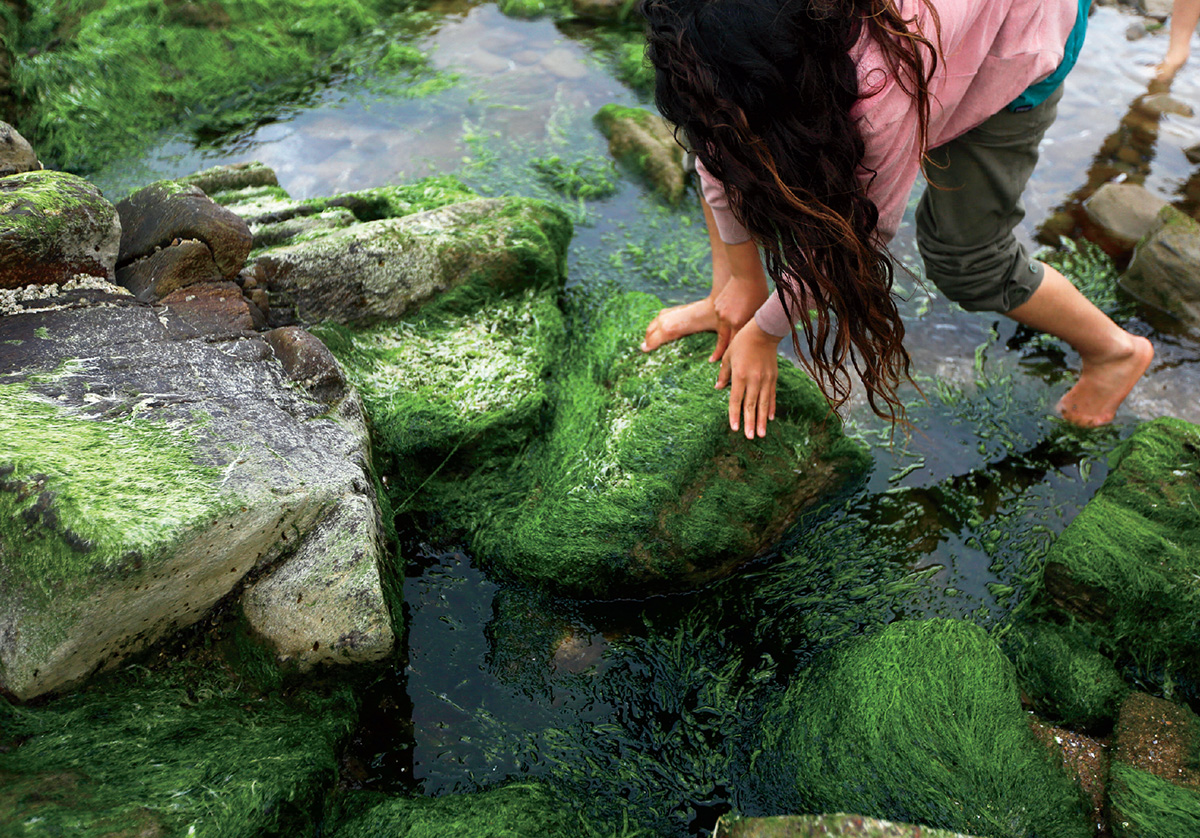
Pearl, twelve, explores tide pools along the coast of La Paloma, Uruguay, in 2024. The algae is harvested and used to make seaweed fritters called buñuelos de algas.
Our children are not necessarily smarter for having lived this way. But they are, I think, wide awake to their lives, this world full of firsts. This wakefulness is its own kind of intelligence, and time moves differently.
Even after all these years and ocean miles, it still blows my mind to move through the world like this—as a mother, wife, photographer, and sailor, choosing the platform of sailing to teach our children, experience the world, and transform our reality.
What began as a simple promise to my husband when we were expecting our first child—to keep traveling even as we became parents—had turned into something far wilder and more committed than either of us had anticipated.
The ocean gave us a framework for everything else. You cannot control nature. You cannot schedule it, negotiate with it, or bend it to your plans. A squall arrives at three in the morning if it wants to, forcing you to reef the sails. What you do control—and this has become the quiet philosophy of our whole family life—is when you go, where you go, and how you move through what you are given. We read the forecast, we wait for the window, we study the sky, we watch the swell, and we go when the sea allows.
This principle bleeds off the water for us into every corner of our parenting.
People ask about school. It’s always the first question. The answer doesn’t map cleanly onto a traditional model. What I can say is this: James and I have decided that we will each teach the things we know best, and we have chosen carefully who teaches the rest.
For me, it has always been teaching my children through the camera. Photography is not specifically the skill I’m passing on—it is a way of seeing that I am sharing. To observe nature, light, texture, pattern, shape, color; to notice the quality of light in the landscape, the geometry of a reef, the expression that crosses a stranger’s face.
Making a photograph is the act of letting something beautiful enter some deeper level of consciousness—of saying, “I was here, I saw this, it mattered.” What doesn’t matter to me is what happens to the image after. Hard drives crash. Boxes of prints get lost in moves. What matters is the act of deep attention, the feeling of genuine appreciation for that tiny moment.
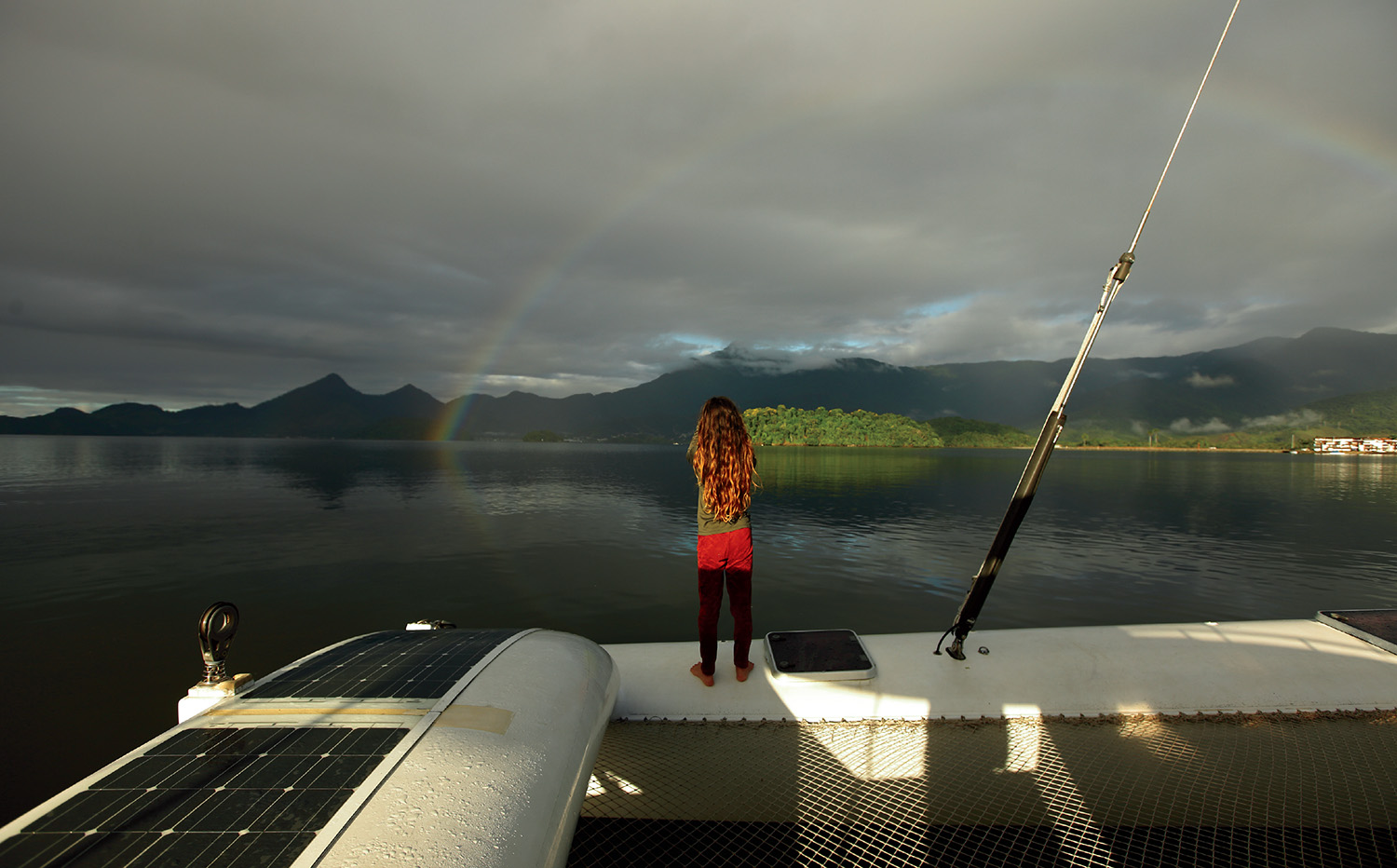
Tormentina, twelve, takes in the sky after some rain in December 2020 at Ilha Grande Bay, Rio de Janeiro, Brazil.
That is what I try to give my children: a reason to stop and look, to observe things in nature and humanity in a deeper way.
James’s gift to them is different. He has built, over decades, a platform for understanding the world firsthand. A lifetime adventurer—guiding clients up 6,000-meter peaks, a pioneer of Ouray ice climbing, forerunner of adaptive sports programs in Norway and Breckenridge, and more—he brought to sailing the same methodical, riskaware intelligence he spent years developing in the extreme mountain environment.
He came from an era of climbing and skiing where people made summits and ascents and did not talk about them. He had been buried in an avalanche, taken a ground fall off a rock face, and lost many friends in the mountains. When he felt he had escaped the odds one too many times, he turned to sailing.
He taught our family how to navigate the sea, yes, but also roads and rivers, trains and buses, borders and bureaucracies.
We have been able to choose our children’s teachers deliberately: athletes, climbers, sailors, artists, filmmakers, poets, scientists, engineers, designers, boat builders. Professionals. Passion followers. People at the top of their game who have not made peace with mediocrity. We want our children to feel what it is like to be in the presence of someone completely alive in their work.
One resource we have that no generation of traveling families before us did is the internet—it has transformed what an education outside of school can look like. If one of the boys becomes obsessed with celestial navigation, he can go as deep as he wants, as fast as he wants. If a daughter wants to understand the biology of the reefs we anchor over, the resources are there. The internet gives our children the ability to follow their curiosity wherever it leads—and that, in our experience, produces a different kind of learner.
To raise children in this way does not map onto any chart I had for my life. I’ve navigated six pregnancies and prenatal care—two children born in the States and four in foreign countries. Tormentina is seventeen; Raivo is fifteen; Pearl is thirteen; Zan is ten; Jade is seven; and our youngest, Atlas, is five—three girls and three boys, their genders alternating with each arrival.
As a family we have made two trips around the world in the last seventeen years: first traveling by bicycle, van, canoe, horseback, trains, buses, ferries, and planes; the second by sailboat on a monohull. For the last seven years we’ve been on a trimaran, ending up in South America through the pandemic years before arriving in the Caribbean in May 2025. The children have grown into strong, natural athletes—rock climbers, skaters, free divers, and surfers, each drawn to the search for their own way of moving through the physical world. We are gravitating next toward Panama and the Pacific, though as always, we stay focused on one voyage at a time.
None of this has been without interruption. A few years ago, James was diagnosed with cancer. The program stopped. We paused everything—the passages, the planning, the forward motion—and turned our full attention to his treatment and recovery. It was a reminder, sharp and clarifying, that managing risk is not only about weather windows and sea state. It is about knowing when to stay put, when the bravest thing you can do is drop the anchor and wait. He recovered. We kept going. But the experience deepened something in all of us—a more conscious gratitude for the ordinary miracle of a healthy body, and a more honest reckoning with what it costs to live at this pace. The physical and mental well-being of every member of the family is the foundation.
My family escaped Cambodia under Pol Pot. In 1975, my parents were forced from their home in Phnom Penh with almost nothing—soldiers told them to pack a few belongings and leave. They were marched out of the city and never returned. What followed in the forced labor camps of the Khmer Rouge stripped away everything else: their identities, professions, freedom. They learned that nothing is permanent, that everything familiar can vanish in an afternoon.
I was born in 1977, in a commune called Damrei Slab in the Kampong Svay District—in a hut with a dirt floor inside the camp. There were no doctors, no anesthesia. Miraculously, my mother and I both survived. My parents credit my arrival as a reason they managed to stay alive. My newborn presence softened the hearts of the villagers who ran the camp; they secretly smuggled extra food to my parents, and my father climbed sugar palms at night to tap them for juice to feed me when my mother was too malnourished to produce breast milk. My life was a silver lining during that period of suffering—a motivating force to keep living and moving forward.
They endured a total of four years under this communist regime before escaping altogether. Once across the border, we lived in refugee camps in Thailand and the Philippines before being relocated to Maine when I was three years old.
We landed at the Portland Jetport in November 1980. They rebuilt from nothing: learned English, found jobs, bought their first bicycles, car, and eventually a house—slowly building a life. They raised us in a quiet rural town, sent money home each year to family in Cambodia, and in 1991, the three of us became US citizens.
I carry my parents’ capacity for release—not as a wound, but as a tool. What they passed on to me was not the trauma of their experience, but its practical core: you can begin again. You can build something from very little, if you have the knowledge, strength, and willingness to try. When I encounter tougher moments of life and motherhood, I find both refuge and humility in knowing that nothing I have faced comes close to what my parents carried.
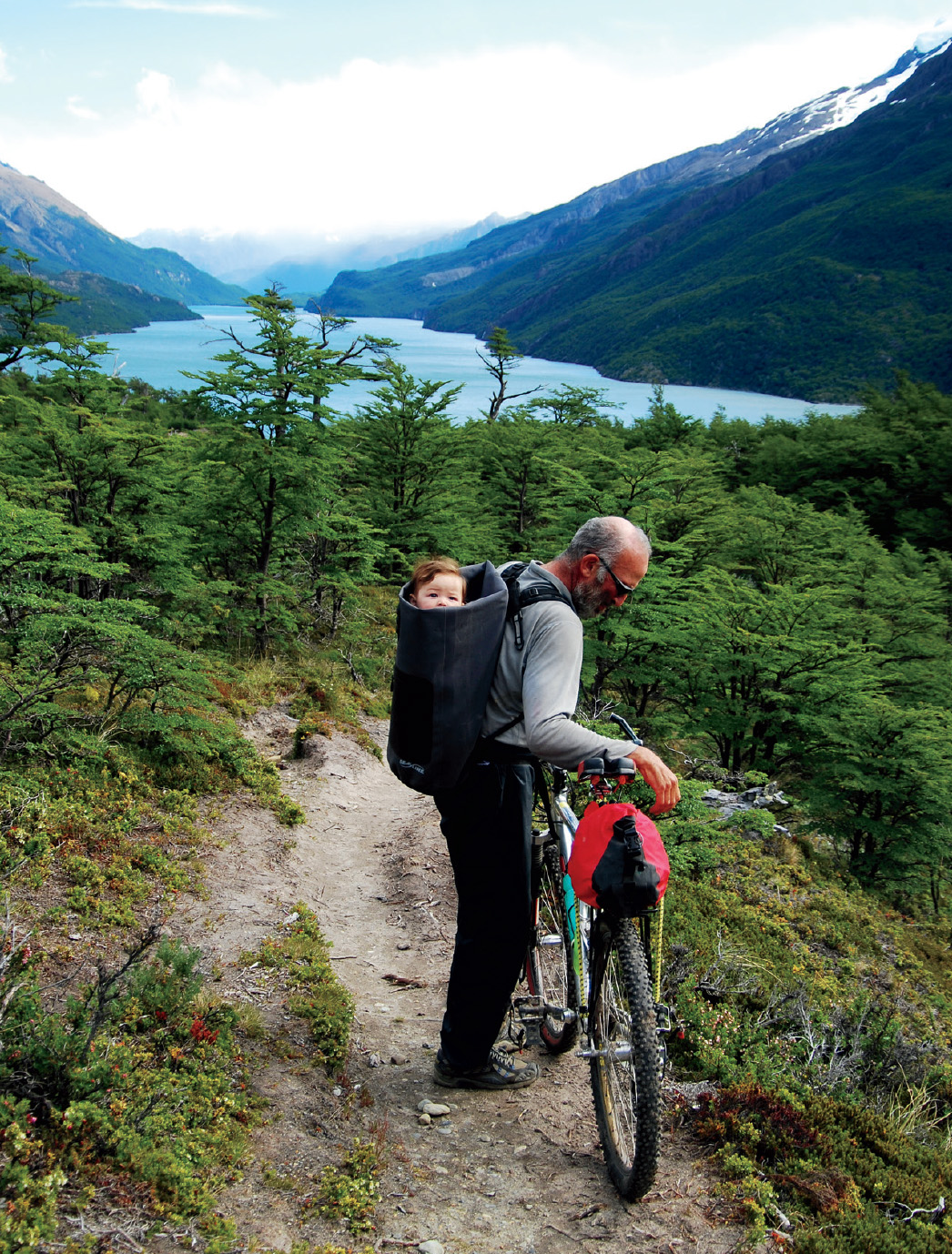
James and five-month-old Tormentina in 2008, on Paso dos Lagos, a famous border crossing between Chile and Argentina that can be made only on foot, by bicycle, or on horseback.
That is what James and I have tried to pass on to our children. We have given them a minimalist life—not as deprivation but design. Carry only what you need. Know how everything works. Repair what is broken before replacing it. Practice beginning again. Boredom and scarcity are the mothers of creativity—the less you have handed to you, the more inventive you become. This is as true on a boat as it is in life.
We are not trying to prepare them for hardship. We are trying to prepare them for change—change is the only certainty. James and I are not retired. We have worked throughout our children’s lives to keep this life afloat. But we have worked with them as witnesses to the up-and-down reality of being self-employed, the pressure of keeping a family fed and healthy, of keeping a boat seaworthy. Life moves forward. How do you move with it? How do you leave a positive wake?
James and I have never tried to escape the world. We have only tried to get closer to it—to nature and to genuine human connection—and the love for our children pulls us forward more powerfully than any wind.
Photography had been a quiet love of mine from childhood. My parents buried a few precious photographs in Cambodia, and they were eventually sent to us in Maine. Those salvaged black-and-white images were sacred objects. I understood early that the camera gave me a way of holding a moment still. By the time I was at Bowdoin, I had found in photography something that felt like a calling—the alchemy of light and shadow, a moment made permanent.
When I met my husband, James Burwick, in Portland in 2005, he was refitting an Open 40 race boat at the Maine Yacht Center, preparing to sail it solo around the world. He was unlike anyone I had known: fearless, methodical, high-energy, with an ability to solve complex problems and connect genuinely with anyone he met. His work of art was the project itself. I visited his boat, wanting to make his portrait before he left. What began as a friendship became an unexpected romance. There was a significant age gap—I was twenty-eight, and he was fifty-one—but he pointed out to me that Alfred Stieglitz and Georgia O’Keeffe had twenty-three years between them too. “Let’s have an epic love affair like they did,” he said.
James set off that December on a winter passage to Bermuda and arrived with a broken mast. I flew down to meet him—a glimpse behind the curtain of what this kind of life required. We said goodbye with no expectations.
Our lives continued on separate tracks. He repaired and sailed nonstop to South Africa as I was preparing for something of my own: a long-overdue return to Cambodia, the country where my own story had begun.
I landed in Phnom Penh in December 2006, more than twenty-three years after I had escaped Cambodia with my parents. The month I spent there was transformative. A strange emptiness I had carried unconsciously all my life began slowly to fill: with understanding, with extended family I had never known, and with history and culture I had been separated from.
When I landed back in Maine in January 2007, something had shifted. The familiar rhythms of Portland felt different. I quit my job, gave away most of my belongings. When James called from his satellite phone with news of another broken mast off Cape Leeuwin, I swallowed my fear. I bought a ticket for Perth with a plan to go to Australia then onward to Cambodia to make a new life.
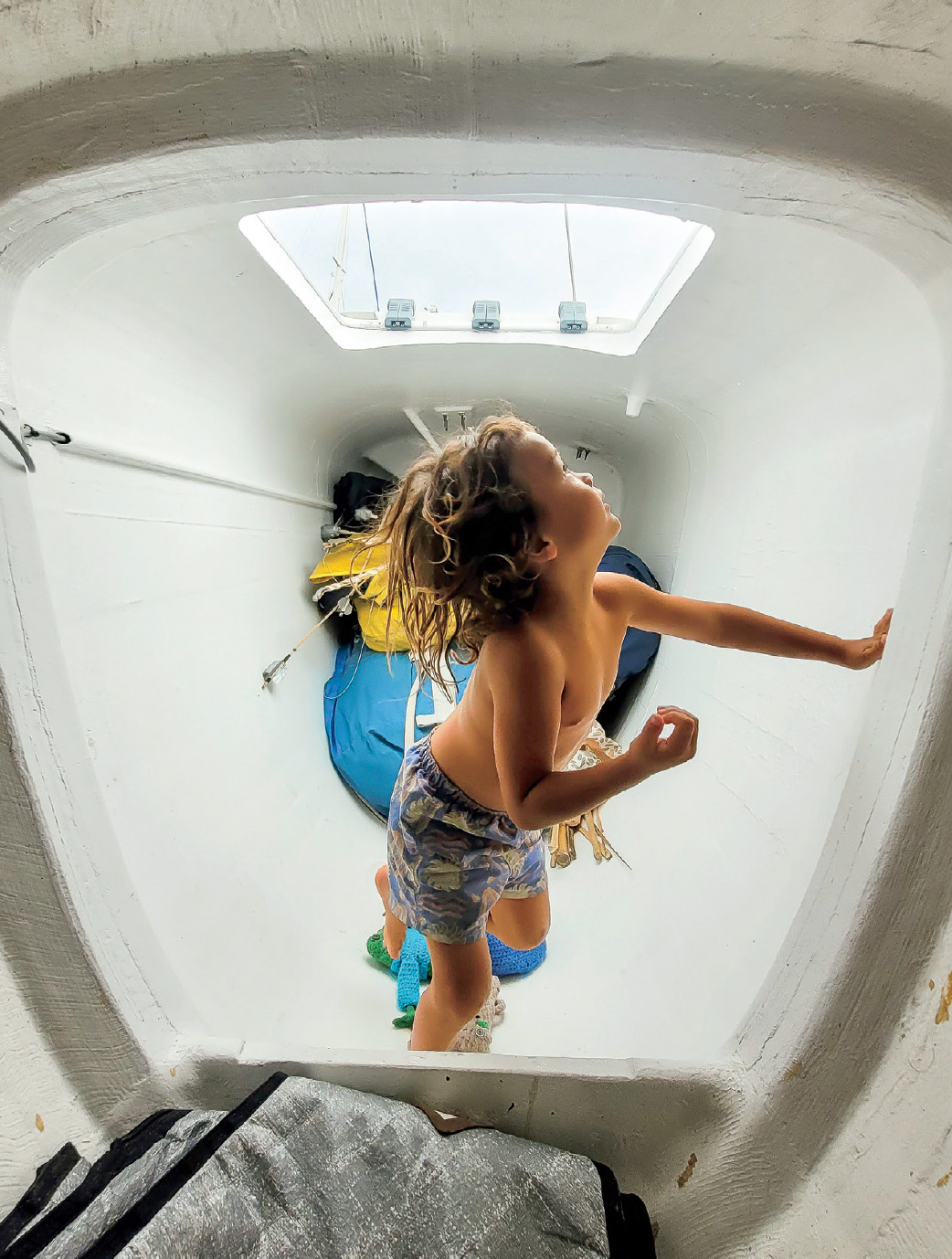
The youngest crewmember, Atlas, at four— on Christmas Day 2024—inside one of the ama compartments that are used for storage but double as in-port berths and playgrounds.
Once James reached Fremantle, I was there to meet him. He sailed on to New Zealand; I flew to Cambodia. I received the contract I had been hoping for: documentary work for the Australian Red Cross, photographing HIV/AIDS programs, water and sanitation projects, and their landmine survivors’ program.
Meeting amputees and telling their stories was the most meaningful and demanding photographic work I had done. I found out my photos would be exhibited in a show in Phnom Penh then travel to twelve cities across Australia to raise mine awareness and help fund continued support for survivors. I felt I was finally doing something with meaning.
It was during these months—moving back and forth between Cambodia and meeting James in port between his solo passages—that something between us crystallized. Our paths had moved organically together, in love, with mutual support for our goals in parallel. We decided to try to have a child.
When I got pregnant, James looked panicked. Then I panicked. He made me promise we wouldn’t stop traveling just because we were about to become parents. Yes, I promised, we would not stop.
James completed his solo circumnavigation, rounding all three great Capes and finishing in Bermuda. I was there in ports and at the finish line to meet him. We returned to the States in my last month of pregnancy, seeing my family and friends and heading out on a road trip through places that had shaped James—the mountain ranges of Colorado, Montana, and Wyoming.
We stopped in the Tetons, where James had spent ten years as a mountain guide. We found a rental in Jackson Hole less than two weeks before my due date. Our daughter Tormentina was born there in July of 2008—healthy, loud, and perfect. The global financial crisis of that year arrived at almost that moment. We were left with a choice: stop moving and start worrying or do what we had promised.
Within weeks, we had assembled mountain bikes, panniers, an expedition tent, and singletrack cargo trailers (one customized for the baby), and we were bound for Chile, planning to cycle high-quality dirt roads along the Carretera Austral.
Then an email arrived from the Australian Red Cross: the exhibition of my work had done well, and they wanted me to return to Cambodia to revisit the landmine survivor beneficiaries and meet new ones. I wanted badly to bring Tormentina, but some of the work was in active mine clearance areas. It wasn’t safe.
For the first time, I felt the tension between being a mother and a working photographer—as if one identity was beginning to crowd out the other just as my work had started to feel truly meaningful.
This is a real weight that many women know.
The first time I photographed the landmine survivors, I had been too timid to ask my subjects to pose—I was intimidated by the intimacy the work demanded. Now I felt ready to go deeper, to make the images I hadn’t been brave enough to make before. Losing that chance stung.
James helped shift that. He introduced me to Jane Sievert, head of the photo department at the outdoor clothing company Patagonia. When we told her about our plan to cycle South America with Tormentina, she lit up. That conversation quietly reset what I understood my life as an adventure mother could be.
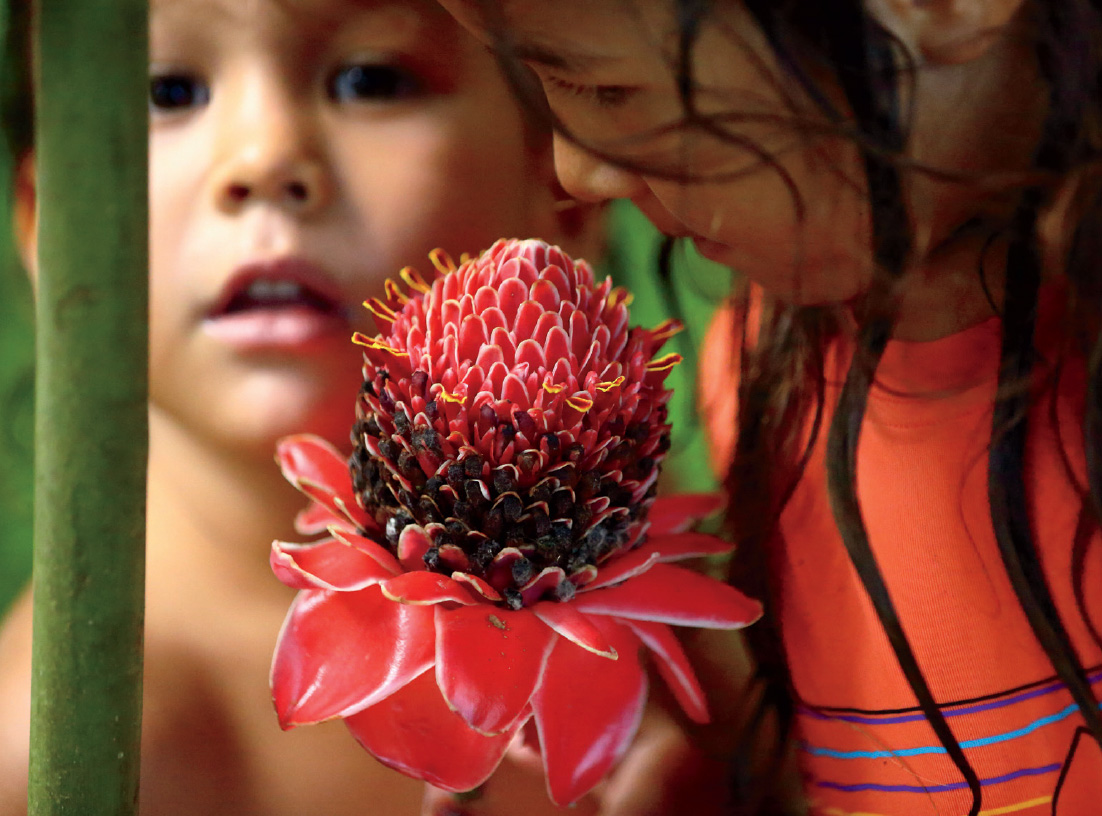
Atlas, four, and Jade, six, take in the beauty of a torch ginger (Etlingera elatior) growing near the family’s anchorage in Saco do Mamanguá, Paraty, Brazil, in March 2025.
“I’m going off watch,” said Raivo. Sensing I was somewhere else, Raivo said sternly, “Mom, are you awake? Don’t fall asleep.” He went below to wake my oldest daughter—my wild seventeen-year-old who had spent her first year of life living in an expedition tent.
Tormentina appeared on the deck, sleepyeyed, ready to take her place beside me. Even half-asleep, she had that magic glint in her eyes—the light I had spent my life as a photographer in search of, the fire I most wanted to protect and nurture in all my children.
I smiled at my oldest—grateful for her, for James, for my parents, for all of it. She was just on watch with me, as she had been so many times. She sat there—sleepy, ready for anything, inspiring, beautiful, amazing, no idea the catalyst she had been in my life as a mother. My oldest child and I sailed on together above the sea, moving fast through the night.
Somira Sao ’99 (Instagram: @somirasao) is a writer, professional photographer, sailor, and mother of six. She majored in biology and visual arts at Bowdoin.
This story first appeared in the Spring/Summer 2026 issue of Bowdoin Magazine. Manage your subscription and see other stories from the magazine on the Bowdoin Magazine website.