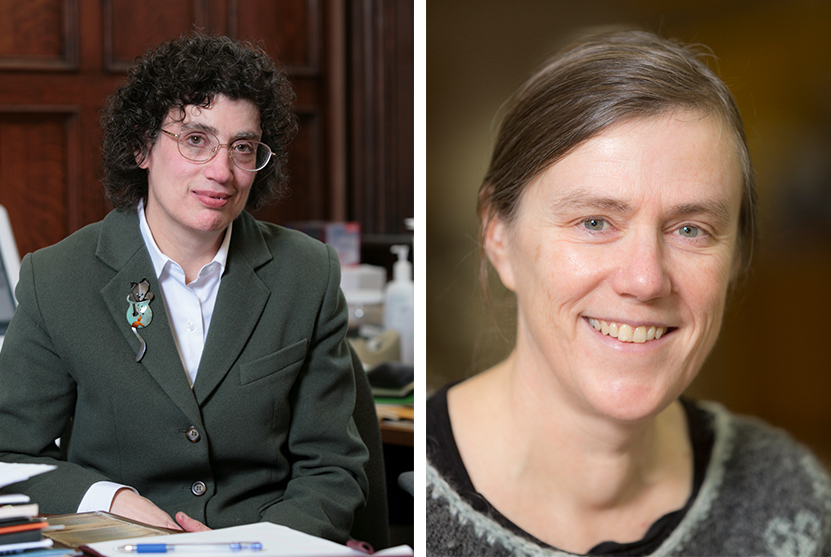
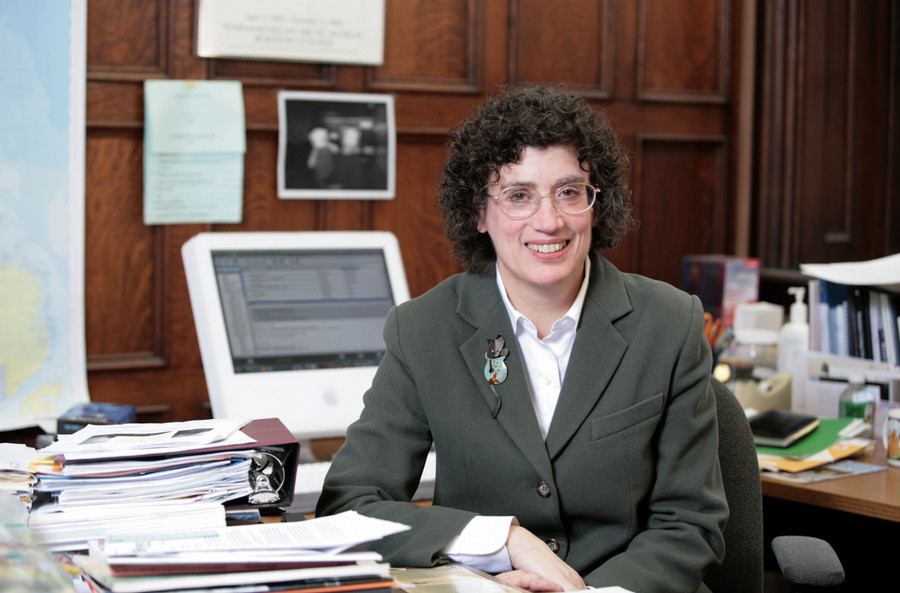
The Peary MacMillan Arctic Museum is delighted to announce the acquisition of the life’s work of renowned polar photographers Bryan and Cherry Alexander. The archive, comprising more than 50,000 images taken over five decades deepens and broadens the Arctic museum’s already large photographic collection.
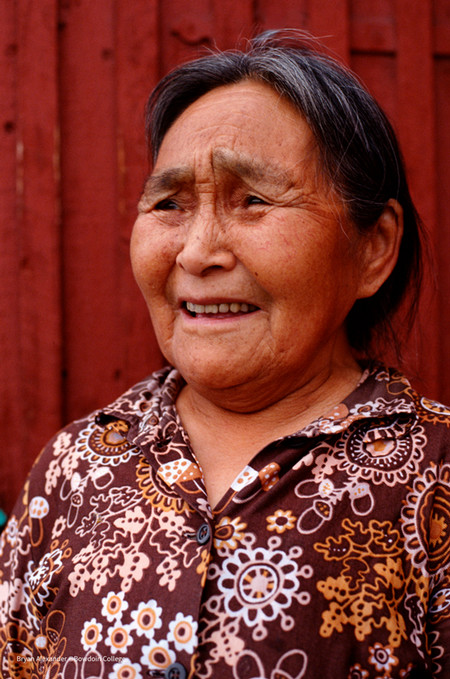
Bryan Alexander, Portrait of Amaunalik Qaavigaq, Northwest Greenland, 1980. In the 1920s, she worked with Donald MacMillan and is the mother of Navarana Ka’avigak’ Sørensen, who received an honorary degree from Bowdoin in 2023.
Rebecca Rowe ’97, a biology and anthropology major while at Bowdoin and a member of the board of trustees, provided the lead gift. Her first exposure to the Arctic took place when she was an undergraduate and participated in an archaeology project on Amaknak Island, Alaska.
She earned a PhD in evolutionary biology at the University of Chicago and is a professor in and chair of the Department of Natural Resources and the Environment at the University of New Hampshire, where she studies the population and community dynamics of small terrestrial vertebrates. Currently, she works in the Great Basin, Arctic Alaska, and New England’s northern forests.
Funds generously donated by Kane Lodge Foundation, Inc., a longtime supporter of Arctic museum initiatives; Caroline and Andy Platt ’66, who have funded the museum’s acquisition and exhibition of photographs; and Everette Dennis, who created a director’s discretionary account, made the acquisition possible.
Bryan Alexander first traveled to northwest Greenland in 1971, fresh from his photography studies in London. After a stay of four months, he knew Greenland was a place he wanted to return to and he did often over the next five decades. Cherry did not join him on that trip but soon she too was in love with the polar regions. Together they established Arctic Photo and made a career of photographing the people and places across the circumpolar North and eventually the Antarctic as well.
“One of the things that stands out about this archive is its temporal continuity and depth of coverage of certain regions,” said curator Genevieve LeMoine. When Bryan arrived in Greenland for the first time, he stayed in small communities and hunting camps throughout northwest Greenland, an area where explorers Robert E. Peary and Donald B. MacMillan had spent much of their careers. After that first visit to northwest Greenland, the Alexanders returned for eight months in 1977 and for seven more months in 1980, and Bryan has returned many times since, most recently this February. “I am really looking forward to continuing and expanding our outreach to the people of Qaanaaq, where I know Bryan’s work is much appreciated” said LeMoine, who does research in that part of Greenland.
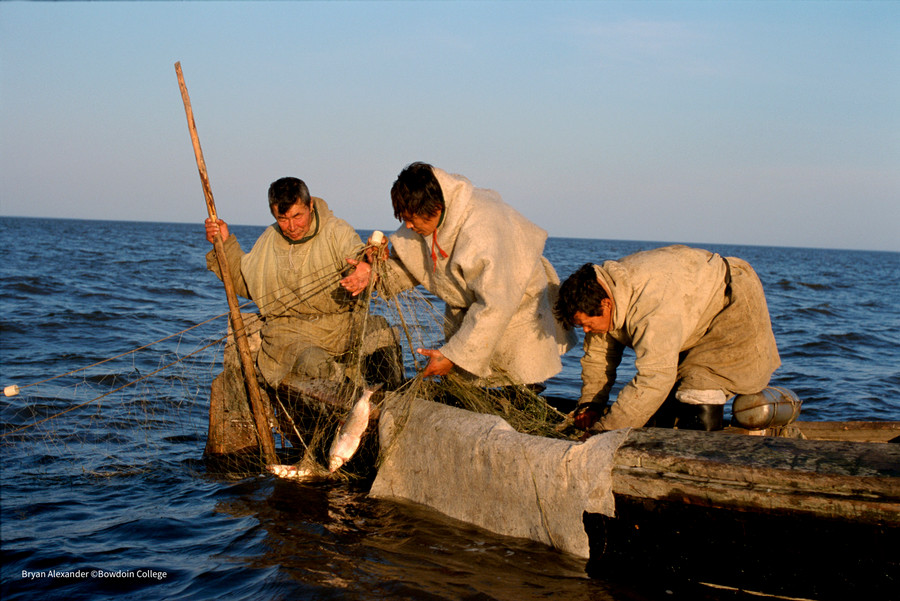
Bryan Alexander, Nenets men, Lyange, Slava & Nikolai, hauling a fish net with a catch of Muksun near the mouth of the River Ob, Yamal, Russia, 2000. Nenets are reindeer herders, but in the summer they also fish for Muksun, a type of whitefish. They store some of the catch for winter and sell the rest.
Bryan adopted the extended visitation pattern when working in other northern communities, developing lasting relationships with individuals and families over decades while documenting their lives. Through the 1970s and into the 1990s, the Alexanders worked in Greenland, Canada, Alaska, and the Nordic Arctic, including Iceland. After the Soviet Union collapsed, Bryan began working in Russia as well, in 1993 among the Nenets in western Siberia, and then in eastern Siberia and along the Bering Sea coast. He made thirty-two extended trips to the Russian Arctic over twenty-eight years and the collection includes his photographs of fourteen different Indigenous Russian communities.
While Bryan has focused on people and their activities, Cherry has specialized in wildlife photography, including in Svalbard and Antarctica. Her photograph “Blue Iceberg,” featuring an ethereal blue iceberg sheltering penguins, won the Wildlife Photograph of the Year award in 1995. In the October 28, 2014, issue of the British Journal of Photography Simon Bainbridge, the editor, wrote of it, “… [t]o my mind, it’s the greatest wildlife photograph ever taken.”
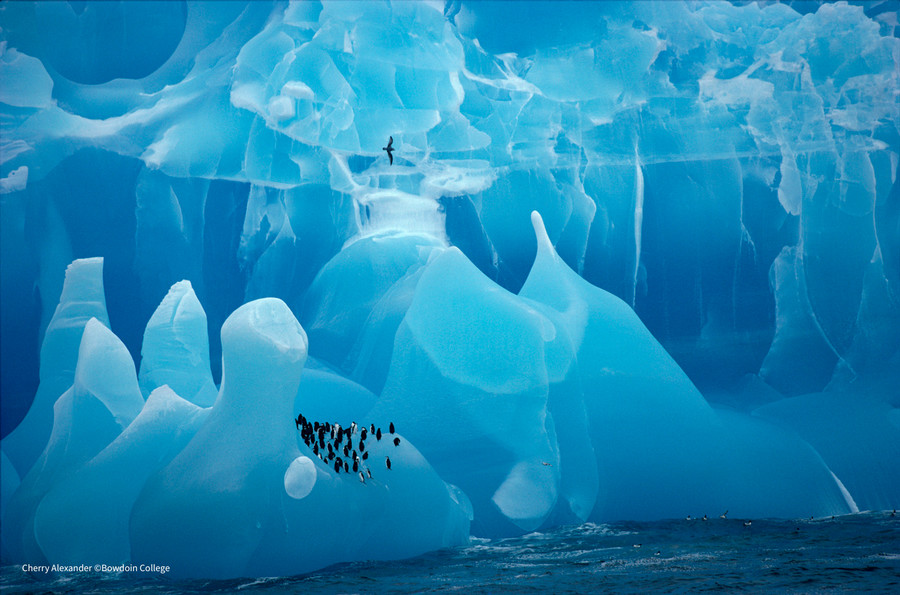
Cherry Alexander, Chinstrap Penguins rest on a rare blue iceberg. Antarctic Prion flies over, Antarctica, 1995. With this photograph of chinstrap penguins on a gorgeous blue iceberg as an Antarctic prion (a type of petrel) flies past, Cherry was named 1995 Wildlife Photographer of the Year by London’s Natural History Museum.
Another exciting aspect of this acquisition, according to Susan A. Kaplan, the museum’s director, is that it expands the geographic representation of the museum’s holdings. “Our strength has been in coverage of communities in the North American Arctic and Greenland, and this collection includes other regions of the circumpolar North as well as areas of Antarctica. We will be exploring opportunities to work with northern communities new to us that are featured in the archive and hope to develop long-term collaborative projects and exhibits with some of them.”
While reflecting on the importance of this archive coming to Bowdoin’s Arctic museum, Rebecca Rowe has commented, “This collection will invite students and the public to explore a profound sense of place, as these works tell powerful stories of continuity and change, both environmental and societal, across the Arctic.”
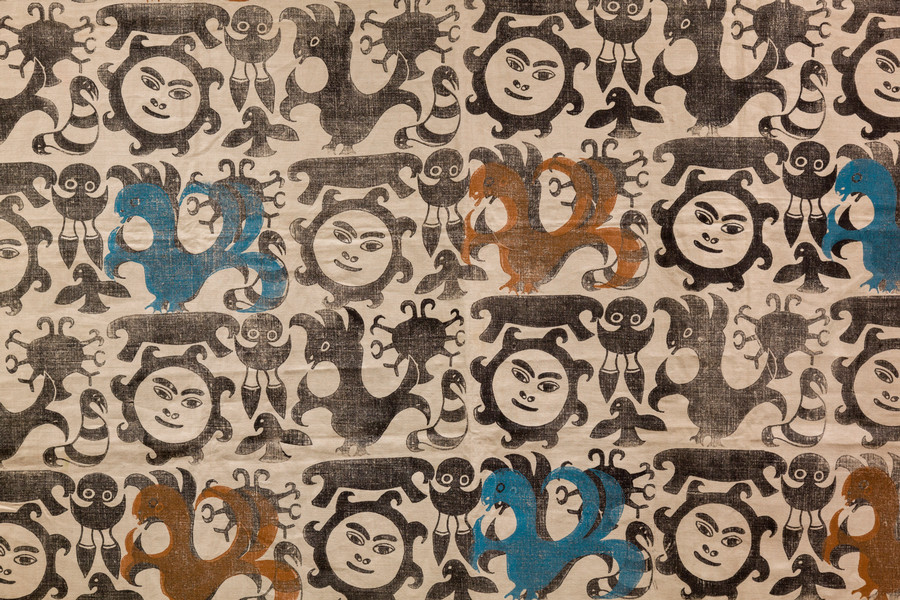
The museum is currently processing this large collection and hopes to have the key element of it, some 15,000 images, available for viewing on the museum’s website in the coming months. A major exhibit of the Alexanders’ photographs, along with associated artworks and ethnographic objects donated to the Arctic museum by the couple, will open in the spring of 2027.