Artificial intelligence (AI) is a “weird and scary thing,” admitted Brian Kim ’13. AI tools can lie (or “hallucinate”), take short cuts, provide misleading information, and flatter to deceive—which is why it’s crucial to know how to use them, he stressed.
Kim is the founder and chief data scientist at Open Augments, a strategic consultancy that helps researchers, nonprofits, and public interest groups use open-source AI tools responsibly.
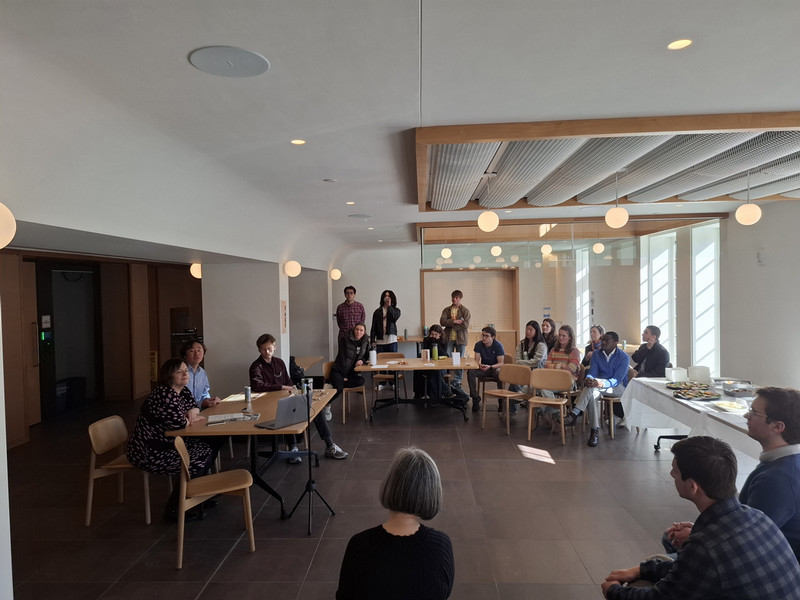
He came to campus on May 20 for a daylong workshop with faculty and staff titled Beyond the Hype: Critical Intuition for AI-Supported Research. The event was sponsored by the Hastings Initiative on AI and Humanity, which was launched in 2025 thanks to a $50 million gift—the largest in Bowdoin’s 232-year history—from Netflix cofounder Reed Hastings ’83. The aim of the initiative is to ensure students graduate well prepared to lead in a world reshaped by this breakthrough technology.
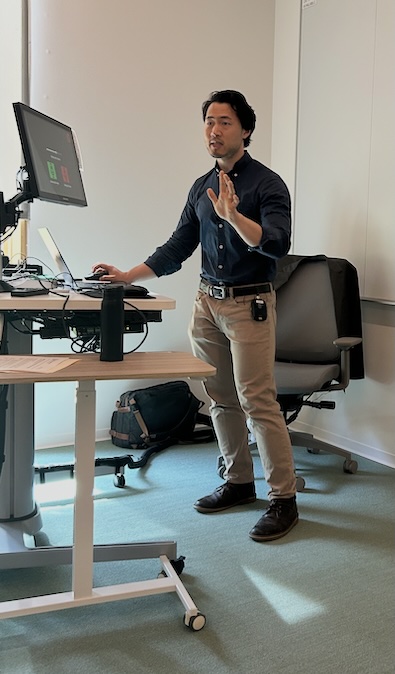
“Right now, there's so much confusion, noise, and grift permeating the discourse about AI,” remarked Kim. “My goal with this workshop is to help people make sense of what's going on and what AI's real current capabilities and limitations are, speaking as someone who's been working with large language models and their predecessors since around 2019.”
Using Anthropic’s Claude tools, Kim began the day by outlining what AI can and cannot do, stressing the importance of understanding how the technology works and how to get the best out of it. “It’s fundamental to understand how these tools work under the hood,” he observed.
When working with large language models (LLMs), Kim recommended using AI’s short-term memory feature (or “working memory”), whereby the user inputs the relevant data for a particular project, rather than rely on the AI’s broader, long-term memory, which he described as “fuzzy and unreliable.” But, he warned, it’s important not to overload the LLM’s short-term memory with too much data, or it can suffer with “context rot” and become unreliable. If you think this sounds strange, you are right, said Kim:
“One of the things people tend not to understand about AI right now is that it's just really, really weird. AI currently requires a very specific and byzantine set of strategies to get any useful output from them—but if you're not aware of that, you're almost always going to be disappointed by what they seem to be able to do.”
Looking at the bigger picture, Kim said he also wants to help people appreciate the nuance and complexity of artificial intelligence. “There are so, so many ethical and moral concerns we need to keep at the forefront of our minds in any conversation here; that can and should happen at the same time as we think through opportunities to cultivate public benefit and societal good and value from these tools,” he stressed.
Later in the day, Kim held two more advanced workshops, in which faculty and staff members got more opportunities to refine their AI skills.
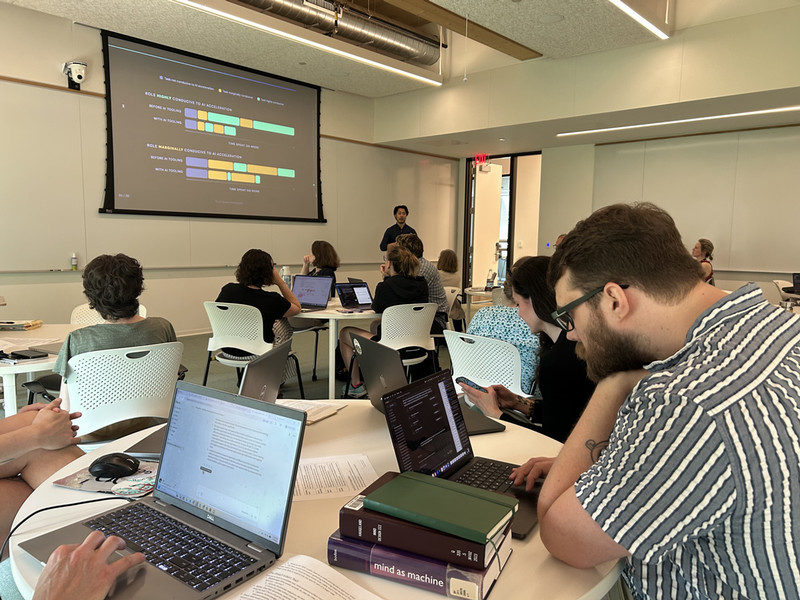
“I'm really excited about Brian's work,” commented Associate Professor of Economics Daniel Stone, who taught Brian as a student and who attended his workshop. “I’m proud he was an econ major, and I love the idea of what he's doing, providing empirical researchers with tools to easily follow standardized, best practices.” Among the tools Kim shared was an open-source framework called Data Analyst Augmentation Framework (DAAF) that accelerates data analysis while strictly enforcing transparency, reproducibility, and rigor. “I hope DAAF is widely adopted and think it could yield huge improvements in the quality of data-based research,” added Stone.
Fellow economist Erik Nelson also found the workshop useful, helping to add perspective to the “doomer versus optimistic” narrative that frames a lot of the current discussion around AI. “As a teacher, I feel it will be important for me to search for and then demonstrate the positive aspects of agentic AI,” he said, referring to autonomous AI systems that can independently create their own action plans without constant human oversight. Nelson said he has leaned heavily on Claude over the spring semester while writing a research paper. “I have treated Claude as a colleague, a coauthor. It is exciting to have a colleague on call 24/7 that can help me think through some economic theory, to review referee comments, and to suggest some very effective code. In some ways, my bespoke Claude agent is the PhD student that I can never have in real life, given I teach at a liberal arts college.”
As someone who studies human memory, Associate Professor of Neuroscience and Psychology Erika Nyhus has a particular interest in how LLMs compare to the human brain. “Some of the tools Kim was demonstrating can do pretty sophisticated research, achieving in one hour what could otherwise take weeks, months, or even years to do.” Nyhus said she was also reassured by Kim’s assertion that LLMs are no substitute for grey matter. “He really emphasized the need for the human in the loop, a genuine expert to check everything and make sure it's accurate.”
"I have treated Claude as a colleague, a coauthor. It is exciting to have a colleague on call 24/7... In some ways, my bespoke Claude agent is the PhD student that I can never have in real life, given I teach at a liberal arts college.” Erik Nelson, economics.
“Part of the Hastings Initiative’s mission is to help the Bowdoin community engage with AI substantively, and bringing Brian to campus was a natural fit for this work,” said Adrienne Kinney, a postdoctoral associate in AI and humanity who works on the Hastings team.
“He’s a Bowdoin alum building real-world AI tools for the common good, and the workshop he led gave faculty, staff, and students a chance to explore advanced AI capabilities and experiment with these tools in their own work. More opportunities like this are on the way,” she said.