President Zaki, Members of the College, and Guests,
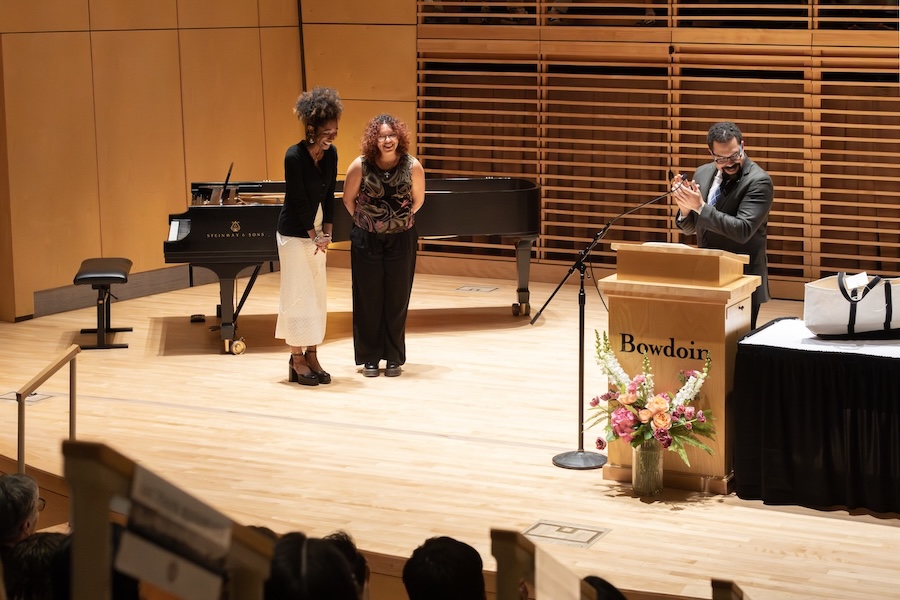
We all arrived at Bowdoin, where sunshine cut through the pines by Roux. Where history hummed from every corner and crevice of campus. When I first arrived at Bowdoin, I didn’t just carry bags—I carried a question. What does it mean to belong here? I brought with me the quiet awareness that I was entering a place not originally built for someone who looked like me. It was a place where simply being there meant proving something, whether I wanted to or not.
I learned soon after what it meant to navigate spaces where you are both seen and unseen simultaneously. To find belonging, it isn’t always in the structures around you–but in the people beside you.
I wasn’t the first to arrive here with that truth. Nearly two hundred years ago, in 1826, a young Black man named John Brown Russwurm walked this same campus, carrying that same weight, and dreamed of something bigger: that dignity, freedom, and possibility could extend far beyond the boundaries of this campus.
Russwurm believed in that possibility so deeply that he looked beyond this campus at his own Commencement and towards Haiti. A nation born out of revolution and a testament to the world that it can be changed by those who were never “meant” to inherit it. That testament is one that I know personally. My grandmother never learned how to read or write but she enrolled my father into school anyway. That was her revolution. That was her Haiti. Generations later, I arrived here as a son of Haitian immigrants, carrying that same belief that possibility isn’t something we wait for, it’s something we build with our very hands. Like many of us, I didn’t find that belief in classrooms alone.
What We Carry Forward
I found it in the people whose late-night conversations stretched longer than they should, in spaces where I didn’t have to explain myself to be understood, and in communities that reminded me I wasn’t navigating this place alone. However, community isn’t built in the good moments.
It’s also built in the ones that break you open. During our first semester, we lost our dear friend Omar Osman. And grief has a way of disrupting everything: your routines, your plans, and even your sense of time. It unveils a curtain that shows you what’s real: the people who stay, the purpose that guides, and the reason you keep showing up.
We found ourselves continuing to show up. Not because it was easy, but because we inherited something that made inaction impossible. Russwurm didn’t leave this campus and look toward Haiti because it was a clear path. It was because belief was stronger than uncertainty. My parents didn’t cross oceans because the destination was guaranteed. They moved because remaining stagnant was never the point.
We leave campus with the people we became in pursuit of our degrees. The friendships we formed at O-trips. The professors who saw something in us before we saw it ourselves. And the losses that quietly shape us.
We are graduating at a time when people’s voices are asked to be smaller and quieter. There is a notion that our “place” should be questioned. Yet, we have never been meant to be small.
Russwurm didn’t graduate into a welcoming world either. Neither did my parents arrive at one.
But still, they built. They made themselves impossible to ignore. That is the inheritance.
Class of 2026, we were never just students here. We were proof. Proof that this place can evolve and expand because we were here. And now, the responsibility is on us. Possibility isn’t
What We Carry Forward something that we wait for. It is something we are. We cannot wait for the possibility; we must create it. We cannot search for belonging; we must define it.
Felisitasyon, Congratulations. Fè li reyalite, make it a reality.